What Makes the Best Peptide Calculator?
A peptide calculator looks simple. You enter a vial size. You enter how much BAC water you added. You enter the amount you want to calculate. Then the calculator tells you where to draw on the syringe.
But the math is not always simple. A small change can move the syringe mark a lot. A 1mL BAC water choice gives a very different result than 2mL or 3mL. A 250mcg entry is very different from a 250mg entry. A 5mg vial is very different from a 50mg vial.
That is why the best peptide calculator should do more than give one number. It should help researchers see the full picture: the concentration, the draw volume, the syringe units, how long the vial may last, how the result compares to real calculator data, what BAC water volumes other researchers choose, what vial sizes are most common, how often researchers plan the compound per week, and where verified vendor options may be found.
Article last updated: July 2, 2026 · Data since August 28, 2025
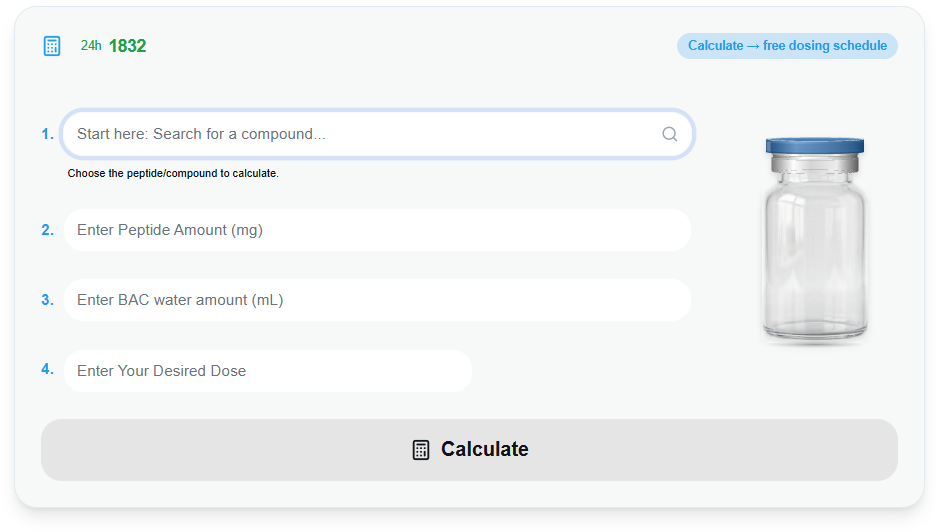
That is what World Peptide Association is building. WPA is designed to be the world's best peptide calculator because it is not just a calculator. It is the most data-driven peptide calculator in the research compound space.
Research-use only. This article is for educational and research-use-only purposes. WPA calculator data reflects anonymized research calculator inputs and does not provide dosing recommendations, medical advice, or human-use guidance.
Table of Contents
- 1.The Short Answer
- 2.Why Peptide Calculator Math Can Go Wrong
- 3.What a Peptide Calculator Should Calculate
- 4.The Formula Behind Every Peptide Calculator
- 5.Why BAC Water and Vial Size Go Together
- 6.Example: 1mL vs 2mL vs 3mL
- 7.Most Calculators Stop at the First Answer
- 8.What Makes WPA Different
- 9.Fastest-Growing Compounds
- 10.Top Compound Calculators on WPA
- 11.Calculator vs Reconstitution vs Dosage
- 12.Who This Calculator Is For
- 13.Why We Call WPA the World's Best
- 14.Use the WPA Peptide Calculator
- 15.Frequently Asked Questions
The Short Answer
The best peptide calculator should not only answer, "How much do I draw?" It should also answer:
- Is the draw easy to measure?
- Did the BAC water amount make the solution too strong or too diluted?
- Does the result fit on the syringe?
- How does this compare with real calculator behavior?
- Can I turn the result into a full research plan?
A basic calculator gives a number. A better calculator gives context. WPA gives the number, the syringe view, the protocol PDF, the vial duration estimate, the calendar, the community comparison, and vendor data.
Why Peptide Calculator Math Can Go Wrong
Most calculator mistakes come from one simple problem: the water choice does not match the vial and the selected amount.
If there is too little water, the solution gets very concentrated. The draw can become tiny. Tiny draws are hard to measure.
If there is too much water, the solution gets too diluted. The draw can become too large. It may not fit in a standard 1mL U-100 syringe.
WPA audited the most recent 30,000 production calculator runs. The data showed several common accuracy flags.
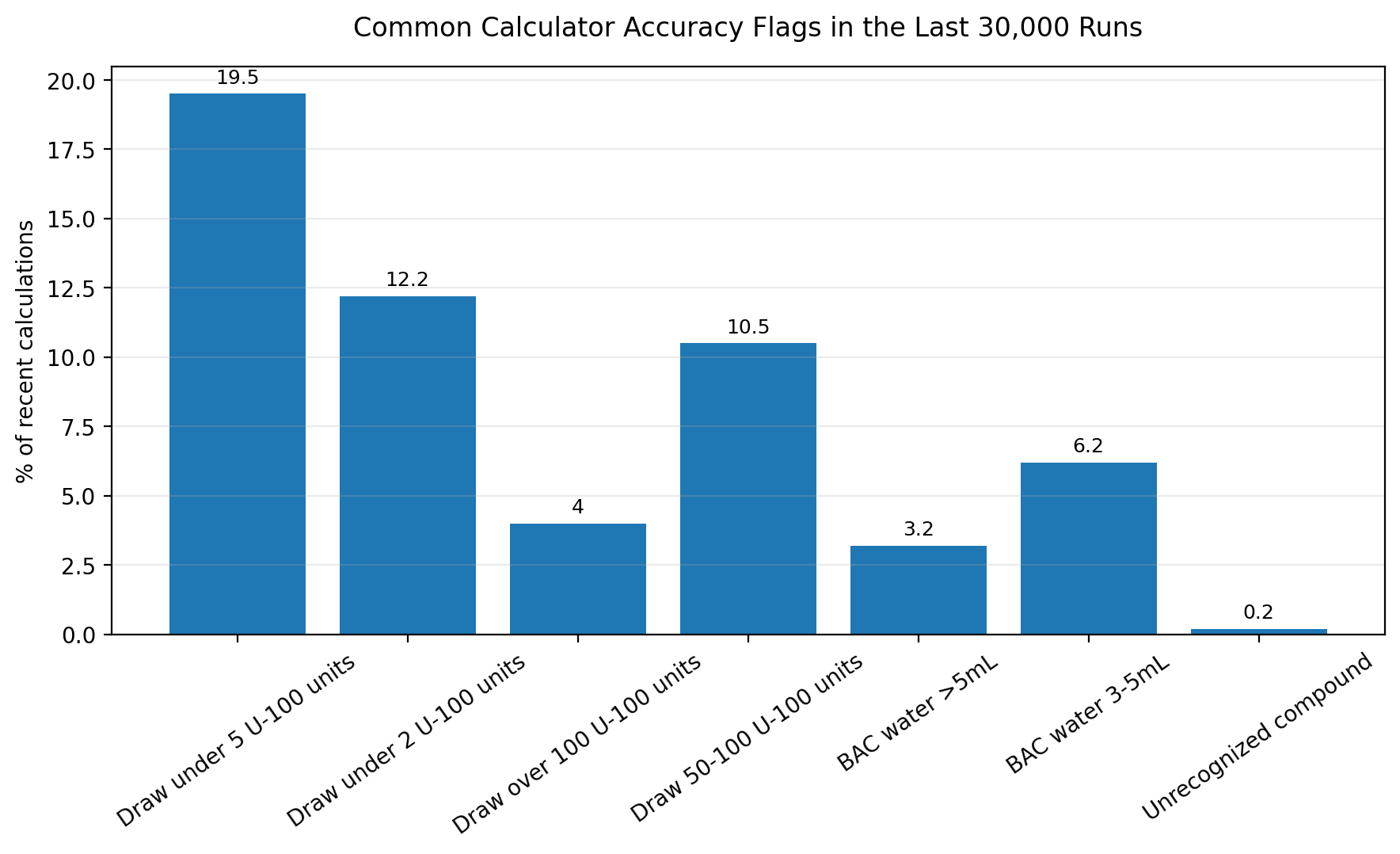
About 19.5% of recent calculations created a draw under 5 U-100 units. About 12.2% were under 2 units. That can be hard to measure with care.
About 4.0% of recent calculations needed more than 100 units. That is more than a standard 1mL U-100 syringe can hold.
Another 10.5% landed between 50 and 100 units. That may fit, but it is a large draw.
This is why a good peptide calculator should not only do math. It should make the result easy to see.
What a Peptide Calculator Should Calculate
A good peptide calculator should use four core inputs.
1. Compound
The compound matters because different compounds are planned in different ways.
WPA supports 182 approved compounds in the calculator database, plus 21 pending review names from custom "Other" entries awaiting approval.
The calculator also reaches farther than the vendor catalog. WPA has vendor pricing attached to 156 active compounds, while the calculator recognizes 182 approved compounds. That means users can run math for more compounds than the vendor pages currently cover.
2. Vial size
The vial size tells the calculator how much compound is in the vial.
Across WPA calculator data, 10mg is the most common vial size. It appears in about one out of every three calculations.
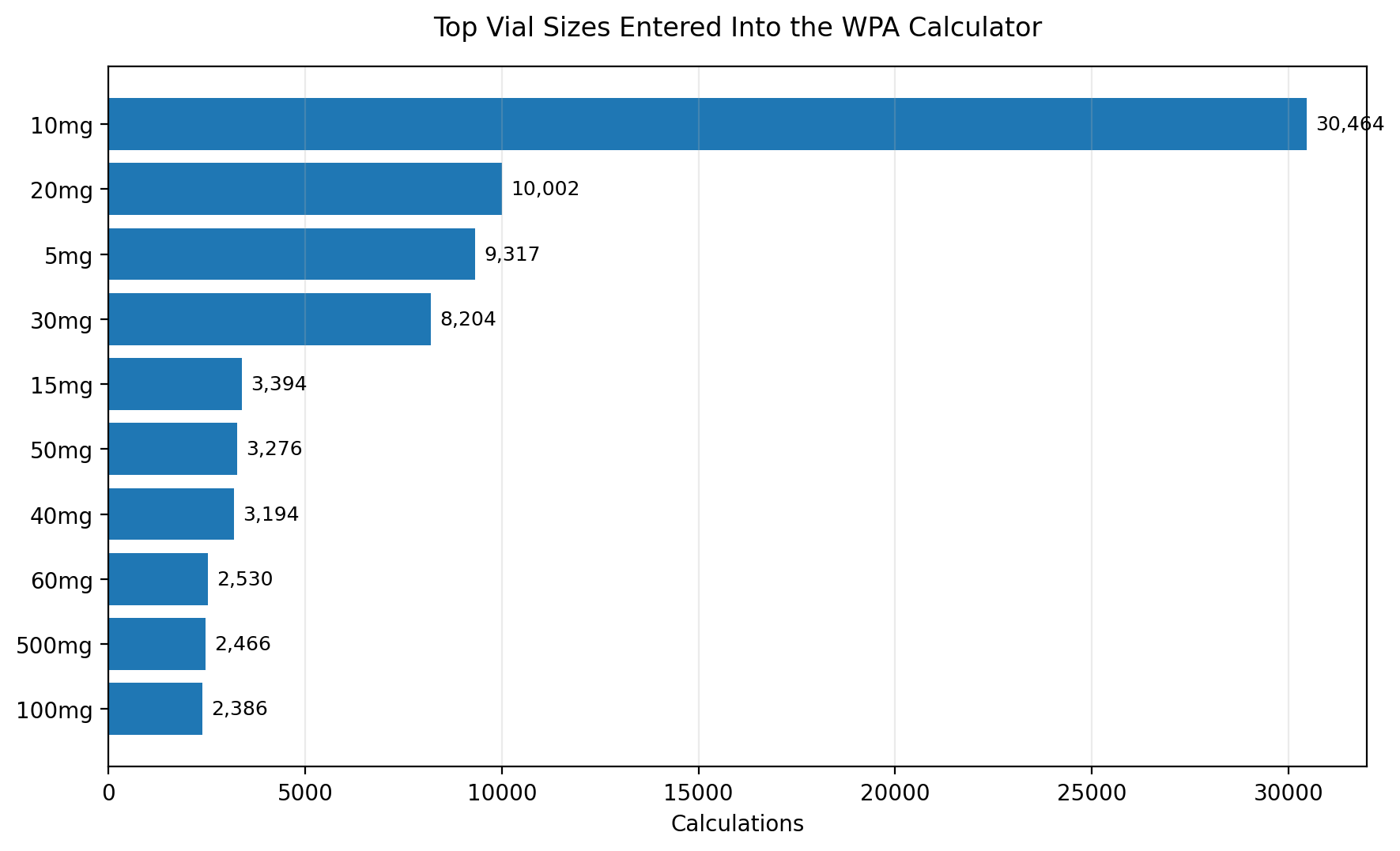
The top vial sizes are:
| Rank | Vial size | Share of calculations |
|---|---|---|
| 1 | 10mg | 34.1% |
| 2 | 20mg | 11.2% |
| 3 | 5mg | 10.4% |
| 4 | 30mg | 9.2% |
| 5 | 15mg | 3.8% |
That tells us the market clusters around small and mid-sized vials. But larger vial sizes still matter, especially for compounds that are sold in higher-mass formats.
3. BAC water amount
BAC water changes the concentration.
Across WPA's live production database, 2mL and 3mL are the two most common BAC water choices. Together, they account for about 72% of all calculations.
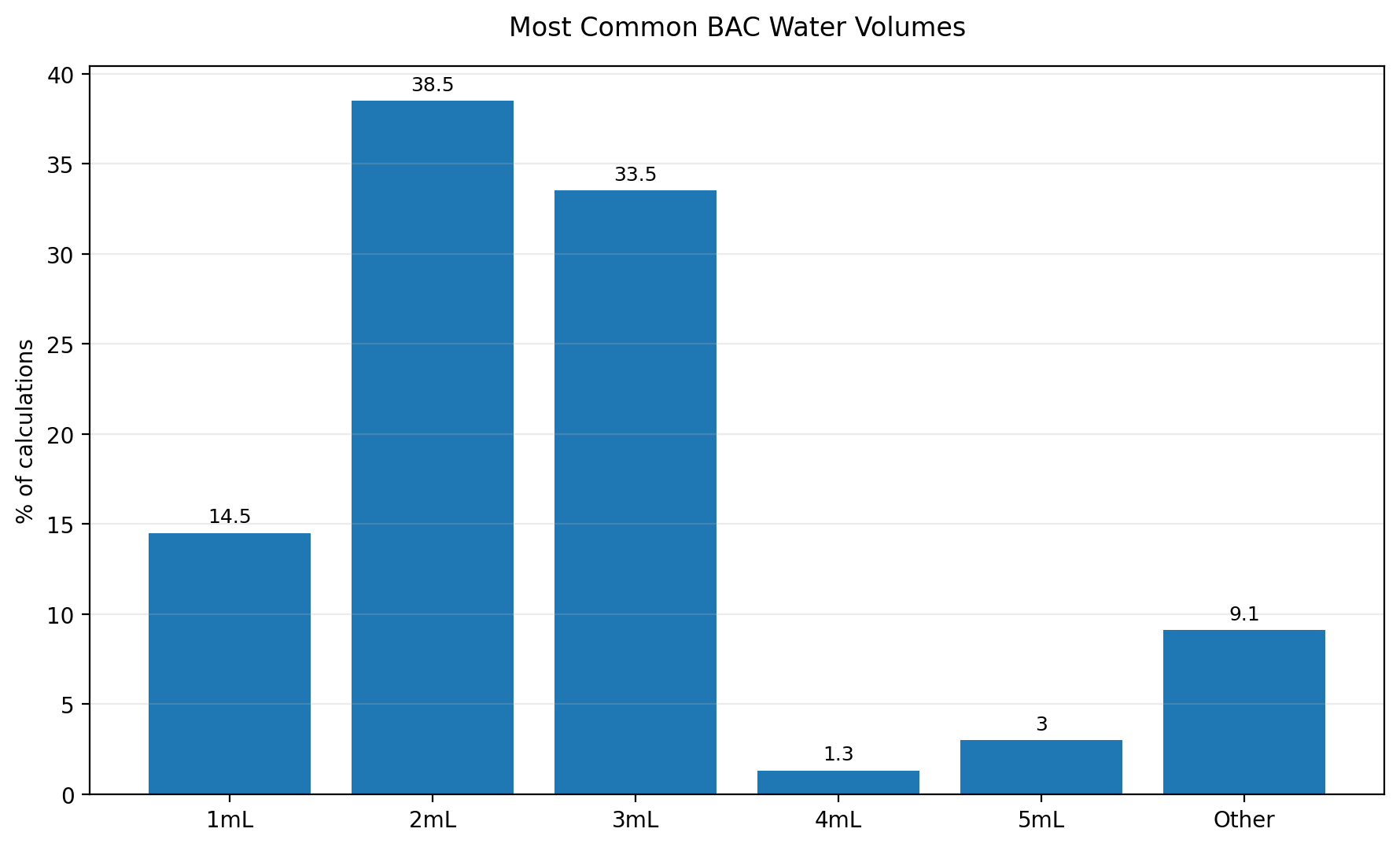
Current BAC water distribution:
| BAC water amount | Share of calculations |
|---|---|
| 2mL | 38.5% |
| 3mL | 33.5% |
| 1mL | 14.5% |
| 5mL | 3.0% |
| 4mL | 1.3% |
| Other | 9.1% |
The "Other" group includes values like 0.5mL, 1.5mL, and 2.5mL.
4. Desired amount
The selected amount is the amount the user wants the calculator to solve for.
The calculator should support mg and mcg. For compounds such as HGH, HCG, and HMG, it should also support IU.
This matters because unit mix-ups are one of the easiest ways to get a bad result.
5. Syringe type
A calculator should not stop at mL.
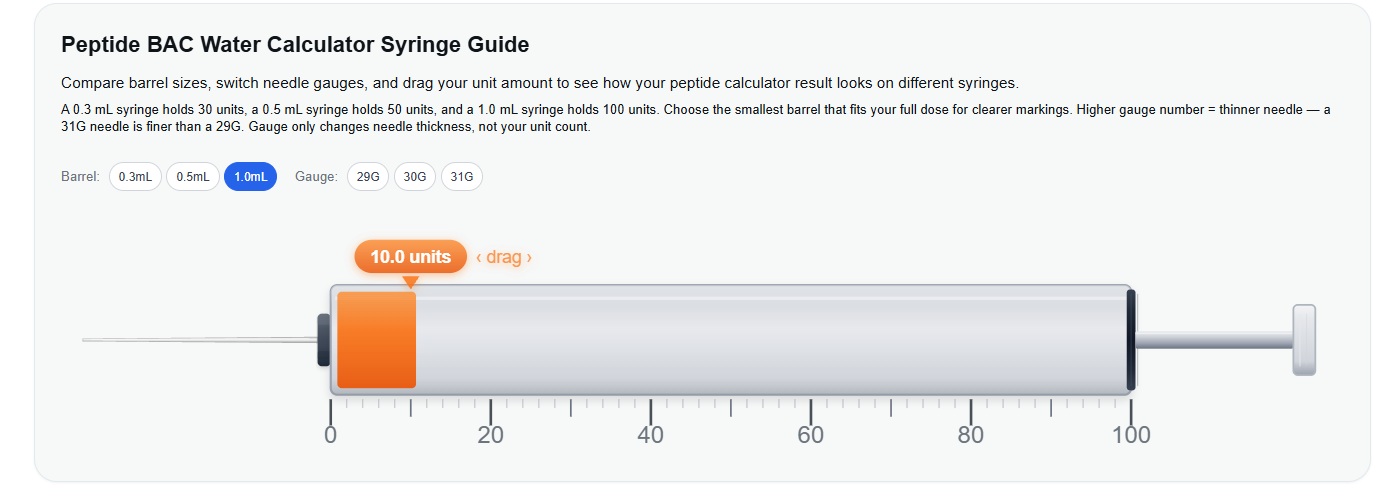
Most users need to see what the result looks like on a syringe. WPA defaults to a 1mL U-100 syringe view. WPA also has a syringe guide where users can compare 0.3mL, 0.5mL, and 1.0mL barrels, plus 29G, 30G, and 31G needle gauges.
The Formula Behind Every Peptide Calculator
The formula is simple.
Concentration = vial size ÷ BAC water added
Then:
Draw volume = selected amount ÷ concentration
Then the draw volume can be shown as U-100 syringe units. On a U-100 syringe:
1mL   = 100 units
0.5mL = 50 units
0.3mL = 30 units
But the syringe units are not the dose by themselves. The units only show liquid volume. The actual amount depends on the concentration.
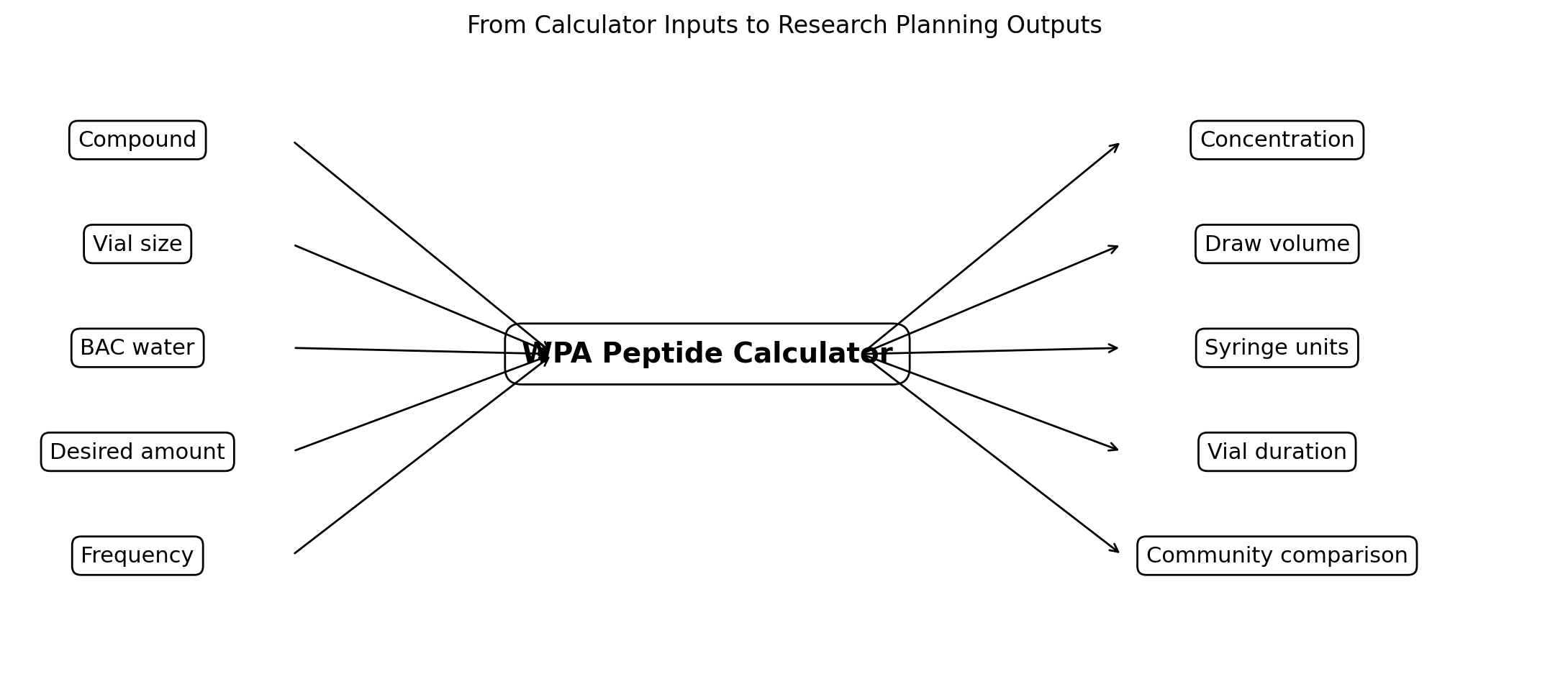
That is why the best peptide calculator should show the full path:
Why BAC Water and Vial Size Must Be Calculated Together
BAC water is not just a random setting. It changes everything.
A 10mg vial mixed with 1mL gives a different concentration than a 10mg vial mixed with 2mL. The same selected amount will lead to a different syringe draw.
That is why WPA tracks how BAC water choices change by vial size. The pattern is clear: small vials are more likely to use 2mL or less. Large vials are more likely to use more than 2mL.
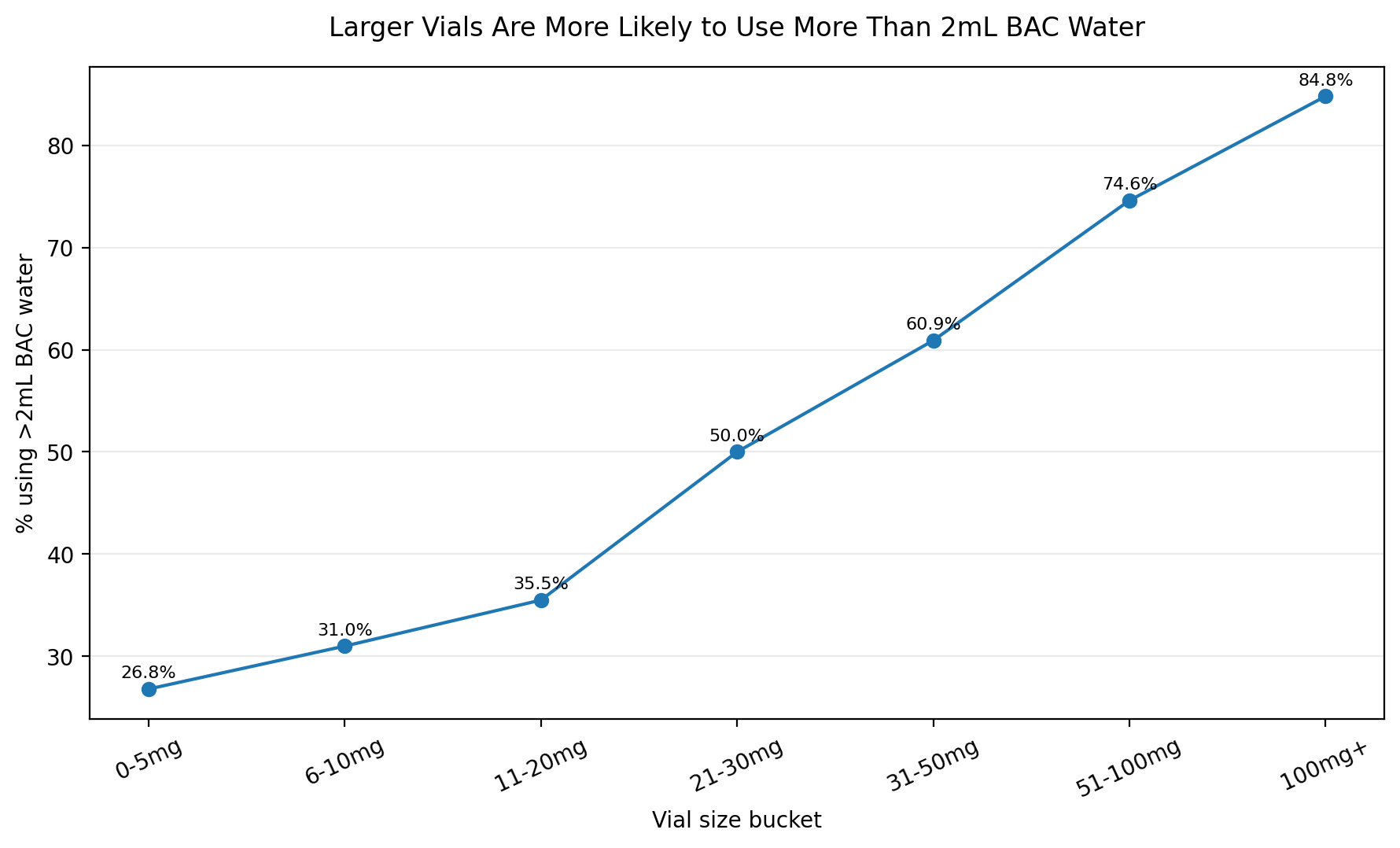
For vials of 0-5mg, only 26.8% of calculations use more than 2mL BAC water.
For vials of 51-100mg, 74.6% use more than 2mL.
For vials above 100mg, 84.8% use more than 2mL.
The crossover happens around the 21-30mg bucket. That is where more than 2mL becomes the majority choice.
This is a good example of why live calculator data matters. A generic calculator can do the formula. WPA can also show what researchers actually enter at scale.
Example: 1mL vs 2mL vs 3mL
Here is a simple example. Assume the vial has 10mg. Assume the selected amount is 250mcg.
| BAC water added | Concentration | Draw volume | U-100 units |
|---|---|---|---|
| 1mL | 10mg/mL | 0.025mL | 2.5 units |
| 2mL | 5mg/mL | 0.050mL | 5 units |
| 3mL | 3.33mg/mL | 0.075mL | 7.5 units |
Same vial. Same selected amount. Different BAC water. Different syringe mark. This is why the calculator matters.
Most Calculators Stop at the First Answer
Most peptide calculators answer one question: Where do I draw on the syringe?
That is useful. But it is not enough. A researcher may still need to know:
- Is the draw too small to read clearly?
- Is the draw too large for the syringe?
- How long will the vial last?
- What dates are in the research schedule?
- What do other researchers usually enter for this compound?
- What vendor has the lowest projected monthly cost?
- What vendor is most popular?
- What vendor has the highest quality score?
WPA was built to answer more of the next questions.
What Makes WPA Different
WPA is not only a peptide calculator. It is a calculator, a data layer, a schedule builder, and a vendor research tool.
Built on real calculator data
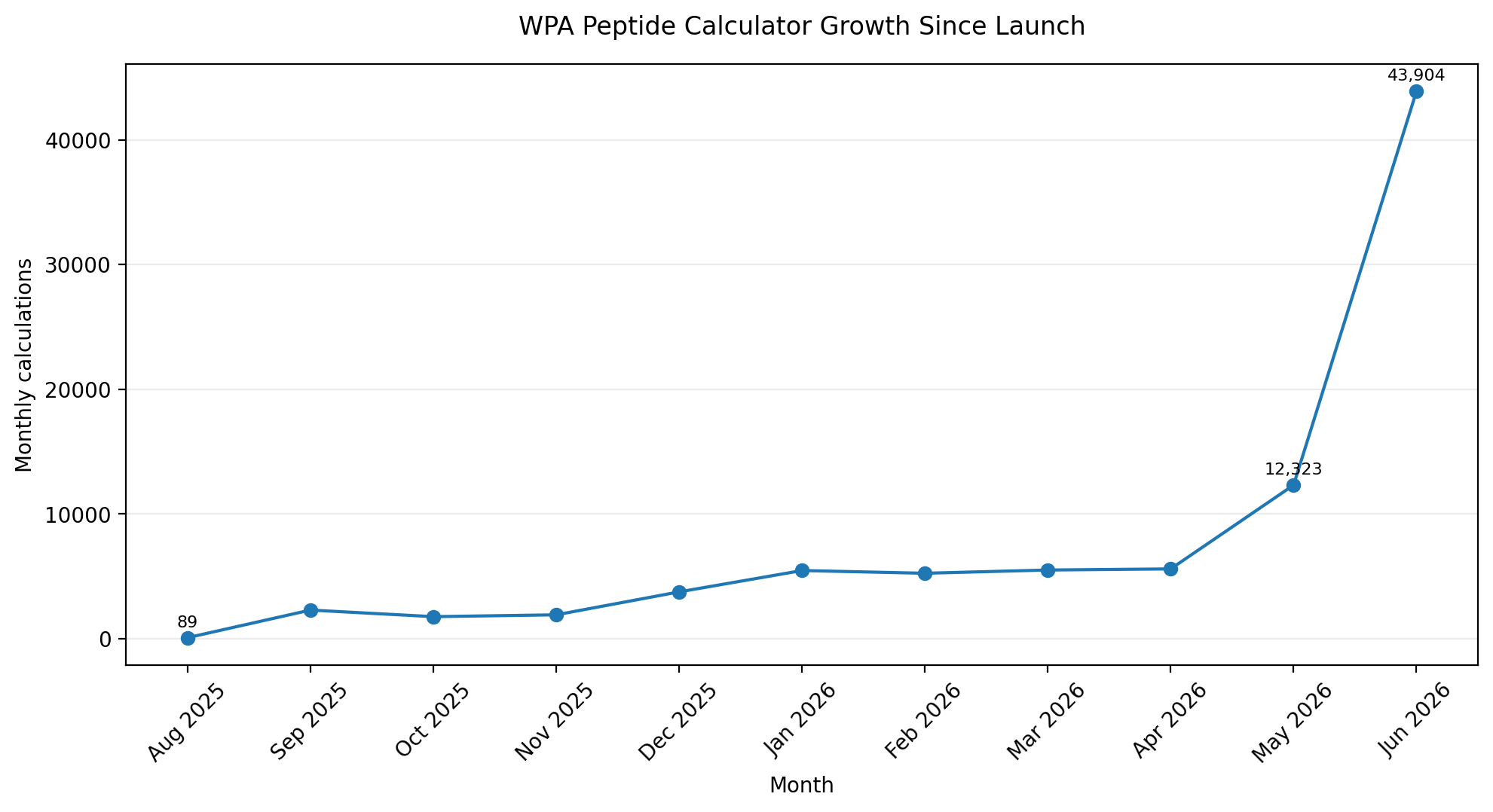
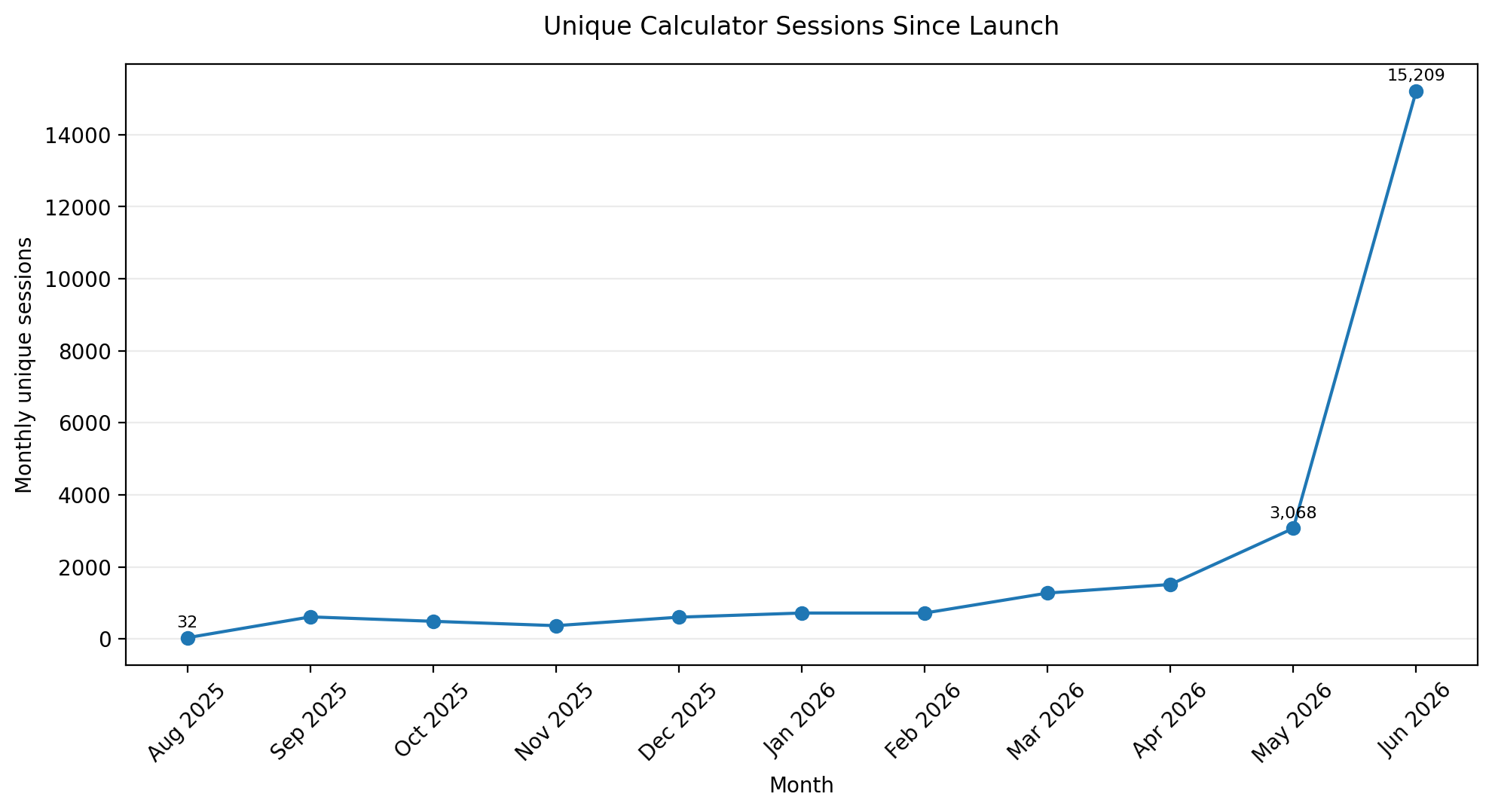
At the time of the latest production export, WPA had logged 89,000+ total calculator runs and 23,000+ unique sessions since tracking began on August 28, 2025.
The calculator is also growing fast. In June 2026 alone, the production database logged 43,904 calculations and 15,209 unique sessions— roughly 1,500 to 2,000 new calculations per day.
Built for scenario testing
Many users do not run one calculation. They test different settings. They change the BAC water. They change the vial size. They try different selected amounts.
WPA session data shows:
| Session behavior | Share of sessions |
|---|---|
| 1 calculation | 43.7% |
| 2-5 calculations | 41.6% |
| 6+ calculations | 14.7% |
The average session runs 4.11 calculations. The median session runs 2 calculations.
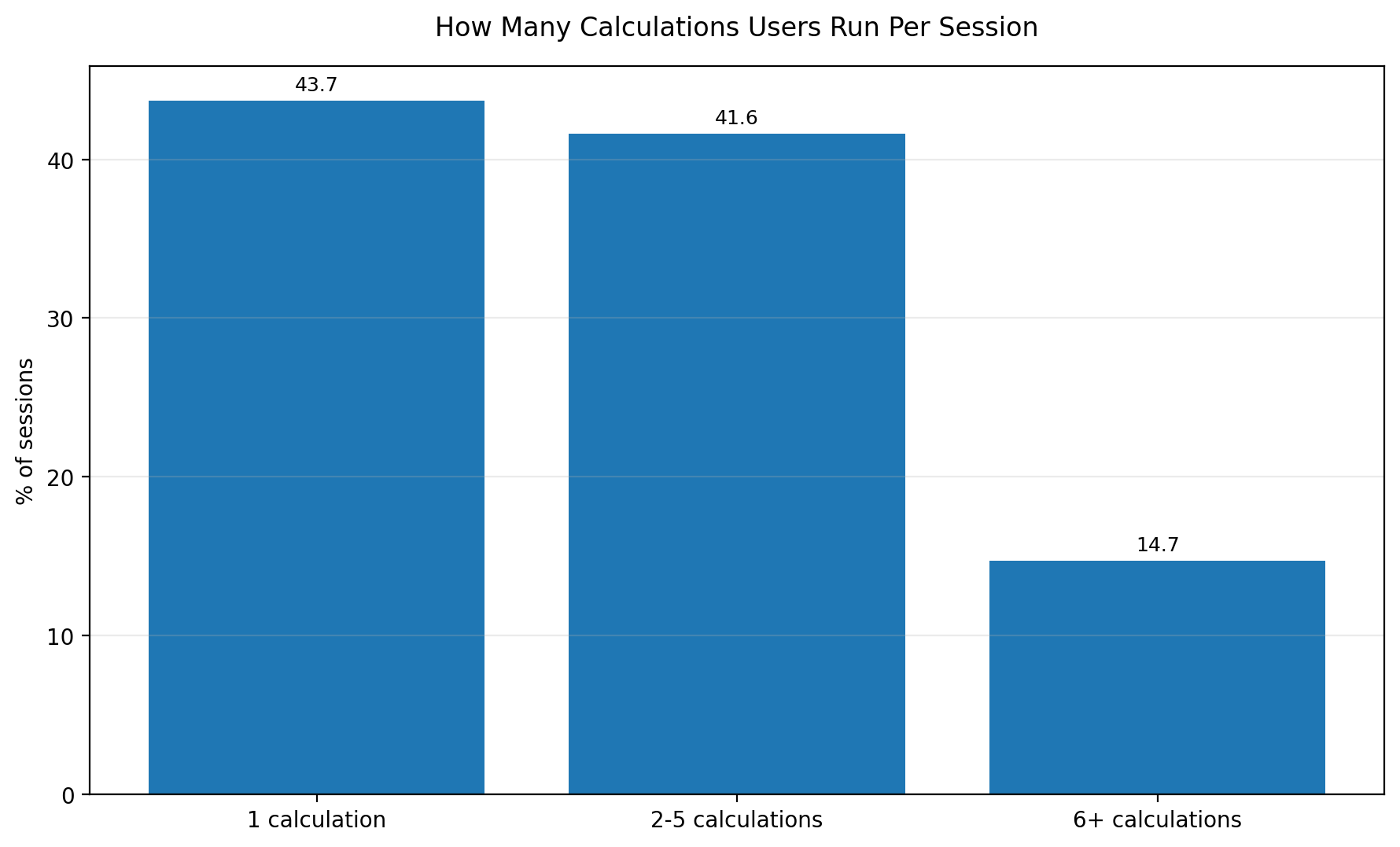
This is a sign that researchers use the calculator to compare scenarios, not just to get one answer.
Built with frequency data
This may be WPA's most unique feature.
WPA tracks how often users plan a compound per week. That does not make the data a recommendation. It only shows how research-use-only users configure calculator scenarios. But it gives useful context that generic calculators do not show.
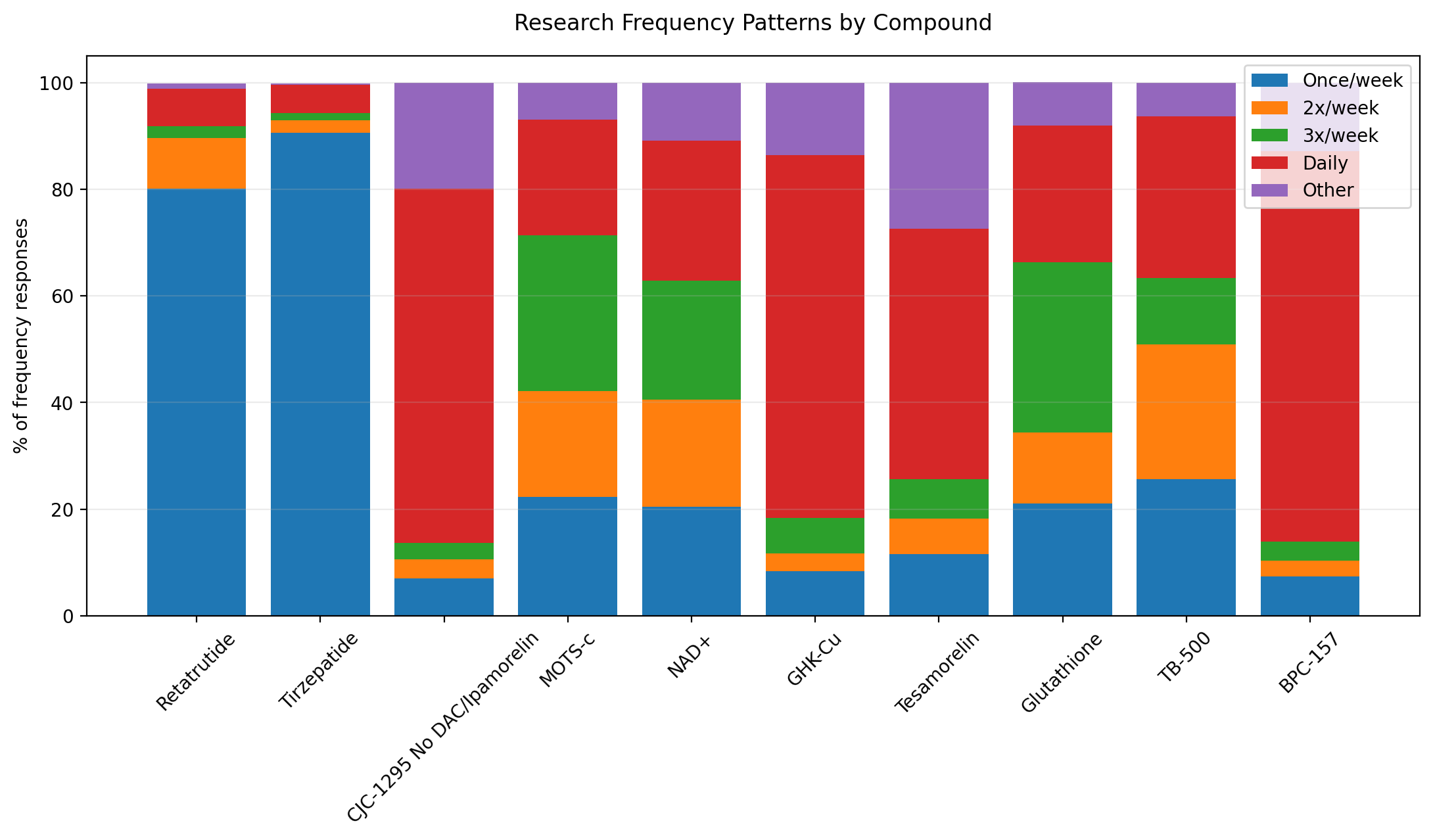
The pattern is clear. GLP-1 compounds are mostly weekly. Retatrutide is about 80% once weekly. Tirzepatide is about 91% once weekly.
Healing and systemic peptides look very different. BPC-157, GHK-Cu, and CJC-1295 No DAC/Ipamorelin are mostly daily in the frequency response data.
MOTS-c, NAD+, and Glutathione are more spread out. That suggests users are still comparing different research cadences for those compounds.
Built to turn a result into a research plan
After a user runs a calculation, WPA can unlock a custom PDF. The PDF can show:
- the inputs
- the concentration
- the draw volume
- the U-100 syringe units
- the vial duration estimate
- the expected run-out date
- vendor options
- a weekly schedule
- a monthly calendar
- community comparison data
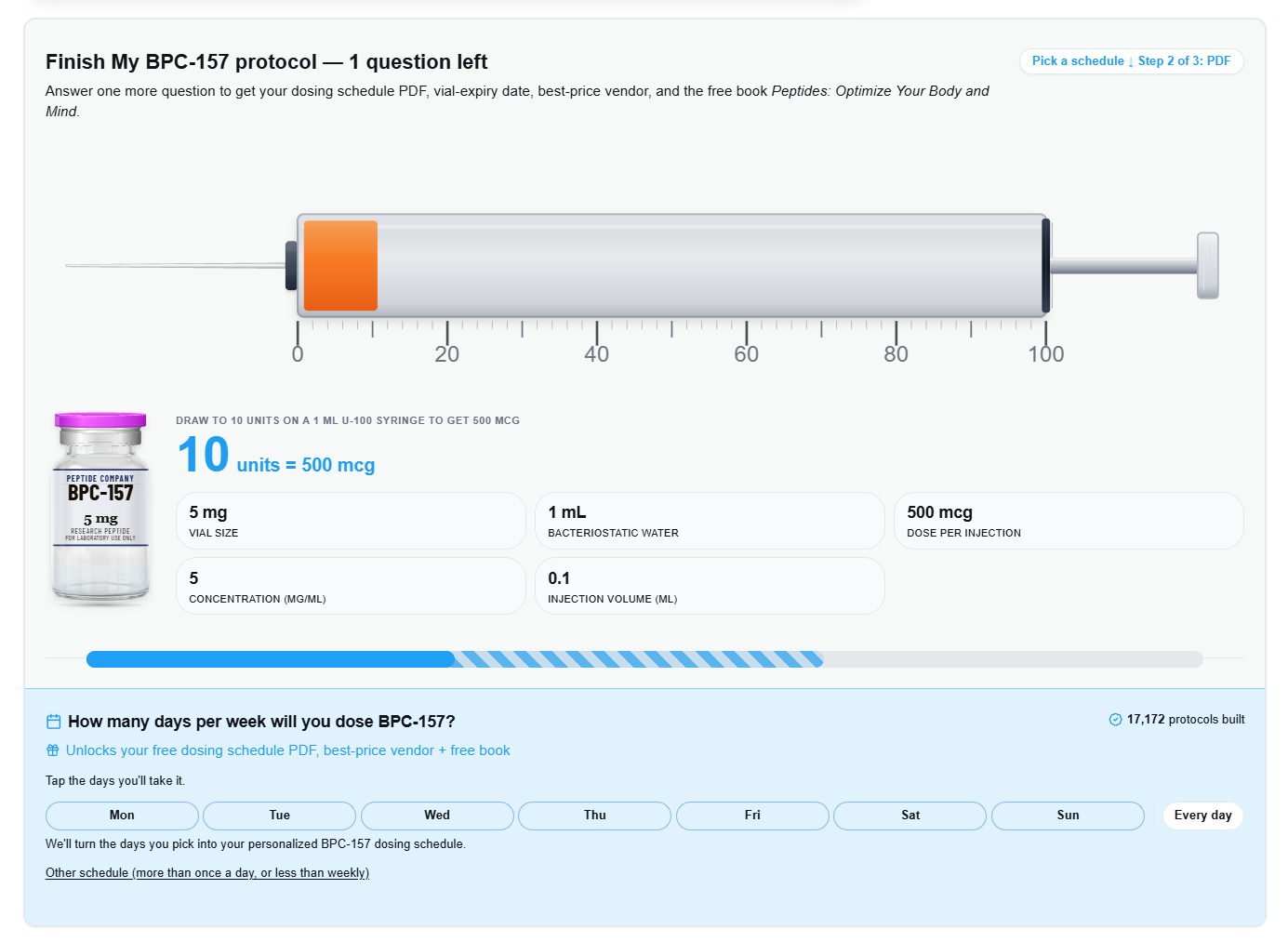
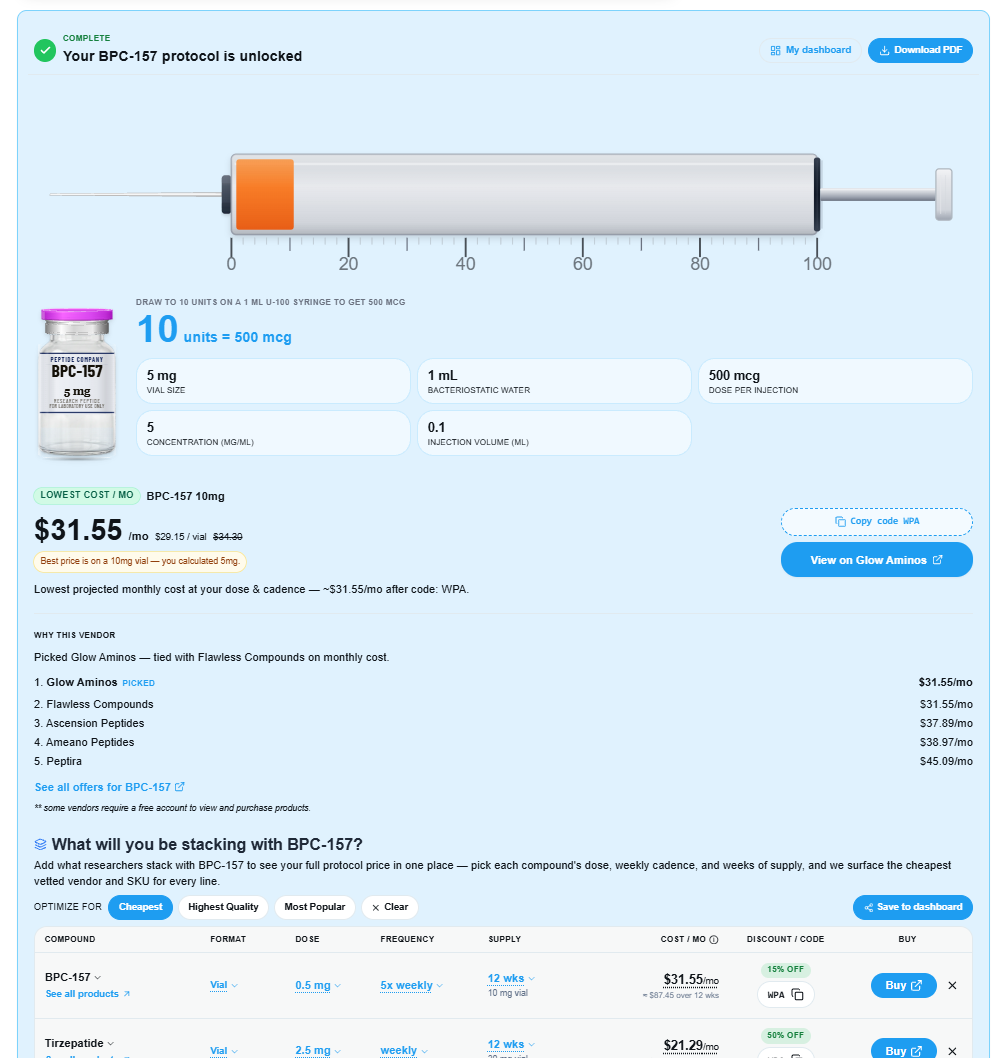
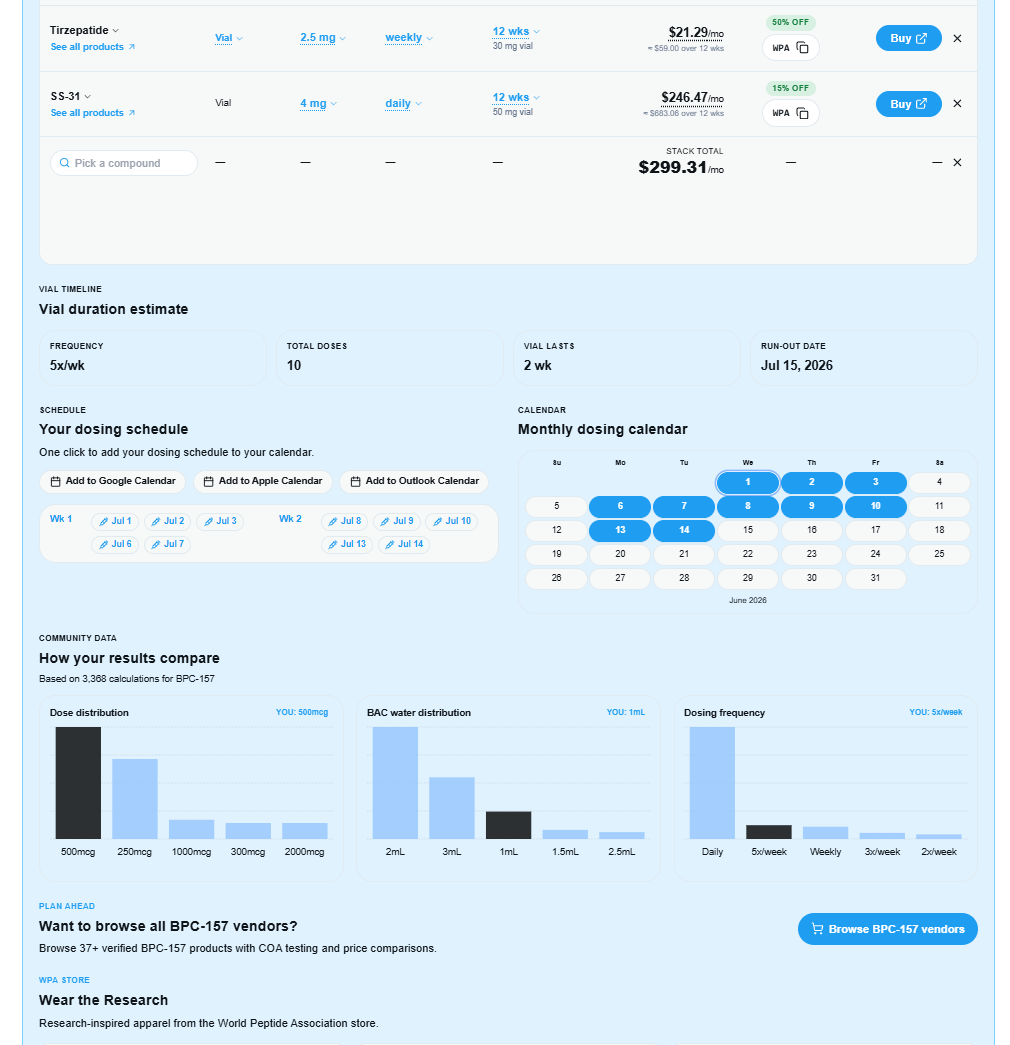
This is the main story: WPA does not stop when the math is done. It helps the user understand the result.
Built with vendor intelligence
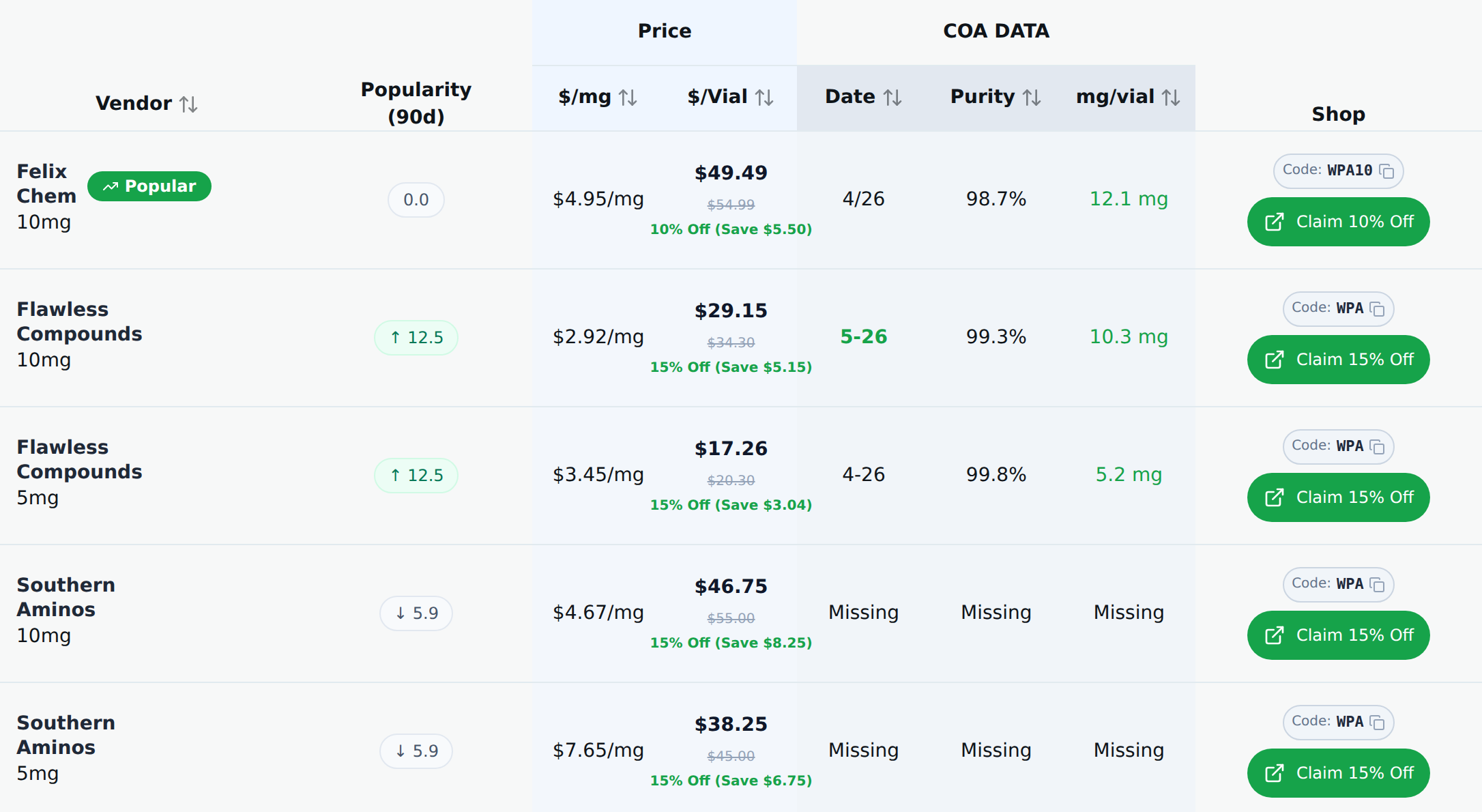
WPA also connects calculator behavior to vendor research. The calculator can lead users to vendor pages where they can compare peptide prices on products, pricing, discount codes, and COA-related information.
The Fastest-Growing Compounds Show Why Live Data Matters
Static calculator pages get old fast. Research interest changes month by month. WPA can see that movement because it tracks calculator behavior over time.
In the latest 30-day growth view, the fastest-growing compounds were:
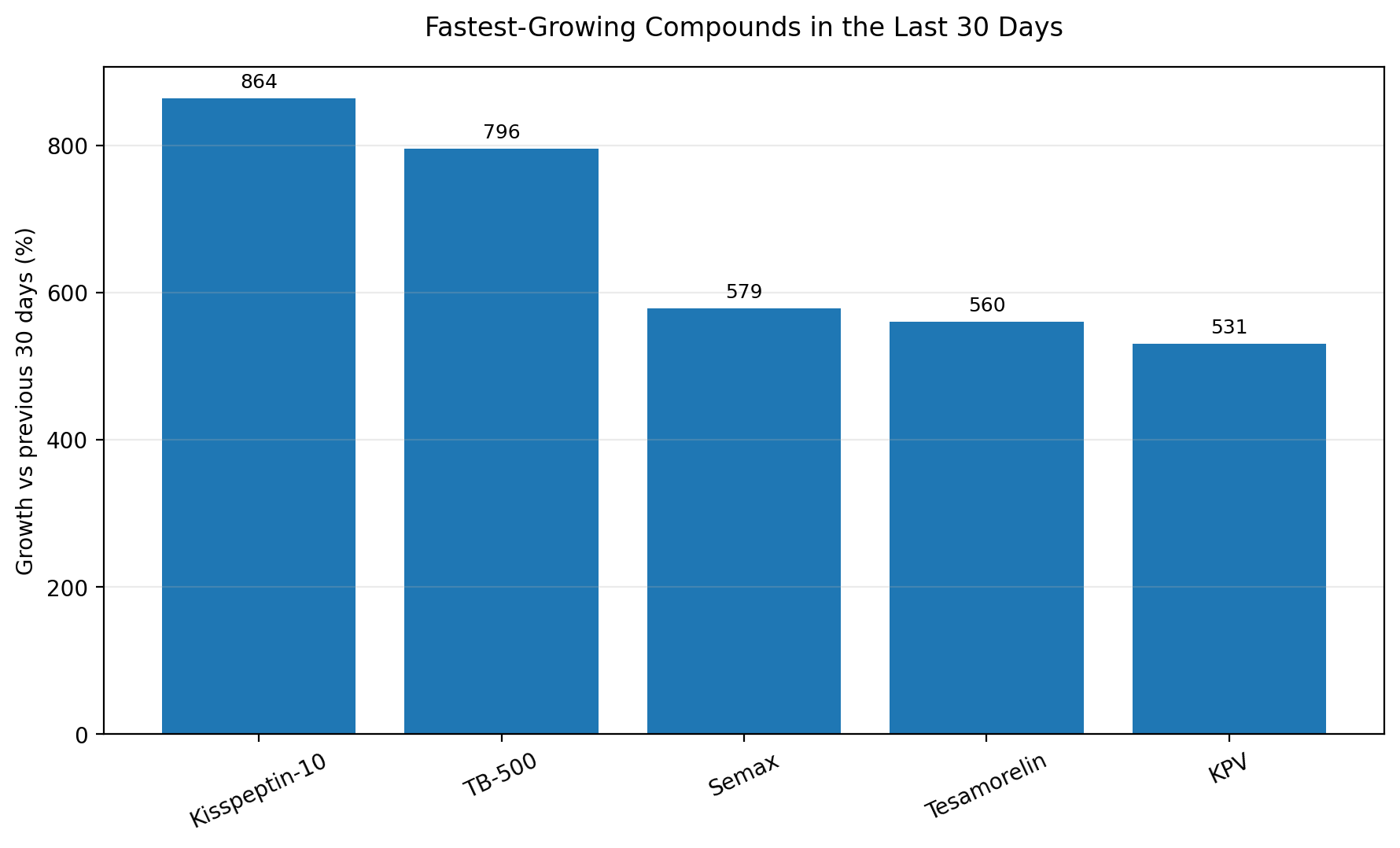
| Compound | Last 30 days calculations | Growth vs previous 30 days |
|---|---|---|
| Kisspeptin-10 | 186 | 864% |
| TB-500 | 2,076 | 796% |
| Semax | 1,044 | 579% |
| Tesamorelin | 2,561 | 560% |
| KPV | 942 | 531% |
Several of these compounds already have dedicated pages — open the TB-500 calculator, the Semax calculator, the Tesamorelin calculator, or the KPV calculator to model them directly.
This is why the best peptide calculator should be dynamic. A calculator should not only solve today's math. It should show what is changing in the research community.
Top Compound Calculators on WPA
WPA has a main peptide calculator and custom calculators for many of the most popular compounds. Open the retatrutide calculator to model GLP-1 scenarios, or jump into a healing-peptide page like the BPC-157 calculator.
Peptide Calculator vs Reconstitution Calculator vs Dosage Calculator
People use different words for the same problem. Some search for "peptide calculator." Some search for "peptide reconstitution calculator." Some search for "peptide dosage calculator." Some search for "peptide dosing calculator."
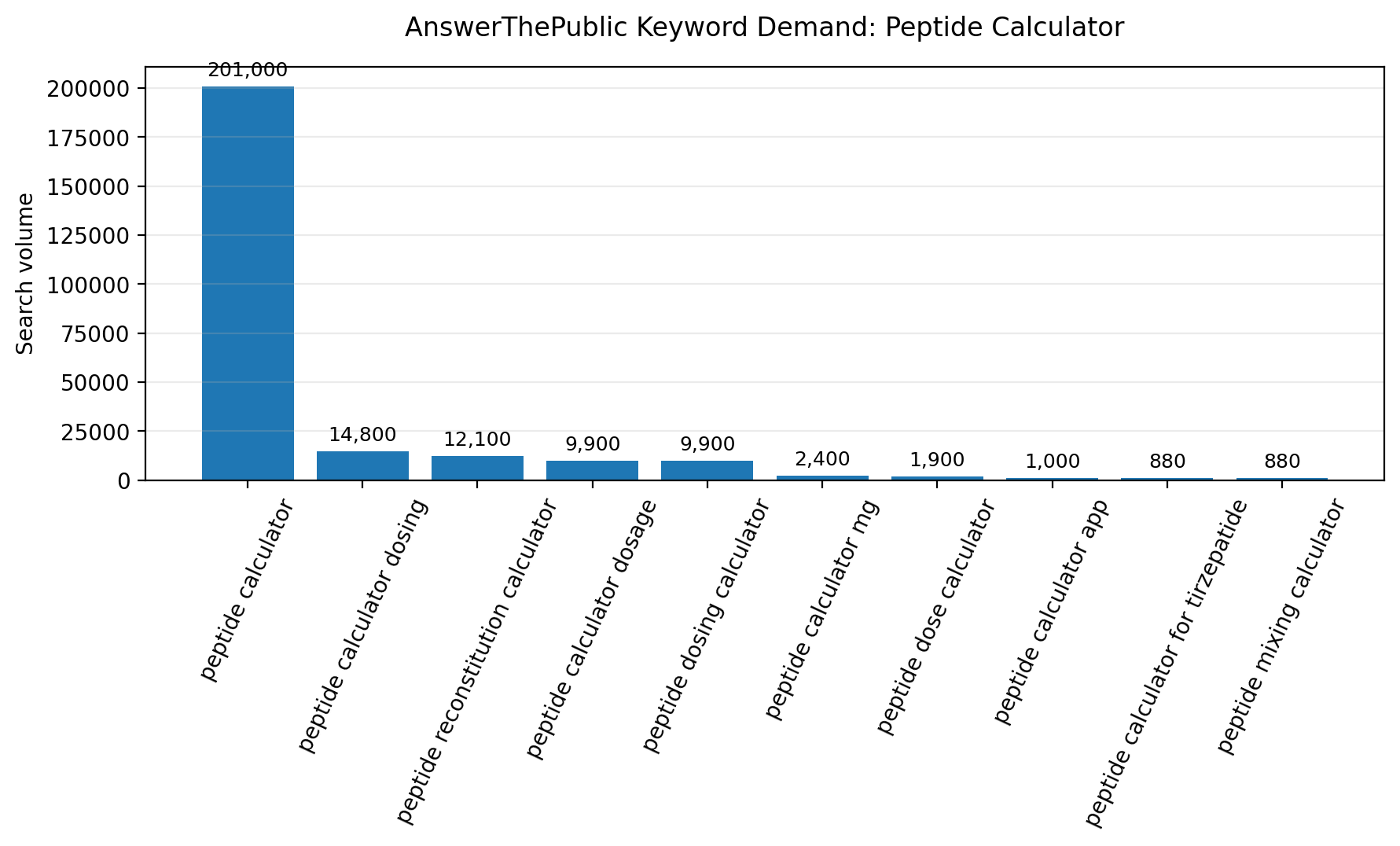
A good calculator should handle all three jobs.
A reconstitution calculator shows concentration
It answers: How strong is the vial after BAC water is added?
A dosage calculator shows the selected amount
It answers: What draw volume matches the amount entered?
A syringe calculator shows the mark on the barrel
It answers: Where should the result appear on a U-100 syringe?
WPA combines all three. If your main question is how to mix peptides with BAC water, start with the peptide reconstitution guide.
Who This Calculator Is For
WPA is for research-use-only users who want clean math and better context. It is for users who want to:
- calculate concentration
- compare 1mL, 2mL, and 3mL BAC water results
- see U-100 syringe units
- check if a draw is too small or too large
- compare their settings with anonymized community data
- build a research schedule PDF
- add a schedule to Google Calendar, Apple Calendar, or Outlook
- compare vendor options after running the math
It is not medical advice. It is not dosing guidance. It is not a recommendation for human use.
Why We Call WPA the World's Best Peptide Calculator
That is a big claim. So here is the proof behind it. Most calculators do the basic formula. WPA does the formula, then adds the data layer.
| Feature | Basic calculator | WPA peptide calculator |
|---|---|---|
| Vial size input | Yes | Yes |
| BAC water input | Yes | Yes |
| Desired amount input | Yes | Yes |
| mg and mcg support | Sometimes | Yes |
| IU support for select compounds | Rare | Yes |
| U-100 syringe view | Sometimes | Yes |
| 0.3mL / 0.5mL / 1.0mL syringe guide | Rare | Yes |
| Compound-specific calculator pages | Sometimes | Yes |
| Real calculator trend data | No | Yes |
| BAC water distribution data | No | Yes |
| Vial-size trend data | No | Yes |
| Frequency-per-week data | No | Yes |
| Custom PDF schedule | No | Yes |
| Calendar integration | No | Yes |
| Vendor comparison data | No | Yes |
| Dynamic data updates | No | Yes |
WPA is not better because it has one extra input. It is better because it helps answer the next question after the math.
Use the WPA Peptide Calculator
Run the math first. Then compare your result with real calculator data.
Browse custom compound calculators
Compare peptide prices
After running the math, use the vetted vendor directory to compare products, pricing, discount codes, and COA-related data.
Frequently Asked Questions
What is the best peptide calculator?
The best peptide calculator is one that does more than return a draw volume. It should show concentration, mL, U-100 syringe units, BAC water impact, vial duration, and research-use-only context. WPA also adds real calculator trend data, frequency data, custom PDF schedules, and vendor comparison tools.
What does a peptide calculator do?
A peptide calculator uses vial size, BAC water amount, and selected amount to calculate concentration and draw volume. WPA also shows the result on a U-100 syringe.
Is WPA a peptide reconstitution calculator?
Yes. WPA works as a peptide reconstitution calculator because it calculates concentration after BAC water is added. It also works as a dosage calculator and syringe units calculator.
Why does BAC water volume matter?
BAC water changes concentration. More water makes the solution less concentrated. Less water makes the solution more concentrated. That changes the syringe draw.
What is the most common BAC water amount?
Across WPA calculator data, 2mL is the most common BAC water amount. 3mL is second, and 1mL is third.
What is the most common peptide vial size?
Across WPA calculator data, 10mg is the most common vial size. It appears in about one out of every three calculations.
Does the calculator support mcg and mg?
Yes. WPA supports mg and mcg. For HGH, HCG, and HMG, WPA also supports IU.
Does the calculator show syringe units?
Yes. WPA shows the draw on a U-100 syringe. It also has a syringe guide for 0.3mL, 0.5mL, and 1.0mL barrels.
Does WPA give dosing recommendations?
No. WPA calculator data reflects anonymized research calculator inputs. It does not provide dosing recommendations, medical advice, or human-use guidance.
Can I compare peptide prices after using the calculator?
Yes. WPA links calculator results to vendor research pages where users can compare products, pricing, discount codes, and COA-related data.
Research-use only. This article is for educational and research-use-only purposes. WPA calculator data reflects anonymized research calculator inputs and does not provide dosing recommendations, medical advice, or human-use guidance.
Related guides
Run your own reconstitution math with the free WPA peptide calculator — concentration, draw volume, U-100 syringe units, and vial duration in one view.
Open the WPA Peptide Calculator