GLP-1 Research Trends Report: What 88,985 Peptide Calculator Sessions Reveal
Since launching calculator tracking in late August 2025, World Peptide Association has collected one of the largest anonymized peptide calculator datasets in the research compound space. Across more than 88,985 calculator runs, WPA can see what research-use-only users are actually calculating: compound selection, vial size, BAC water volume, desired dose, and unit format.
Report last updated: July 1, 2026 · Data since late August 2025
Research-use only. A WPA calculator run is counted when a user enters the required inputs — compound name, vial size, BAC water amount, desired dose, and unit selection — and runs a calculation. This data reflects anonymized research planning behavior. It does not represent clinical dosing data, verified research outcomes, medical advice, or human-use recommendations.
Table of Contents
- 1.Executive Summary
- 2.Why Calculator Data Matters
- 3.Market Backdrop
- 4.Monthly GLP-1 Calculator Trend
- 5.Lifetime GLP-1 Calculator Share
- 6.Unique Sessions
- 7.Calculator Scenario Intensity
- 8.Retatrutide
- 9.Tirzepatide
- 10.Semaglutide
- 11.BAC Water Trends
- 12.Research Category Trends
- 13.Vendor Click Data
- 14.Cost-Per-mg vs Cost-Per-vial
- 15.Vial-Size Fragmentation
- 16.Watchlist
- 17.What This Data Can and Cannot Tell Us
- 18.Methodology
- 19.Use the WPA GLP-1 Calculators
- 20.Frequently Asked Questions
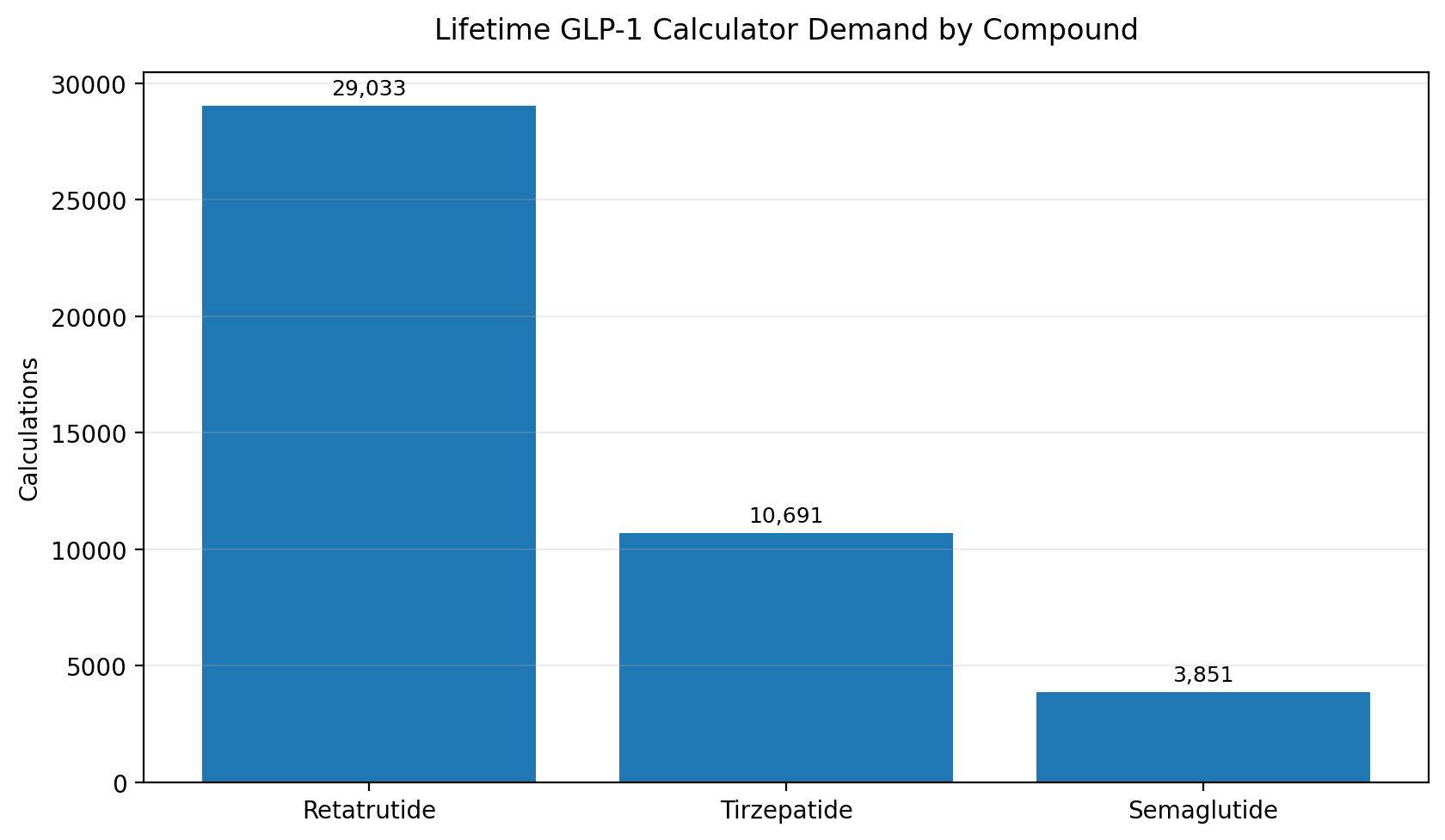
This report focuses on the three most important GLP-1-related compounds in the WPA dataset: retatrutide, tirzepatide, and semaglutide. Based on the latest production data, these three compounds account for approximately 43,575 lifetime calculator runs.
Executive Summary
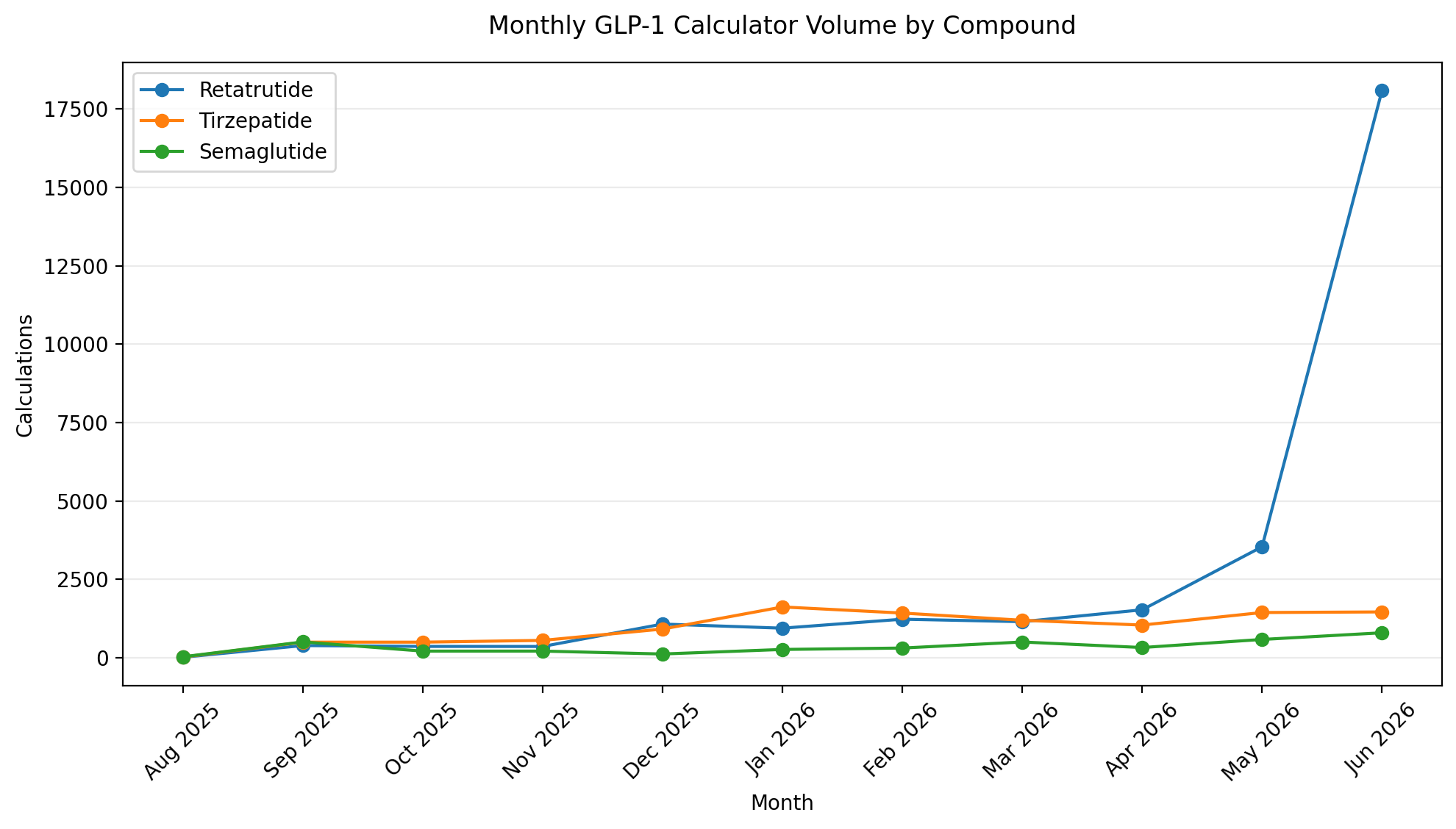
The WPA calculator dataset shows a clear shift in GLP-1 research interest over time. When calculator tracking began in August 2025, semaglutide was the early leader by monthly GLP-1 calculation share. Tirzepatide then became the dominant compound for several months, especially from October 2025 through March 2026. Beginning in April 2026, retatrutide moved ahead on a monthly basis and then accelerated sharply in May and June.
By June 2026, retatrutide accounted for approximately 88.9% of all GLP-1 calculator activity across retatrutide, tirzepatide, and semaglutide. That made June the most important month in the dataset so far.
The timing is notable. In May 2026, Eli Lilly announced positive topline Phase 3 TRIUMPH-1 results for retatrutide, describing it as an investigational first-in-class GIP, GLP-1, and glucagon triple hormone receptor agonist. Retatrutide remains investigational and Lilly states it is legally available only to participants in Lilly clinical trials.
The most important findings from WPA's calculator and vendor data are:
- Retatrutide is now the clear GLP-1 calculator leader. It has the largest lifetime calculator count, the largest unique-session count, and the sharpest recent growth.
- Tirzepatide shows the highest calculator scenario intensity. Tirzepatide users run approximately 4.8 calculations per unique session, compared with approximately 2.8 for retatrutide and 3.4 for semaglutide.
- Semaglutide appears to be the most mature GLP-1 calculator market. It has fewer unique vial-size entries and more concentrated calculator behavior.
- Retatrutide appears to be the most exploratory GLP-1 market. It has the highest calculation count, the widest vial-size dispersion, and the most dramatic recent growth.
- BAC water volume scales with vial size. Larger vial sizes are more likely to be paired with more than 2mL of BAC water in calculator sessions.
- Vendor-click behavior differs by compound. Semaglutide users appear more cost-per-mg driven, tirzepatide users appear balanced with a slight value lean, and retatrutide users appear more sensitive to lower upfront vial price.
Why Calculator Data Matters in the GLP-1 Research Market
Most GLP-1 research discussion online is anecdotal. Researchers often encounter isolated Reddit posts, YouTube commentary, forum opinions, or one-off research protocols without knowing whether those examples reflect broader behavior.
WPA's calculator data gives the research community a different kind of signal. Instead of relying on isolated anecdotes, WPA aggregates anonymized calculator activity across thousands of research-planning sessions. That matters because GLP-1 research planning usually involves multiple variables at once: compound selection, vial size, BAC water volume, desired dose, unit format, weekly cadence, vendor availability, cost per mg, and cost per vial.
A single calculator run does not prove that a configuration is better, safer, or more effective. But tens of thousands of calculator runs can show where research-use-only users are concentrating their attention, where behavior is fragmented, and where market demand appears to be moving. This is the core value of the WPA dataset: it helps replace guesswork with aggregated calculator behavior.
Market Backdrop: Why GLP-1 Interest Keeps Expanding
The GLP-1 category has expanded because semaglutide and tirzepatide moved from niche metabolic research topics into mainstream obesity and cardiometabolic discussions. The FDA approved Wegovy, a semaglutide injection, for chronic weight management in adults with obesity or overweight with at least one weight-related condition, used with a reduced calorie diet and increased physical activity. The FDA later approved Zepbound, a tirzepatide injection, for chronic weight management in adults with obesity or overweight with at least one weight-related condition.
Retatrutide has added another layer of interest because it is being studied as a triple hormone receptor agonist targeting GIP, GLP-1, and glucagon receptors. WPA calculator data cannot prove that clinical-trial news caused the June spike, but the timing suggests retatrutide became a much larger research-planning focus shortly after major Phase 3 attention.
Monthly GLP-1 Calculator Trend: Semaglutide to Tirzepatide to Retatrutide
The monthly production data shows three distinct phases.
Phase 1: Semaglutide Led Early
In August and September 2025, semaglutide was the largest or near-largest GLP-1 compound in WPA calculator activity. In August, semaglutide represented approximately 46.6% of GLP-1 calculator activity across the three compounds. This likely reflects semaglutide's position as the most established GLP-1 benchmark at the start of WPA's tracking period.
Phase 2: Tirzepatide Became the Steady Leader
From October 2025 through March 2026, tirzepatide became the most consistent GLP-1 calculator leader. It reached 1,617 calculations in January 2026 and remained in the 1,000–1,600 monthly range for several months. Tirzepatide's pattern is notable because it looks steadier than retatrutide. It did not show the same explosive spike, but it maintained a consistently high level of calculator activity.
Phase 3: Retatrutide Took Over
Retatrutide became the clear monthly leader in April 2026, expanded its lead in May, and then surged in June. Based on the monthly production rows:
| Month | Retatrutide | Tirzepatide | Semaglutide |
|---|---|---|---|
| 2026-04 | 1,526 | 1,039 | 322 |
| 2026-05 | 3,537 | 1,439 | 580 |
| 2026-06 | 18,085 | 1,458 | 793 |
June retatrutide activity was approximately 5.1x May, approximately 11.9x April, and greater than all previous retatrutide months combined.
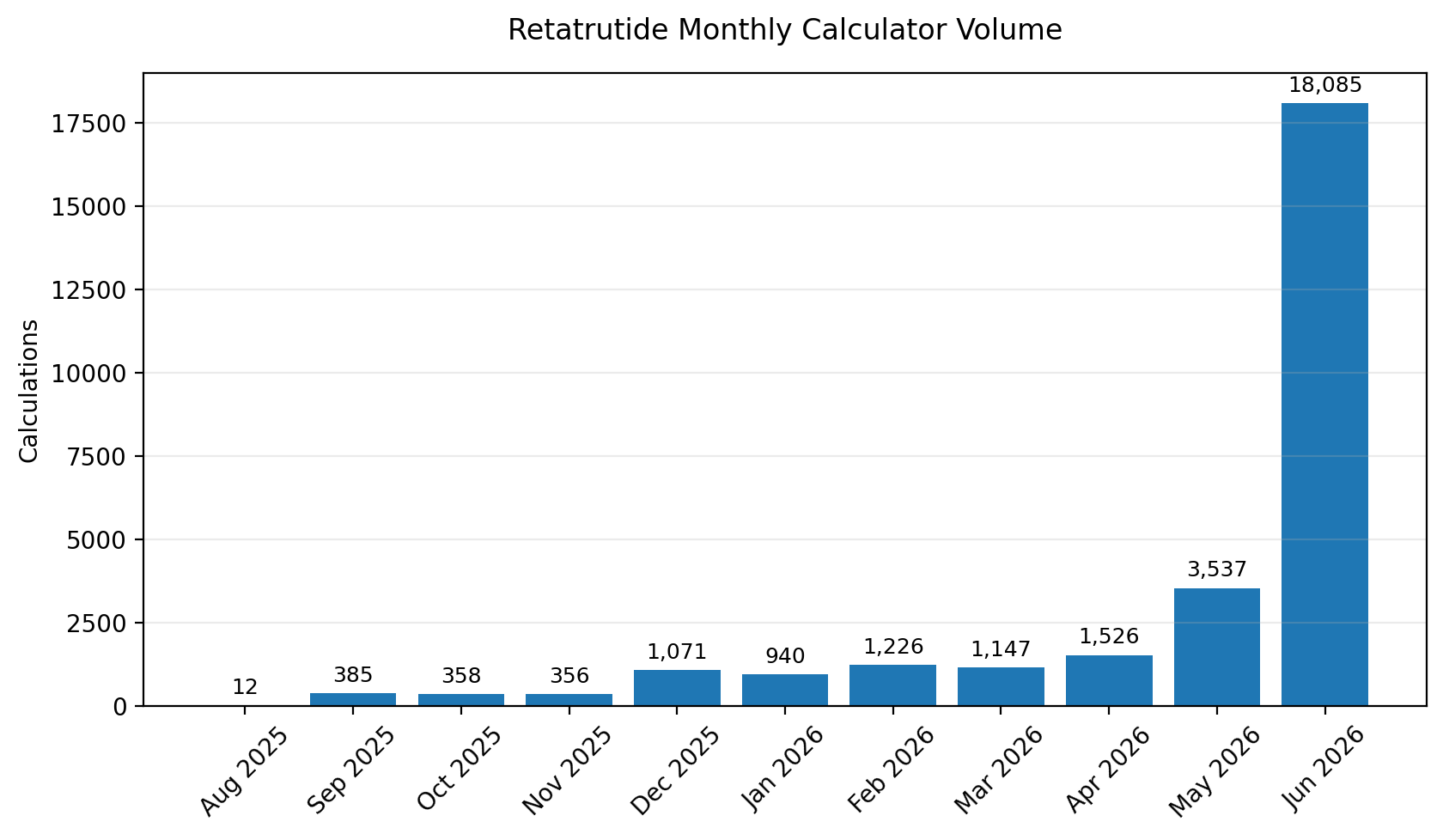
July 2026 is excluded from these trend conclusions because it currently reflects only the first day of the month.
Lifetime GLP-1 Calculator Share
Across the three primary GLP-1 compounds, retatrutide now represents the majority of lifetime calculator activity.
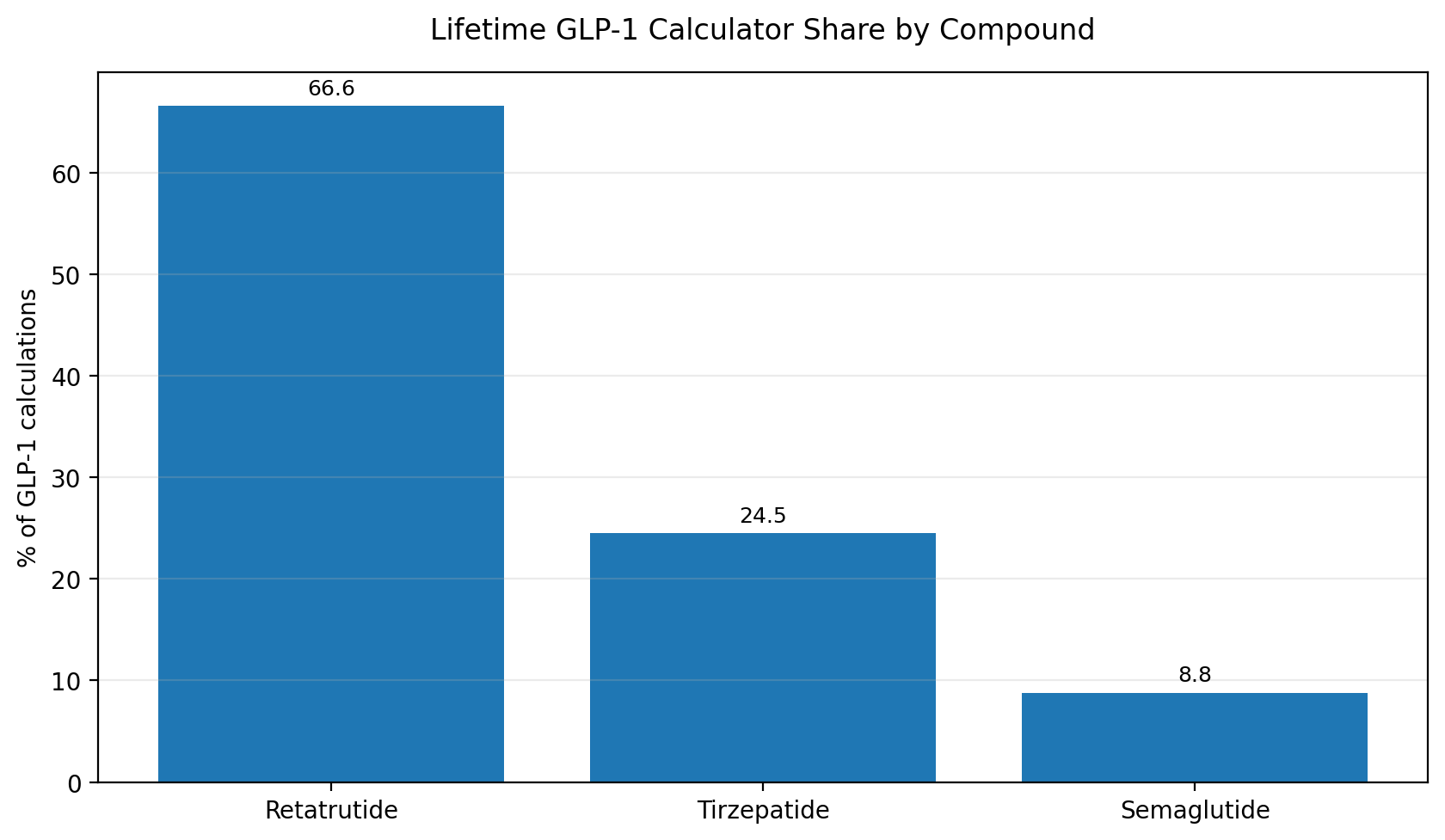
The lifetime GLP-1 calculator distribution is approximately:
| Compound | Lifetime Calculations | Share of GLP-1 Calculations |
|---|---|---|
| Retatrutide | 29,033 | 66.6% |
| Tirzepatide | 10,691 | 24.5% |
| Semaglutide | 3,851 | 8.8% |
The key takeaway is clear: retatrutide is now the dominant GLP-1 compound in WPA calculator activity.
Unique Sessions: Retatrutide Has the Broadest Reach
Calculation volume shows total activity. Unique sessions show how many distinct browser or device sessions are represented. Current lifetime unique-session data:
| Metric | Value |
|---|---|
| Total unique calculator sessions | 23,670 |
| Retatrutide unique sessions | 10,316 |
| Tirzepatide unique sessions | 2,217 |
| Semaglutide unique sessions | 1,148 |
Retatrutide alone accounts for approximately 43.6% of all unique sessions that have ever run a WPA calculator.
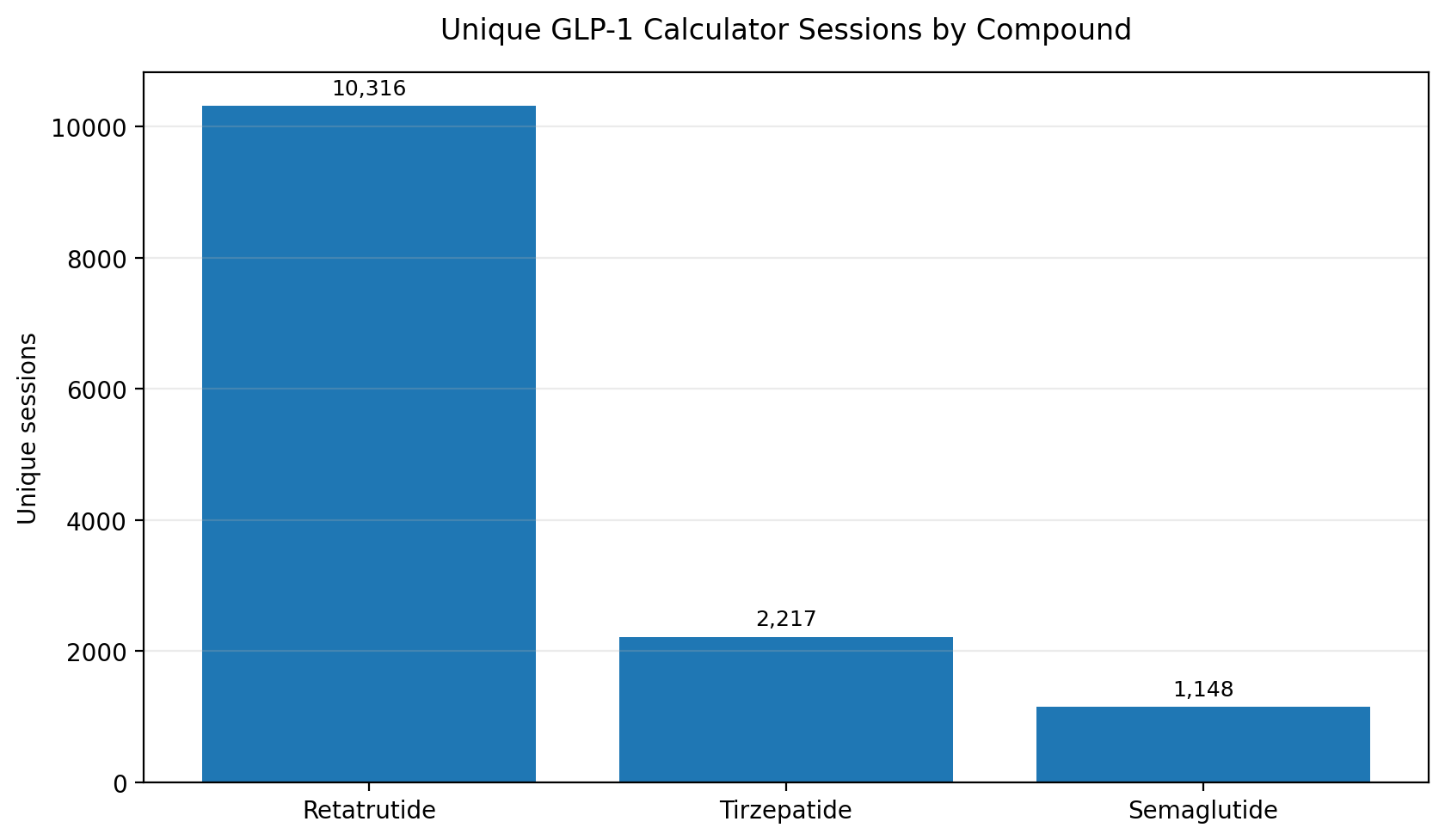
These compound-level unique sessions do not add up to the total unique-session count because one session can run calculations for multiple compounds.
Calculator Scenario Intensity: Tirzepatide Users Run More Calculations Per Session
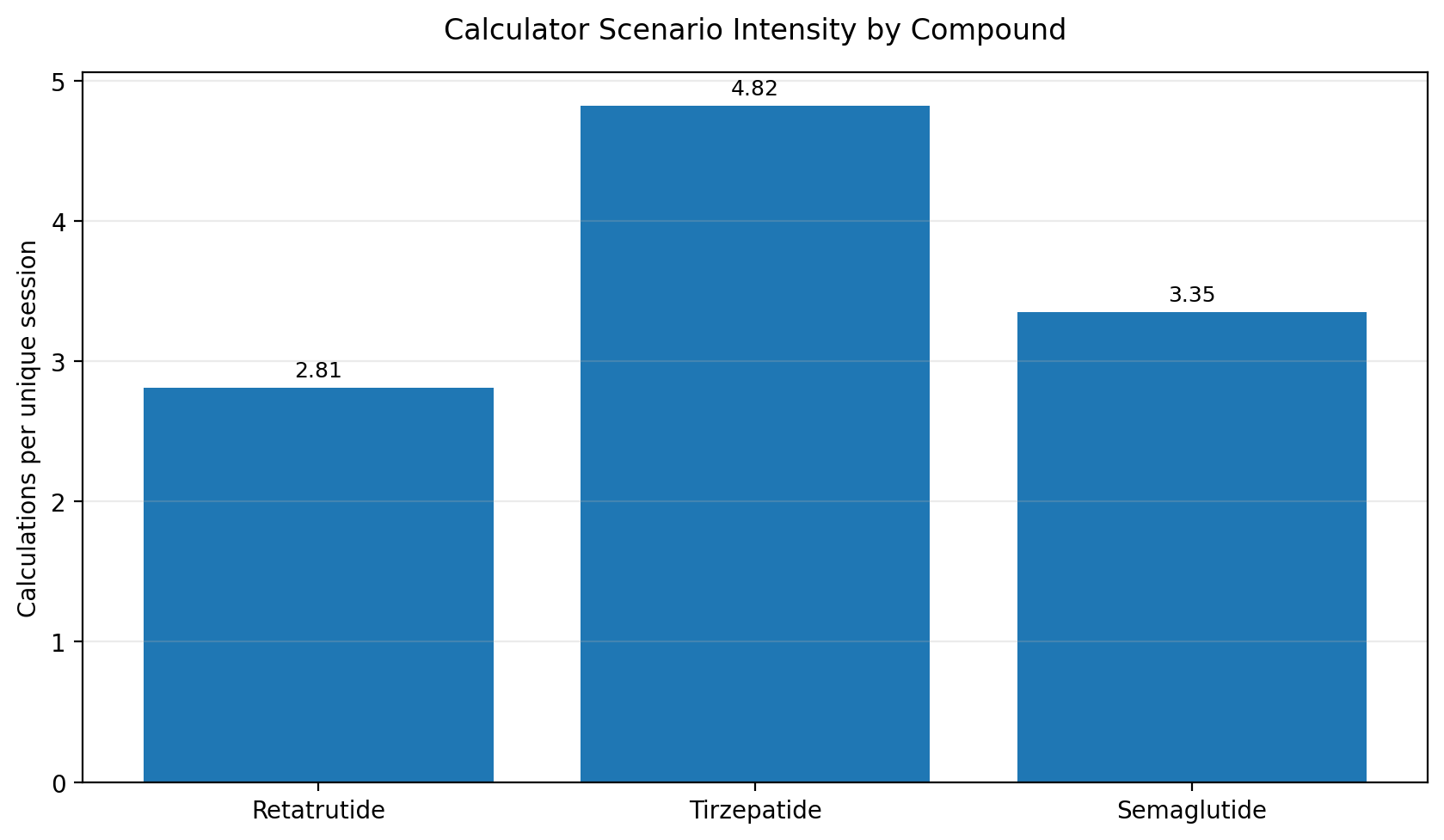
One of the most interesting derived metrics is calculator scenario intensity: the number of calculations per unique session.
| Compound | Calculations Per Unique Session |
|---|---|
| Retatrutide | 2.8 |
| Tirzepatide | 4.8 |
| Semaglutide | 3.4 |
Tirzepatide appears to have the highest scenario intensity. This means tirzepatide users run more calculator configurations per unique session than users calculating retatrutide or semaglutide. A likely explanation is that tirzepatide users are comparing more vial-size, BAC water, and cost scenarios. This is a directional interpretation, not a confirmed causal finding.
Retatrutide: The Current Leader and Fastest-Moving GLP-1 Calculator Compound
Retatrutide is now the largest and fastest-moving GLP-1-related compound in the WPA calculator dataset. It has the highest lifetime calculation volume, the most unique sessions, and the strongest recent acceleration.
The June 2026 spike is the most important single-month event in the dataset. Retatrutide jumped from 3,537 calculations in May to 18,085 in June, an increase of approximately 411%.
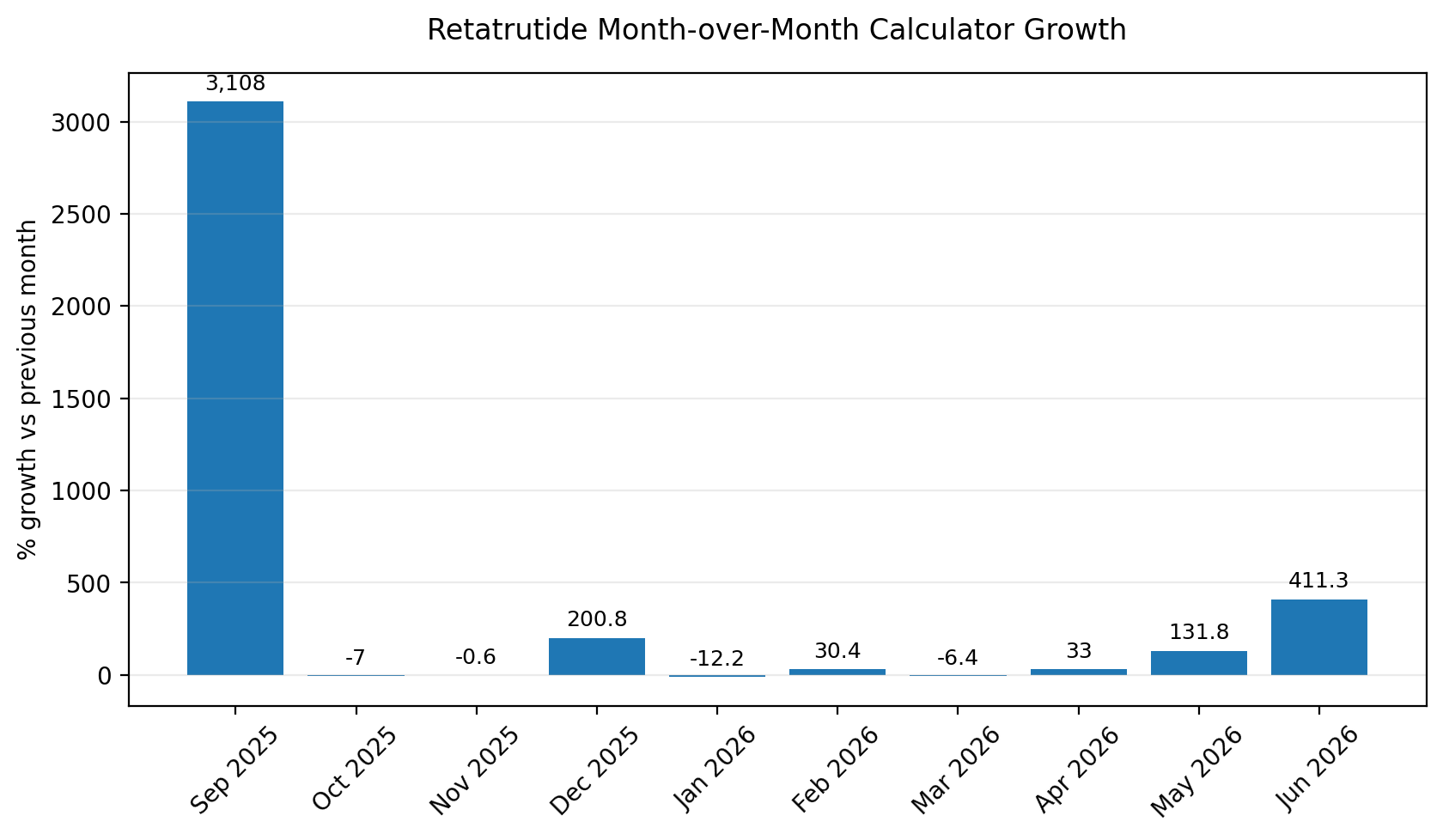
WPA continues to monitor this spike. It may reflect a combination of increased market attention, clinical-trial news, internal marketing, viral traffic, or unusual traffic behavior. WPA is reviewing the June traffic pattern by source, session quality, geography, referrer, and bot indicators before treating the spike as entirely organic.
Retatrutide Dose-Selection Patterns
The five most common retatrutide dose selections are:
| Rank | Dose Selection | Share of Retatrutide Calculations |
|---|---|---|
| 1 | 2mg | 22% |
| 2 | 1mg | 17% |
| 3 | 0.5mg | 10% |
| 4 | 4mg | 8% |
| 5 | 5mg | 6% |
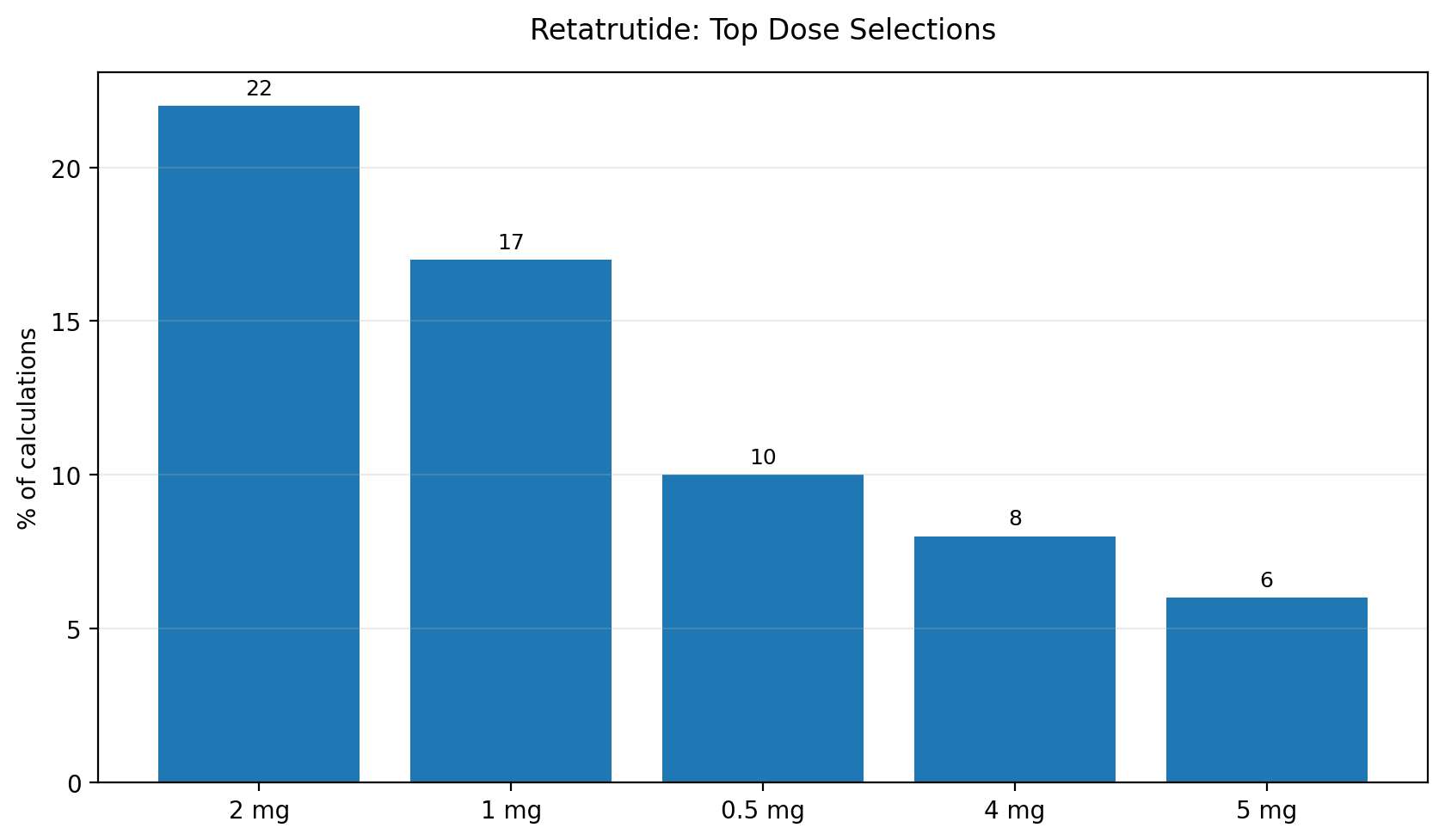
The most common retatrutide dose selection is 2mg, but it represents only 22% of retatrutide calculations. That means approximately 78% of retatrutide calculator runs use a dose selection other than 2mg. This dispersion is important. Retatrutide users are not clustering around a single dominant configuration. Instead, the data shows a wide spread across dose selections, vial sizes, and calculator scenarios.
Retatrutide Vial-Size Behavior
The most common retatrutide vial sizes entered into the calculator are:
| Rank | Vial Size | Calculations |
|---|---|---|
| 1 | 10mg | 8,536 |
| 2 | 20mg | 6,196 |
| 3 | 30mg | 4,731 |
| 4 | 5mg | 1,796 |
| 5 | 15mg | 1,720 |
| 6 | 12mg | 1,221 |
| 7 | 40mg | 950 |
| 8 | 24mg | 843 |
| 9 | 50mg | 737 |
| 10 | 60mg | 669 |
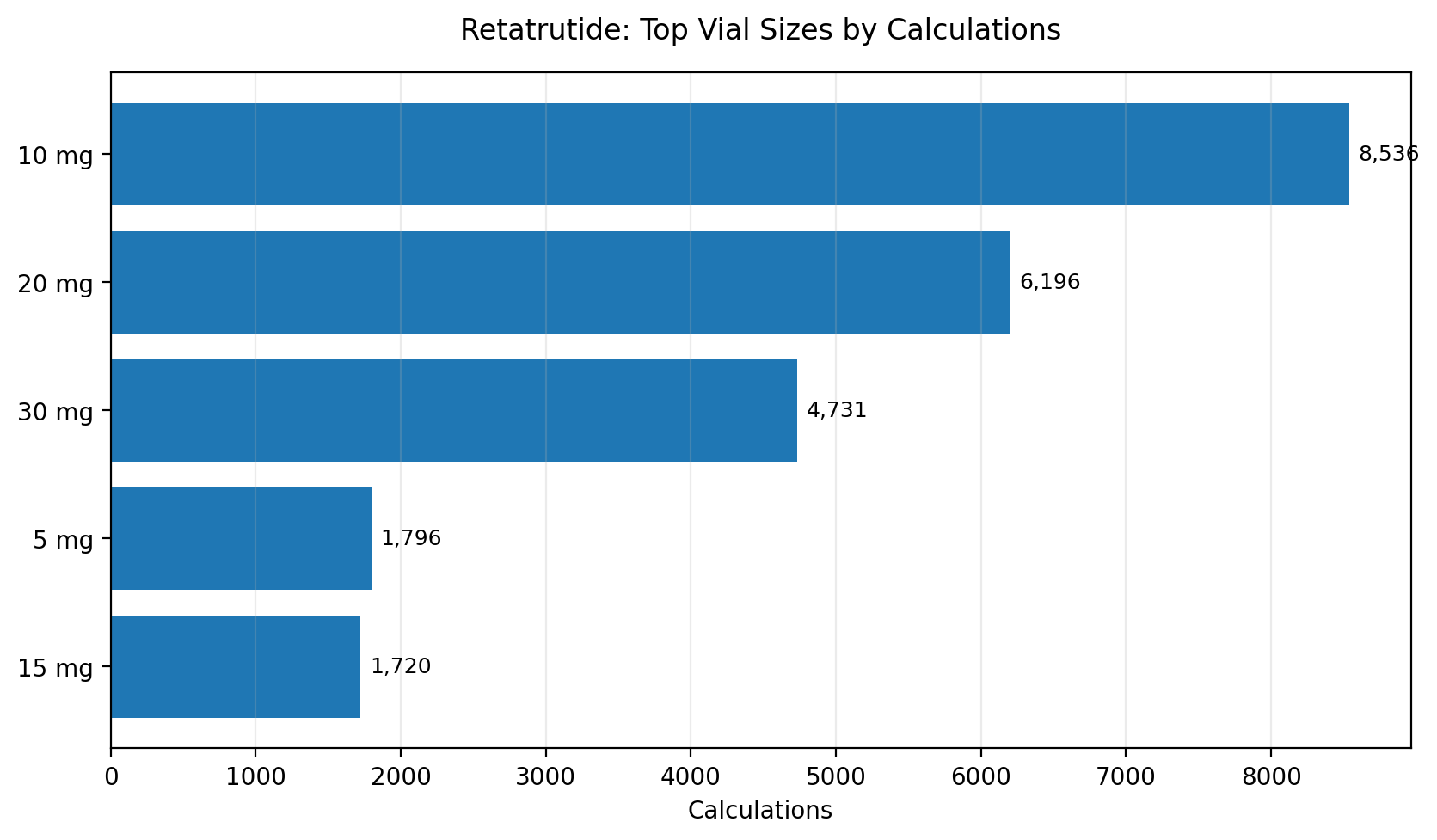
Retatrutide has the widest vial-size dispersion of the three main GLP-1 compounds. That may be a sign of an earlier-stage, fast-moving market where users and vendors are still experimenting with preferred vial sizes. Researchers can model configurations with the retatrutide calculator or compare retatrutide prices.
Tirzepatide: The Steadiest GLP-1 Calculator Compound
Tirzepatide is the second-largest GLP-1 compound in the WPA calculator dataset by lifetime calculations. It was also the most consistent calculator leader from late 2025 into early 2026. Unlike retatrutide, tirzepatide has not shown a single explosive breakout month. Instead, it has maintained steady monthly calculator activity, generally in the 1,000–1,600 range since January 2026. This makes tirzepatide the most stable of the three major GLP-1 calculator markets.
Tirzepatide Dose-Selection Patterns
The five most common tirzepatide dose selections are:
| Rank | Dose Selection | Share of Tirzepatide Calculations |
|---|---|---|
| 1 | 2.5mg | 23% |
| 2 | 5mg | 20% |
| 3 | 7.5mg | 12% |
| 4 | 10mg | 10% |
| 5 | 12.5mg | 5% |
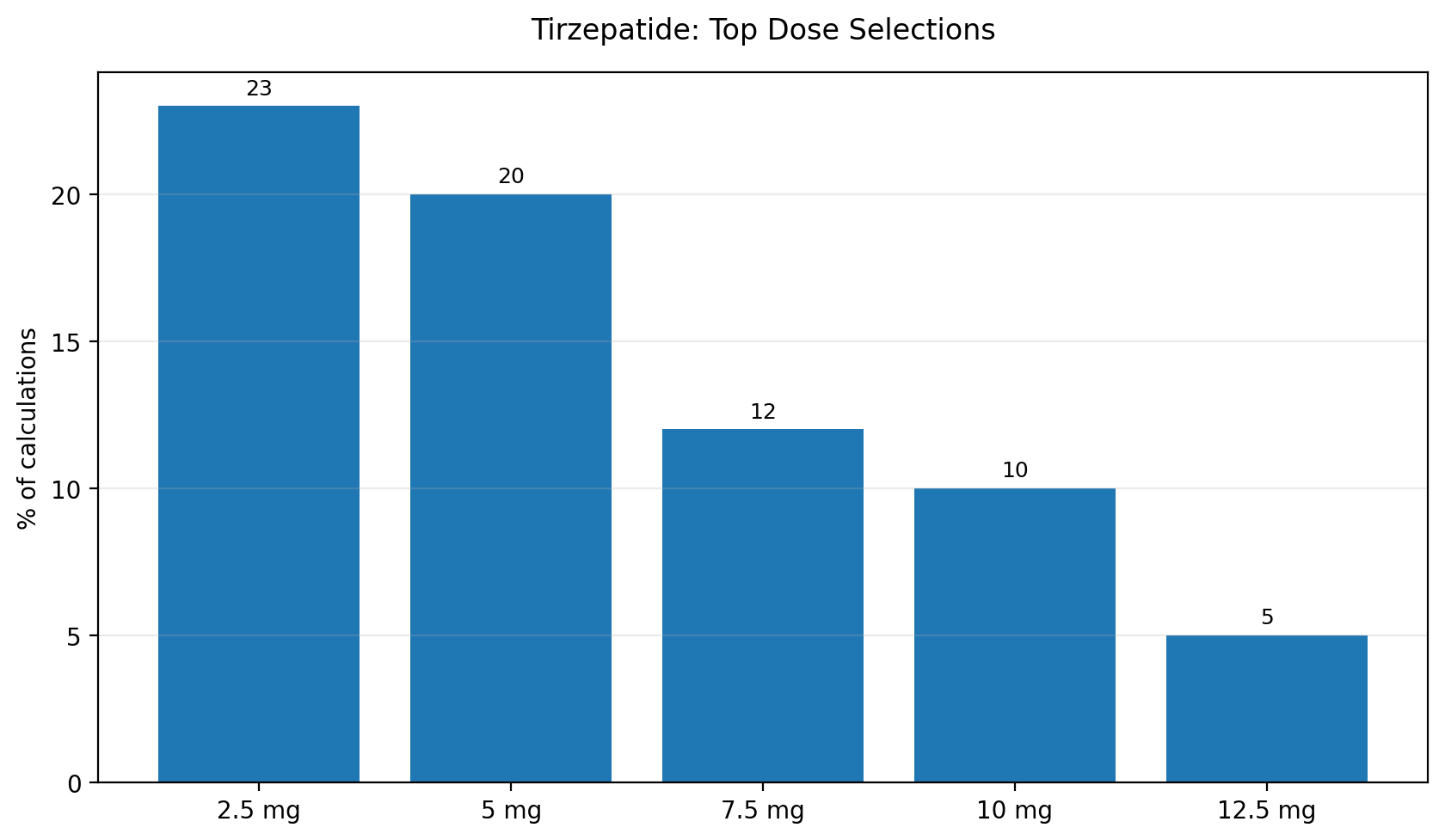
Tirzepatide's dose-selection pattern appears more standardized than retatrutide's. The top selections follow a clear stepwise structure, which may explain why tirzepatide calculator behavior looks more stable over time.
Tirzepatide Vial-Size Behavior
The most common tirzepatide vial sizes entered into the calculator are:
| Rank | Vial Size | Calculations |
|---|---|---|
| 1 | 30mg | 2,858 |
| 2 | 10mg | 2,112 |
| 3 | 60mg | 1,779 |
| 4 | 15mg | 1,132 |
| 5 | 20mg | 915 |
| 6 | 40mg | 512 |
| 7 | 5mg | 278 |
| 8 | 50mg | 170 |
| 9 | 100mg | 148 |
| 10 | 34mg | 79 |
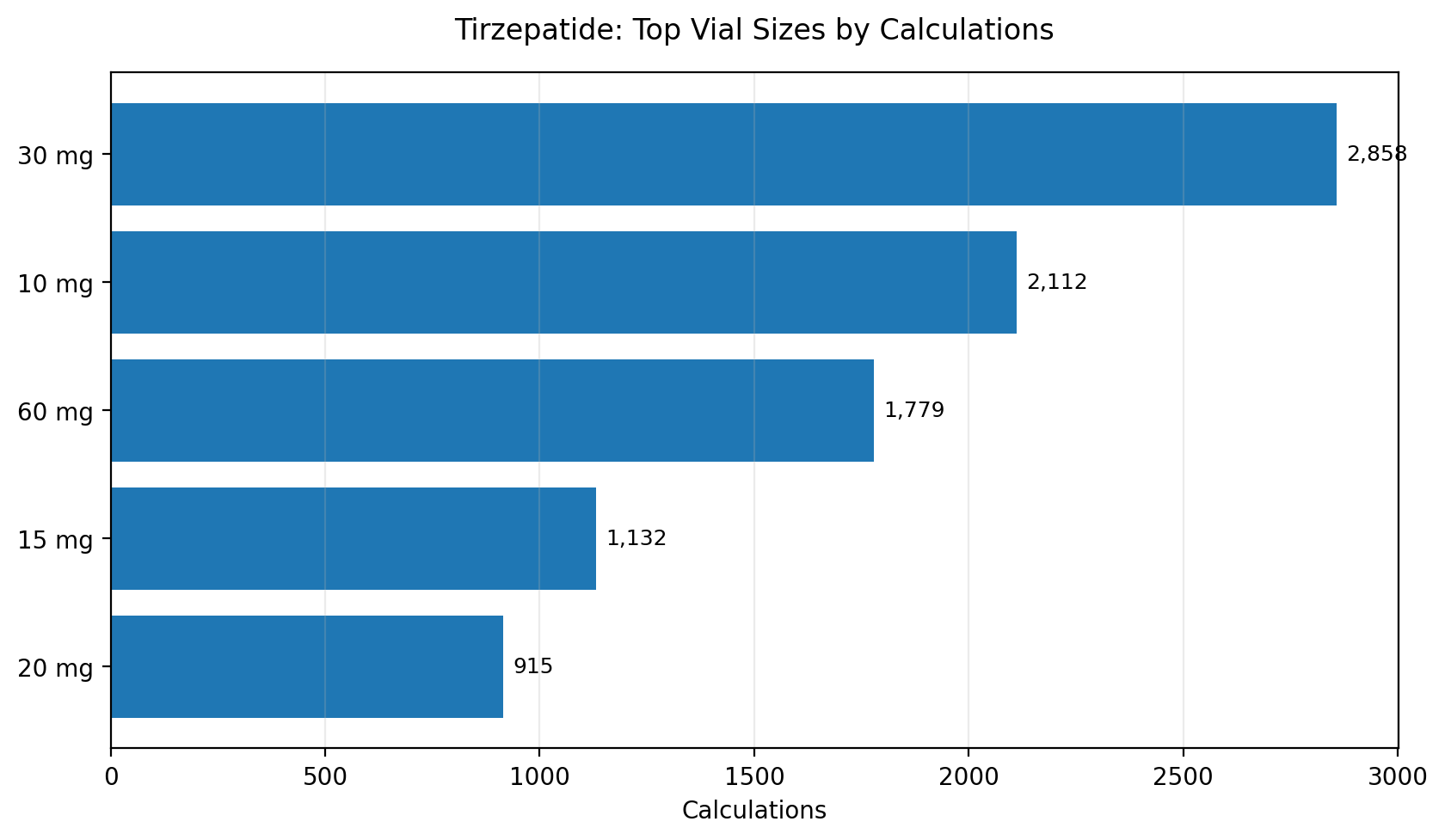
Tirzepatide's most common vial size is 30mg, which is three times larger than the most common retatrutide and semaglutide vial size. It also shows meaningful activity around 60mg vials. This becomes important when comparing calculator behavior with vendor-click behavior. Researchers can model configurations with the tirzepatide calculator or compare tirzepatide prices.
Semaglutide: The Mature Benchmark
Semaglutide has the lowest calculation count of the three major GLP-1 compounds in the current WPA dataset, but it remains an important benchmark. It was the early calculator leader when WPA began tracking in August 2025. Since then, semaglutide has become the smallest and most stable of the three major GLP-1 calculator categories. This likely reflects market maturity. Semaglutide has been widely discussed for longer than tirzepatide and retatrutide, so calculator behavior appears less fragmented.
Semaglutide Dose-Selection Patterns
The five most common semaglutide dose selections are:
| Rank | Dose Selection | Share of Semaglutide Calculations |
|---|---|---|
| 1 | 0.25mg | 25% |
| 2 | 0.5mg | 15% |
| 3 | 1mg | 14% |
| 4 | 2.5mg | 7% |
| 5 | 2mg | 6% |
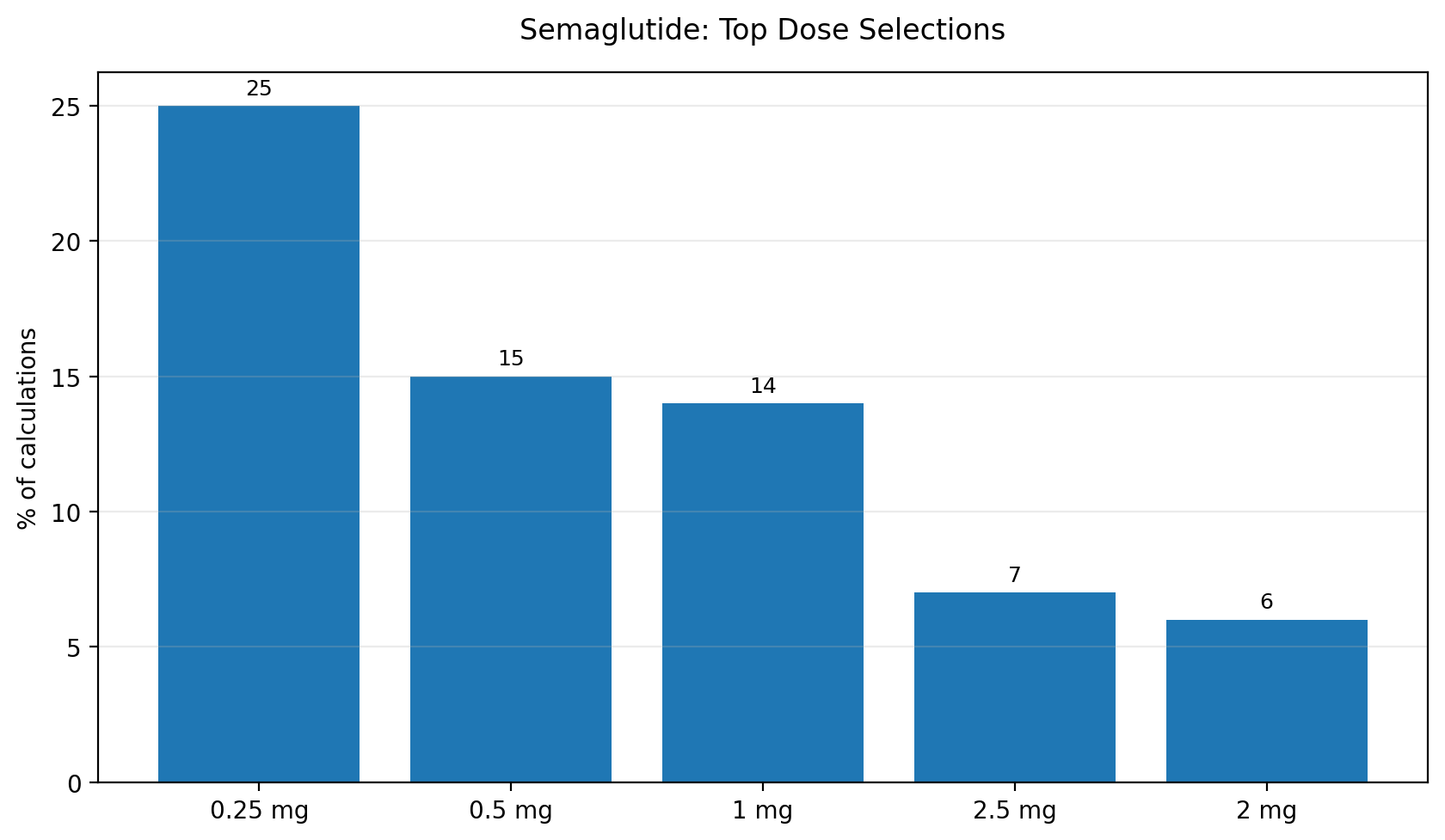
Semaglutide's top dose pattern is more concentrated than retatrutide's. It appears to behave like a more mature calculator category, with fewer extreme long-tail configurations.
Semaglutide Vial-Size Behavior
The most common semaglutide vial sizes entered into the calculator are:
| Rank | Vial Size | Calculations |
|---|---|---|
| 1 | 10mg | 1,492 |
| 2 | 5mg | 1,162 |
| 3 | 6mg | 279 |
| 4 | 20mg | 250 |
| 5 | 15mg | 172 |
| 6 | 30mg | 98 |
| 7 | 2mg | 90 |
| 8 | 12mg | 55 |
| 9 | 22mg | 28 |
| 10 | 2.5mg | 27 |
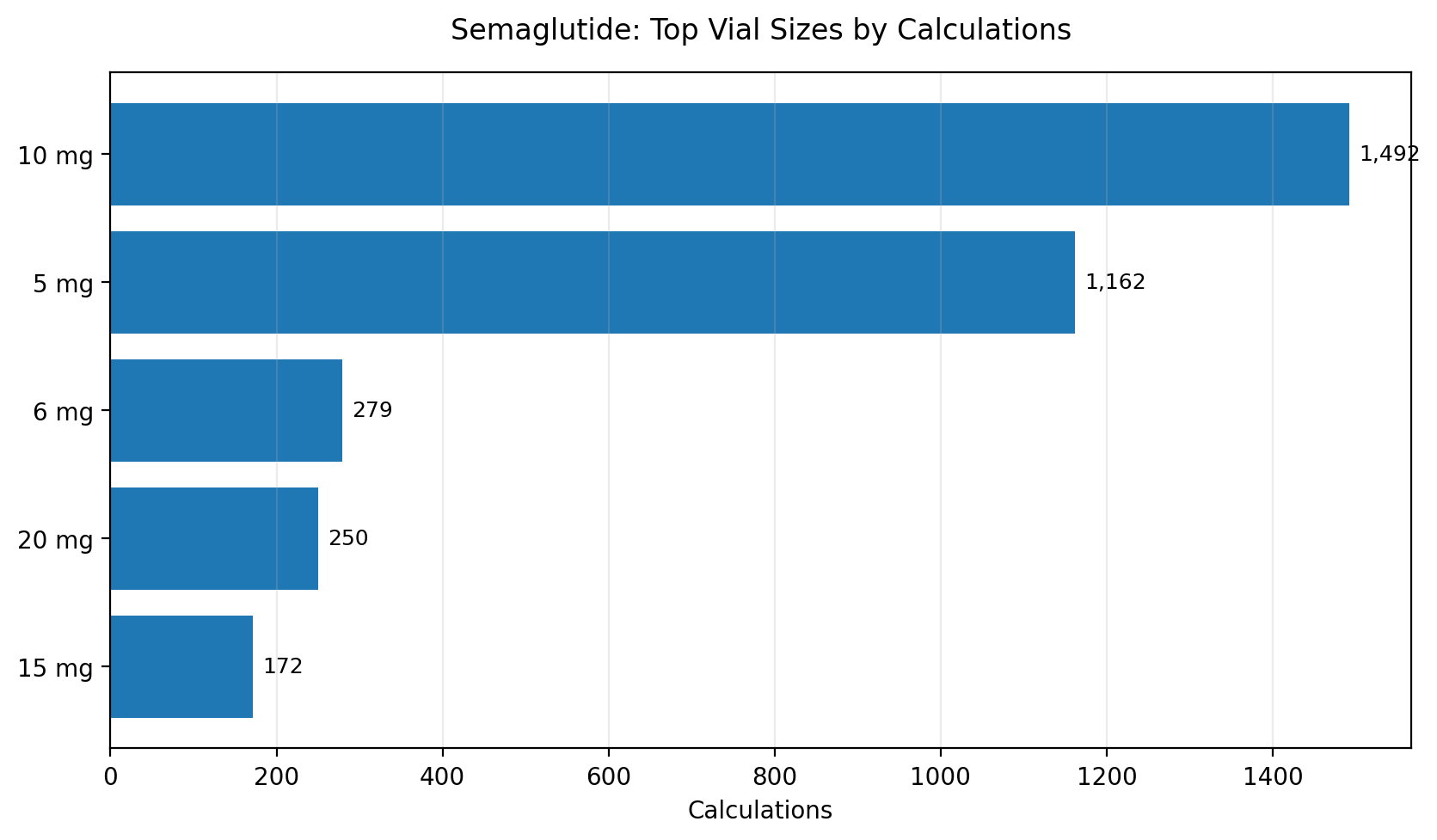
Semaglutide has the fewest unique vial-size entries of the three major GLP-1 compounds. That supports the idea that semaglutide is the most mature and standardized GLP-1 calculator market in the WPA dataset. Researchers can model configurations with the semaglutide calculator or compare semaglutide prices.
BAC Water Trends: 2mL Is the Most Common Reconstitution Volume
BAC water volume is one of the most important calculator inputs because it directly affects final concentration per mL. Across WPA peptide calculator activity, 2mL is the most commonly selected BAC water volume, followed by 3mL and 1mL.
The data shows 2mL accounting for roughly 39% of logged BAC water selections, followed by 3mL at roughly 33% and 1mL at roughly 15%. Together, those three values account for the large majority of BAC water selections.
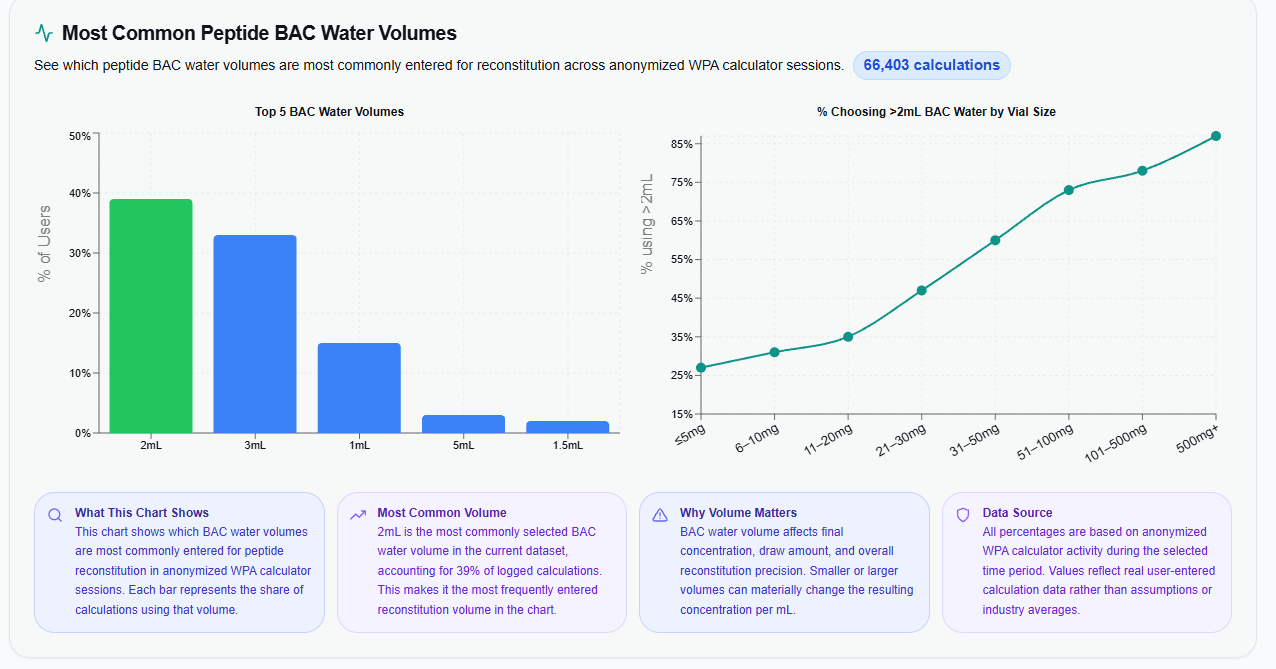
The more important insight is how BAC water behavior changes as vial size increases. Larger vial sizes are associated with a higher percentage of users selecting more than 2mL of BAC water. This is intuitive from a calculator perspective. When a larger vial size is paired with a very small reconstitution volume, the resulting concentration becomes more compressed. A higher BAC water volume can make calculator draw amounts easier to measure and interpret.
Research Category Trends: Weight Loss Dominates WPA Calculator Activity
Weight loss is currently the largest research category in the WPA calculator dataset. The category trends data shows weight loss with approximately 39.3k lifetime calculator volume and 47% 30-day growth.

This matters because the GLP-1 compounds in this report sit inside the largest research category on WPA. Retatrutide, tirzepatide, and semaglutide are not isolated calculator trends. They are part of a broader shift toward metabolic and weight-loss-related research planning. The data also shows growth across other research categories, including anti-aging, performance, recovery, skin, muscle, memory, and testosterone. But weight loss is clearly the largest category by total calculator volume.
Vendor Click Data: Calculator Demand and Vendor Intent Are Not the Same
WPA's vendor data adds another important layer. Calculator volume shows what users are researching. Outbound vendor clicks show what users may be evaluating next. Current lifetime outbound vendor-click data shows:
| Compound | Total Outbound Vendor Clicks | Unique Sessions Clicking |
|---|---|---|
| Retatrutide | 2,565 | 900 |
| Tirzepatide | 1,450 | 520 |
| Semaglutide | 626 | 253 |
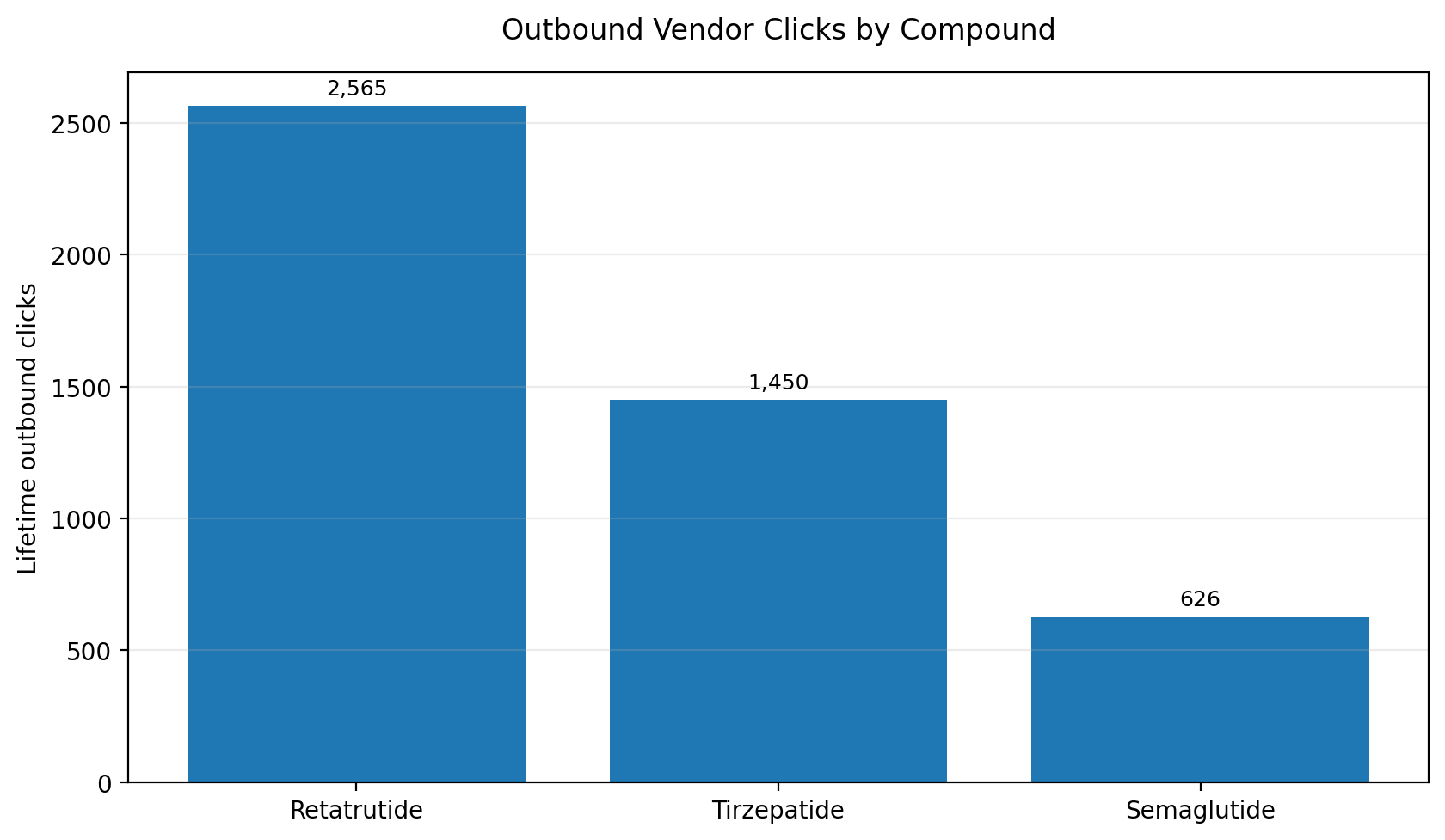
Retatrutide has the highest total vendor-click volume, which is expected given its calculator dominance. But click intent per unique calculator session tells a different story.
| Compound | Vendor-Clicking Sessions / Unique Calculator Sessions |
|---|---|
| Retatrutide | 8.7% |
| Tirzepatide | 23.5% |
| Semaglutide | 22.0% |
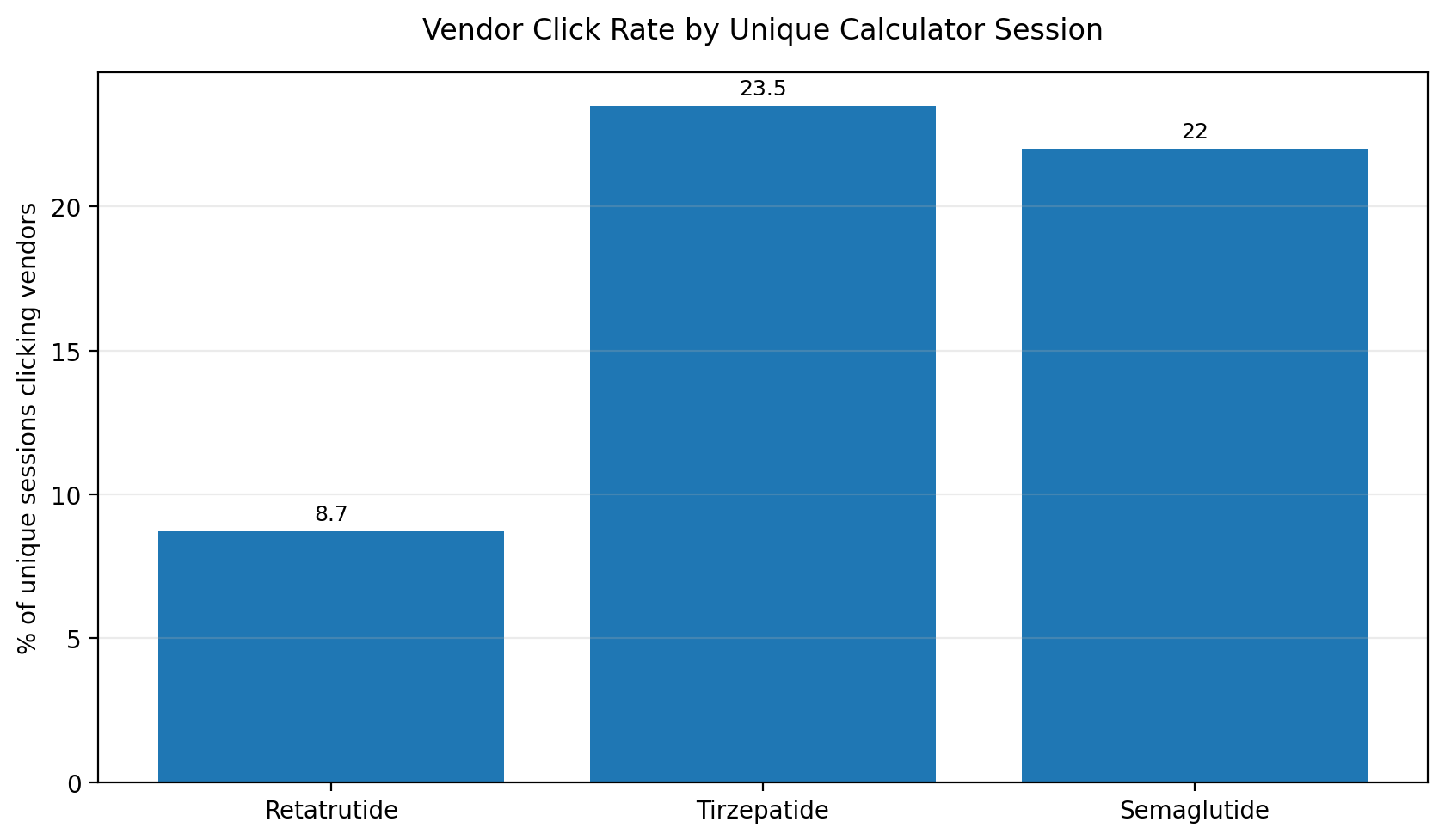
This suggests retatrutide has the most attention, while tirzepatide and semaglutide may have stronger downstream vendor-comparison intent per unique calculator session. A cautious interpretation is that retatrutide users are still exploring, while tirzepatide and semaglutide users may be closer to vendor comparison. This should be treated as directional, because vendor-click data includes naming variants and blends while compound calculator sessions are based on exact compound names.
Top Clicked Vendor Vial Sizes
The most-clicked vendor vial sizes differ meaningfully by compound.
| Rank | Retatrutide | Tirzepatide | Semaglutide |
|---|---|---|---|
| 1 | 10mg | 60mg | 5mg |
| 2 | 20mg | 10mg | 10mg |
| 3 | 60mg | 30mg | 20mg |
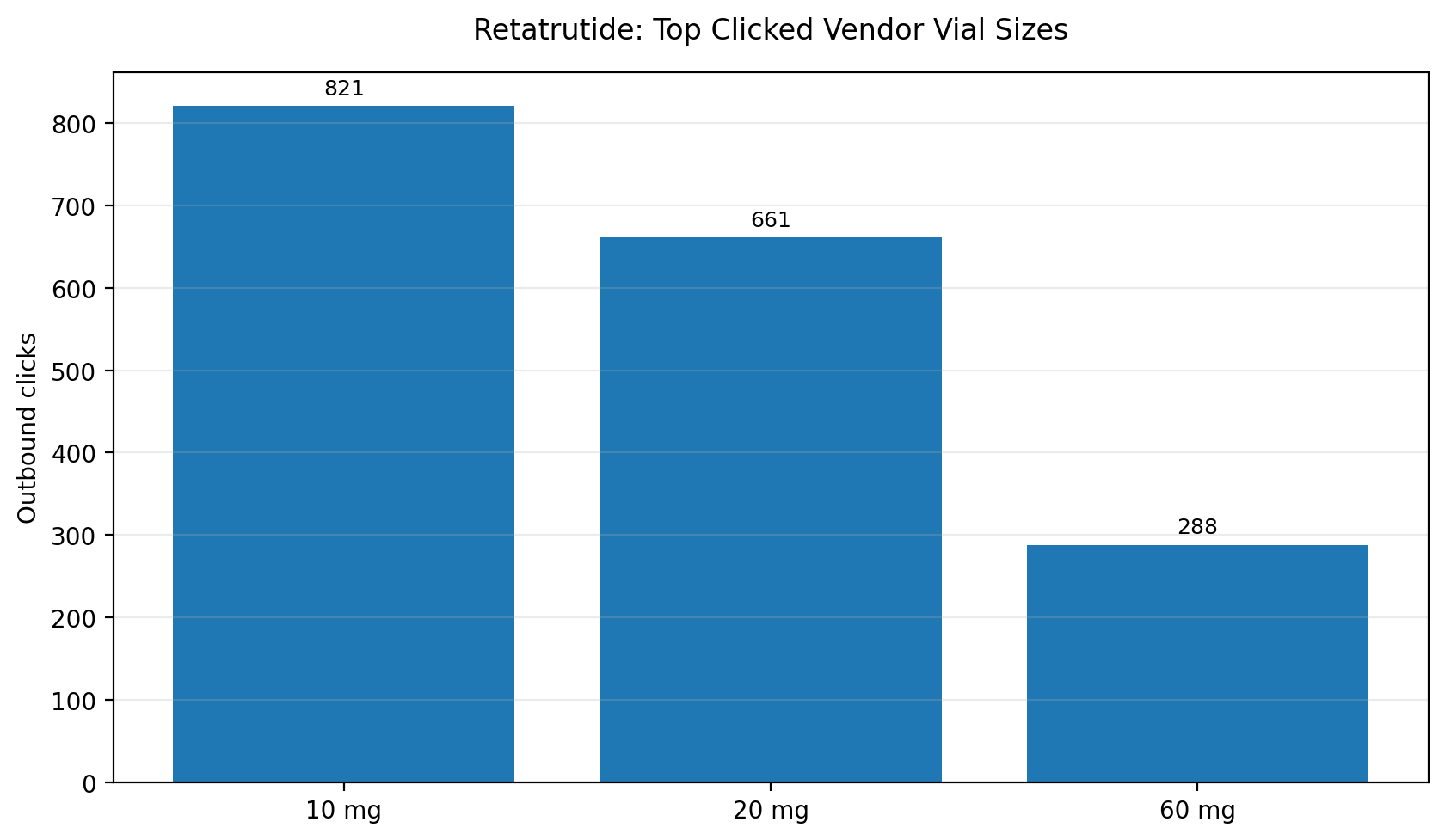
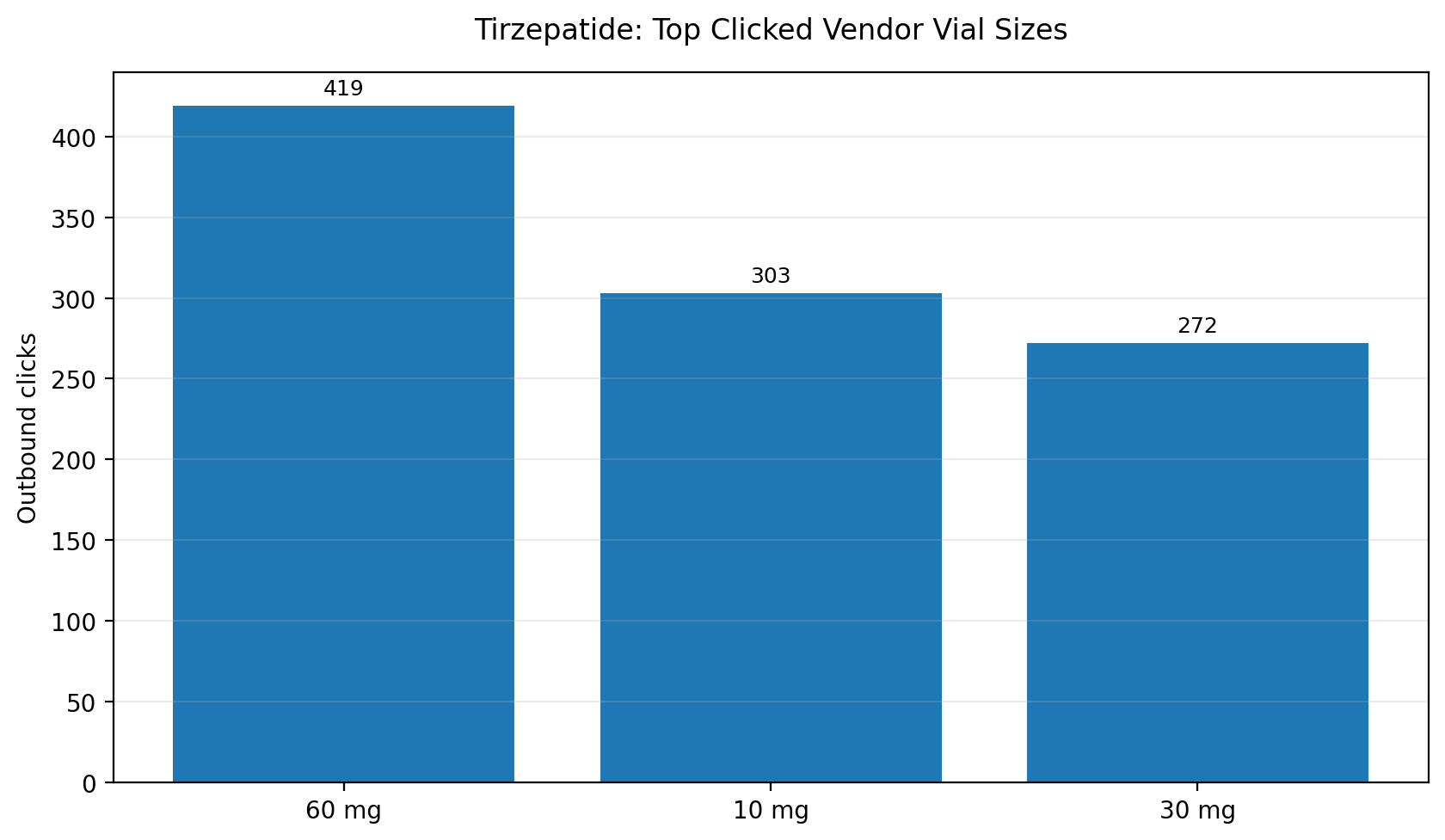
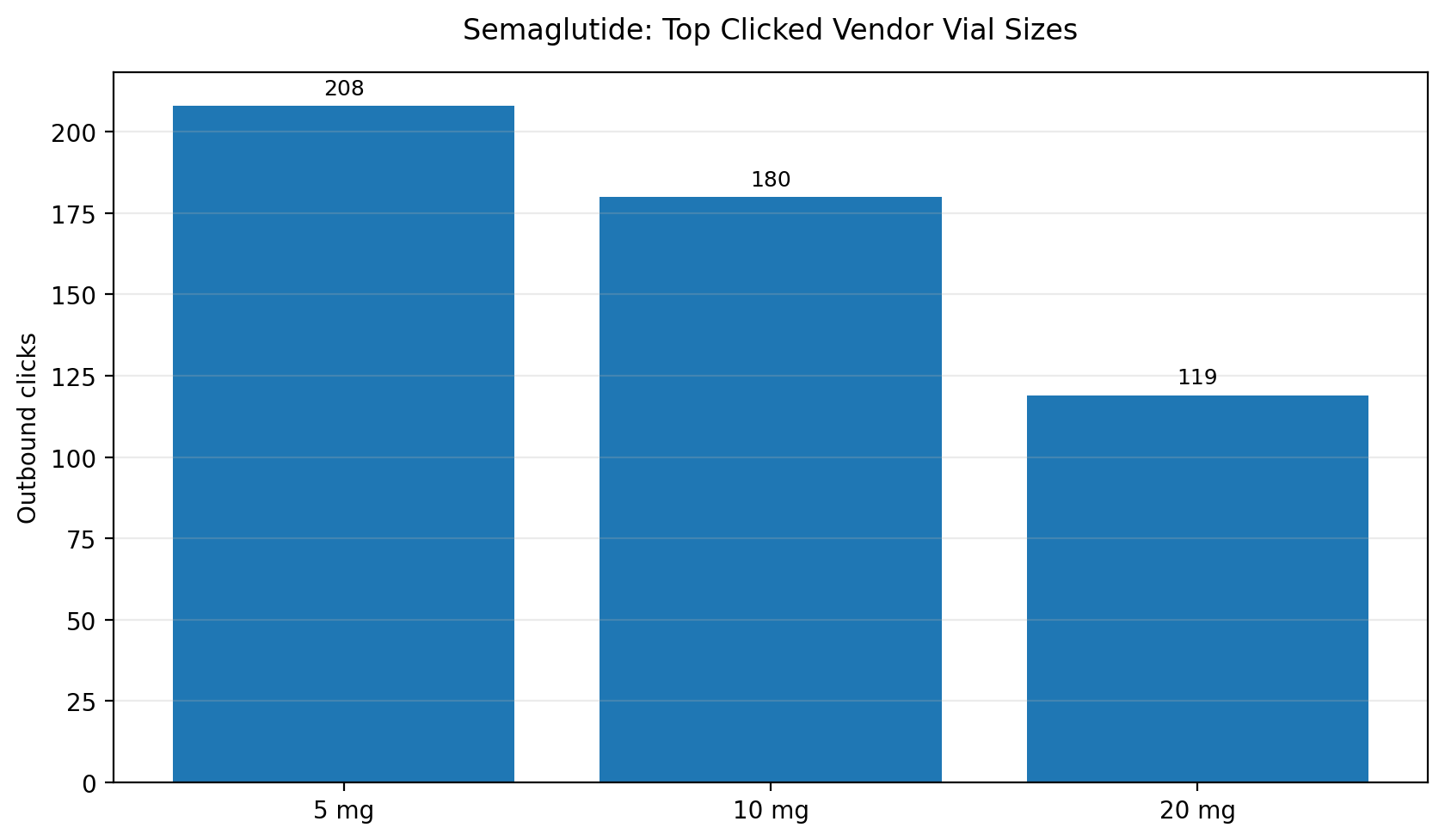
This reinforces three different purchasing-intent patterns:
- Retatrutide clicks concentrate around smaller upfront vial sizes, especially 10mg and 20mg.
- Tirzepatide clicks show the strongest interest in 60mg products, suggesting stronger bulk-value behavior.
- Semaglutide clicks concentrate around 5mg, 10mg, and 20mg, which fits a more mature and cost-conscious market.
Cost-Per-mg vs Cost-Per-vial Behavior
WPA vendor-click data suggests users evaluate price differently depending on the compound.
| Compound | Avg $/mg Percentile | Avg $/vial Percentile | Directional Lean |
|---|---|---|---|
| Semaglutide | 8th | 28th | Strongly value-driven by cost per mg |
| Tirzepatide | 25th | 22nd | Balanced, slight value lean |
| Retatrutide | 36th | 21st | Leans toward lower sticker price per vial |
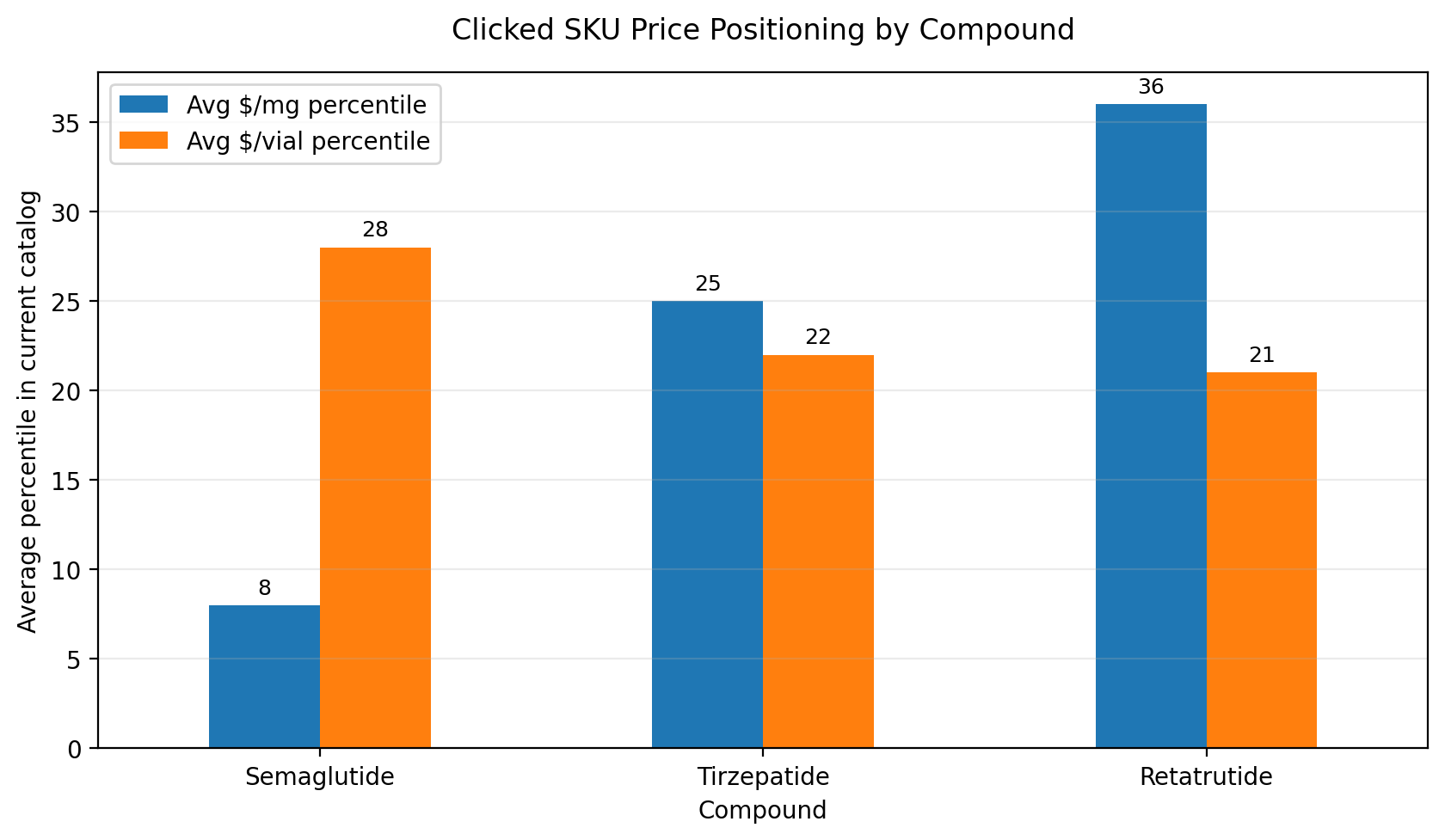
Semaglutide users appear to be the most value-conscious by cost per mg. Retatrutide users lean more toward lower total sticker price per vial, which matches the popularity of smaller retatrutide vial sizes. Tirzepatide sits between the two, with meaningful interest in larger vials such as 60mg.
Data caveat: These price percentiles compare historical clicks against the current live catalog. Because vendor prices can change over time, this should be treated as directional rather than exact.
This is a useful market signal. It suggests that calculator users do not behave the same way across compounds. A semaglutide user may be more sensitive to best cost per mg. A retatrutide user may be more sensitive to upfront vial price. A tirzepatide user may be more willing to evaluate larger bulk vial sizes when unit economics are attractive.
Vial-Size Fragmentation May Signal Market Maturity
Vial-size fragmentation is one of the strongest market-maturity signals in the WPA dataset. Retatrutide has approximately 105 unique vial-size entries. Tirzepatide has approximately 97. Semaglutide has approximately 45.
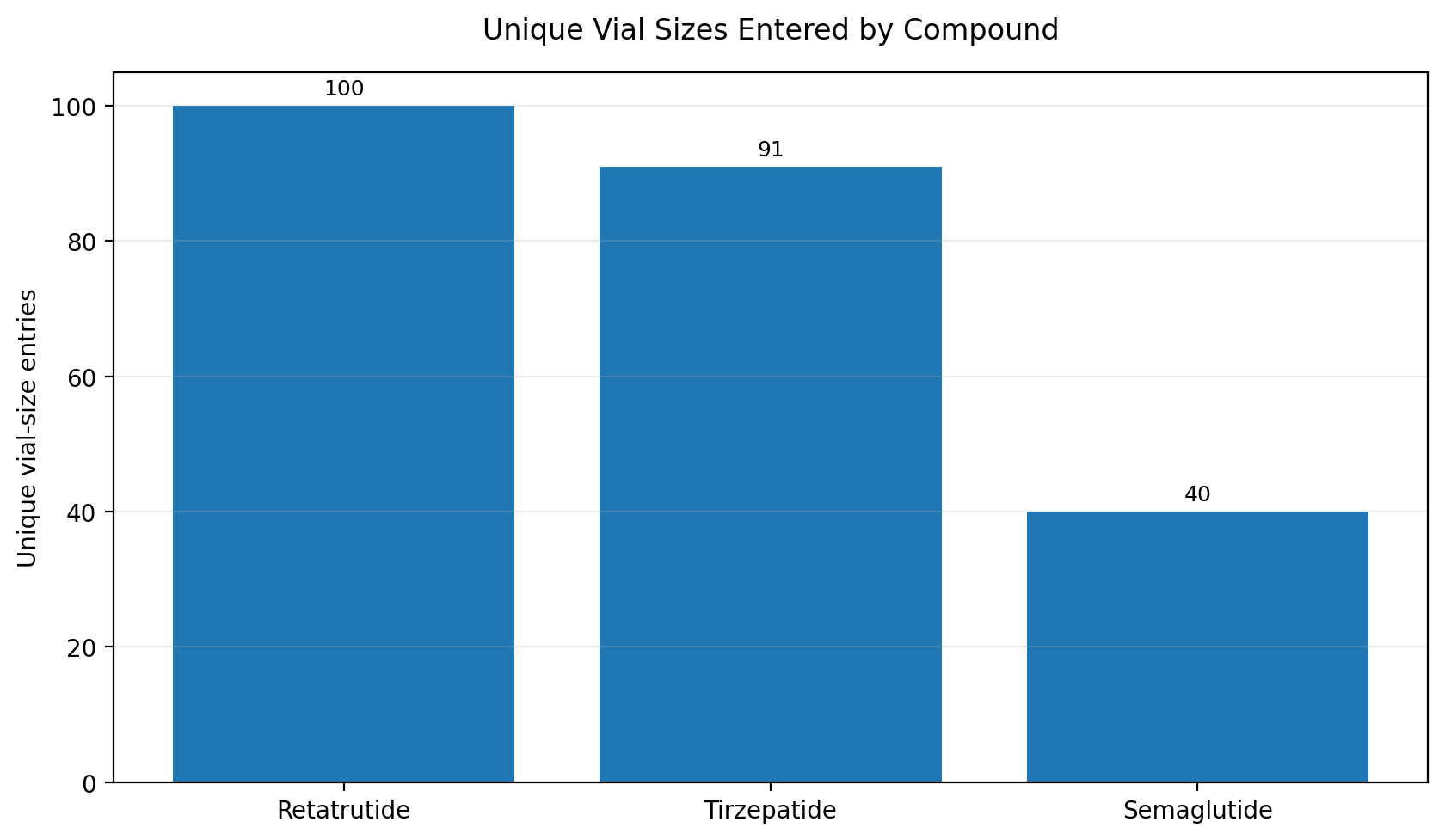
This suggests a possible maturity curve:
- Semaglutide appears more mature and standardized.
- Tirzepatide appears developed but still actively compared across larger vial sizes.
- Retatrutide appears experimental, fragmented, and fast-moving.
This does not mean one compound is more mature or more developed by choice. It means users interact with these compounds differently inside calculator and vendor-comparison workflows.
Watchlist: Lesser-Known GLP-1 and Metabolic Research Compounds
WPA also tracks smaller GLP-1 and metabolic research compounds, including survodutide, liraglutide, and mazdutide. At the time of this report, each of these compounds has fewer than 100 calculator runs, so they are not large enough for a full trend section. However, they are worth monitoring.
As new compounds gain traction, WPA can expand this report without changing the core article architecture. Any compound can graduate into a full section once it crosses a threshold such as 1,000 lifetime calculations or 500 calculations in a rolling 90-day period.
What This Data Can and Cannot Tell Us
WPA calculator data is powerful because it shows what research-use-only users are calculating at scale. It can reveal demand shifts, vial-size preferences, BAC water patterns, dose-selection dispersion, and vendor-comparison behavior. However, the data has clear limits.
- It does not prove that a dose is optimal.
- It does not measure research outcomes.
- It does not establish safety or efficacy.
- It does not verify that a calculator configuration was used in a research setting.
- It does not replace qualified professional judgment, institutional protocols, or applicable laws and regulations.
The value of the dataset is not that it tells users what to do. The value is that it replaces guesswork with aggregated, anonymized calculator behavior.
Methodology
A WPA calculator run is counted when a user enters the required calculator inputs and runs a calculation. Required inputs include compound name, vial size, BAC water amount, desired dose, and unit selection.
A unique session represents a distinct browser or device session. A single session can run multiple calculations, and a single session can calculate more than one compound. Because of that, compound-level unique-session counts do not add up to total unique sessions. Current lifetime unique-session data includes:
| Metric | Value |
|---|---|
| Total unique calculator sessions | 23,670 |
| Retatrutide unique sessions | 10,316 |
| Tirzepatide unique sessions | 2,217 |
| Semaglutide unique sessions | 1,148 |
Pending or unapproved custom compound entries are excluded. Compound-level session counts are based on exact compound names unless otherwise noted. Vendor-click data may include naming variants and blends where specified.
Use the WPA GLP-1 Calculators
Use WPA's GLP-1 calculators to model research configurations across vial size, BAC water volume, desired dose, and unit format.
Compare GLP-1 Research Prices
WPA also tracks GLP-1 research vendors, vial sizes, product availability, pricing, discount codes, and COA-related data across more than 970 products.
Browse the Live Dosing Data
Prefer to browse the raw numbers? All of the statistics in this report come from the live WPA dosing database.
Frequently Asked Questions
What is the most popular GLP-1 compound in WPA calculator data?
Retatrutide is currently the most popular GLP-1-related compound in WPA calculator data. It became the clear monthly leader in April 2026 and accelerated sharply in May and June.
What counts as a WPA calculator run?
A calculator run is counted when a user enters the required calculator inputs and runs a calculation. Inputs include compound name, vial size, BAC water amount, desired dose, and unit selection.
Does WPA calculator data show recommended GLP-1 doses?
No. WPA calculator data shows anonymized research calculator behavior. It does not provide dosing recommendations, prove optimal protocols, or measure research outcomes.
Which GLP-1 compound has the widest vial-size dispersion?
Retatrutide currently has the widest vial-size dispersion among the three major GLP-1 compounds in this report.
What is the most common BAC water volume?
Across WPA peptide calculator data, 2mL is currently the most common BAC water volume entered for reconstitution calculations.
Why does BAC water volume matter in calculator planning?
BAC water volume changes the final concentration per mL. In calculator planning, different reconstitution volumes can change the draw amount required for a selected dose.
Why did retatrutide calculator activity spike in June 2026?
Retatrutide calculator activity rose sharply in June 2026. The timing followed major Phase 3 attention around retatrutide, but WPA calculator data cannot prove causation. WPA continues to monitor traffic sources, session quality, and referral patterns to understand the spike more fully.
How often is this report updated?
WPA updates this report monthly. The strongest evergreen structure is to show lifetime data for authority and monthly or rolling 90-day data for trend movement.
Related guides
Model your own GLP-1 research configuration. Use the free calculators to get exact reconstitution and dosing numbers across any vial size and BAC water volume.
Open the Retatrutide Calculator