Peptide Calculator Mistakes That Can Change Your Syringe Draw
Article last updated: July 2, 2026
A peptide calculator is only as good as the numbers you enter
A peptide calculator looks simple.
You enter a compound. You enter the vial size. You enter how much BAC water is added. You enter the desired dose. Then the calculator gives a syringe draw.
But one small input can change the whole result.
A dose entered in mg instead of mcg can change the math by 1,000x. A vial mixed with too little BAC water can create a tiny draw that is hard to read. A vial mixed with too much BAC water can create a draw that does not fit in one standard syringe.
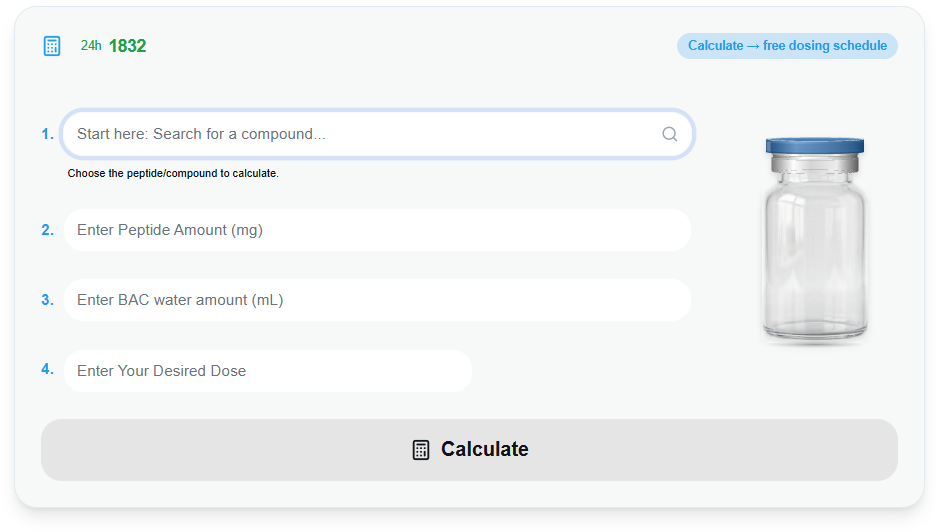
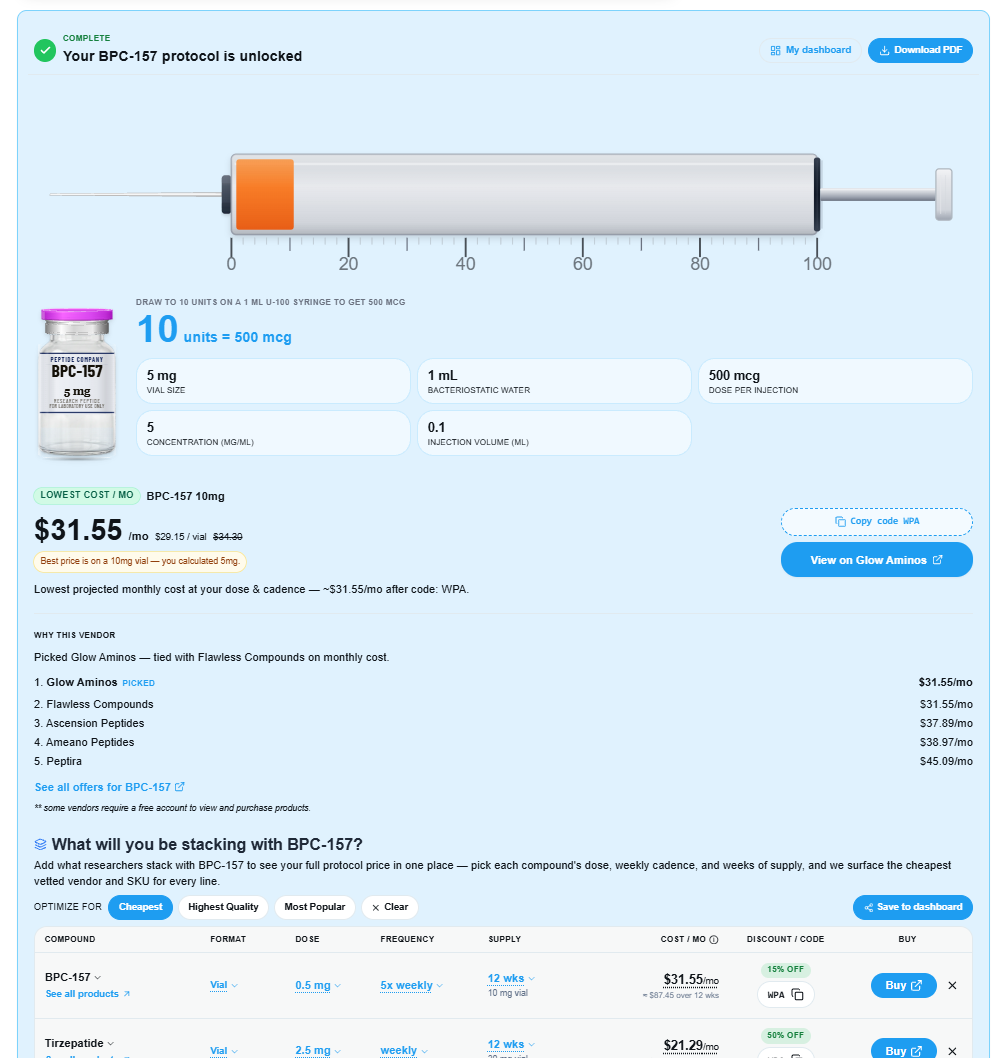
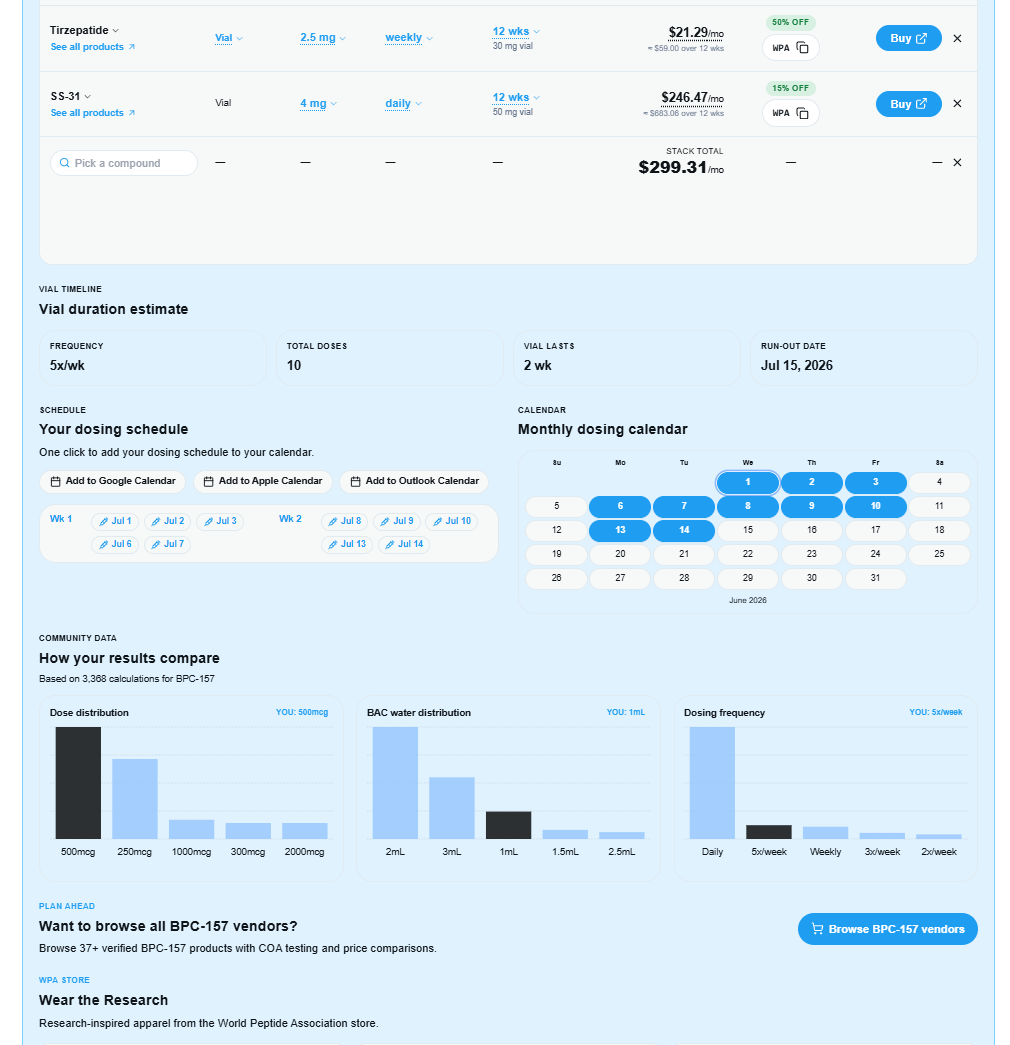
That is why WPA built more than a basic peptide calculator. The WPA calculator shows the math, the syringe view, the draw volume, the concentration, the vial duration, and how the result compares with real calculator data from other research-use-only users.
Research-use only. This article is for educational and research-use-only purposes. WPA calculator data reflects anonymized research calculator inputs and does not provide dosing recommendations, medical advice, or human-use guidance.
Table of Contents
- 01Only as Good as the Numbers You Enter
- 02What WPA Sees in Real Calculator Data
- 03Mistake #1: Mixing Up mg and mcg
- 04Mistake #2: A Draw Too Small to Read
- 05Mistake #3: A Draw That Doesn't Fit One Syringe
- 06Mistake #4: More BAC Water Isn't Always Easier
- 07Mistake #5: Using Too Little BAC Water
- 08Mistake #6: Assuming 2mL Is Always Right
- 09Mistake #7: Ignoring Vial Size
- 10Mistake #8: Thinking Syringe Units Are the Dose
- 11Mistake #9: Copying Someone Else's Setup
- 12How WPA Helps Users Check the Math
- 13The Most Common Vial Sizes in WPA Data
- 14What This Means for Researchers
- 15Popular WPA Calculators
- 16Methodology
- 17FAQ
What WPA sees in real calculator data
This article is not based on guesses. It is based on WPA calculator data.
At the time of this analysis, WPA had more than 91,082 lifetime peptide calculator runs. For this article, WPA reviewed the most recent 30,000 calculator runs and looked for results that may be hard to measure, hard to fit in a syringe, or worth double-checking.
These are not all proven mistakes. WPA cannot know what every user meant to enter. A better name is accuracy flags. An accuracy flag means the result should make the user pause and check the math.
These flags are pulled from the same dataset that powers WPA's dosing data hub, where the full set of vial size, BAC water, and dose trends is broken down compound by compound. For how widely inputs vary in aggregate, see the aggregate reconstitution patterns in WPA's 123,000-entry calculator data study.
In the last 30,000 calculator runs:
- 19.8% returned a tiny draw under 5 units on a U-100 syringe.
- 12.3% returned a draw under 2 units.
- 4.0% returned a draw over 100 units, which is more than a full 1mL U-100 syringe.
- 14.1% returned a large 50-100 unit draw.
- 63.7% triggered at least one review flag, but this includes high-but-plausible 3-5mL BAC water entries.
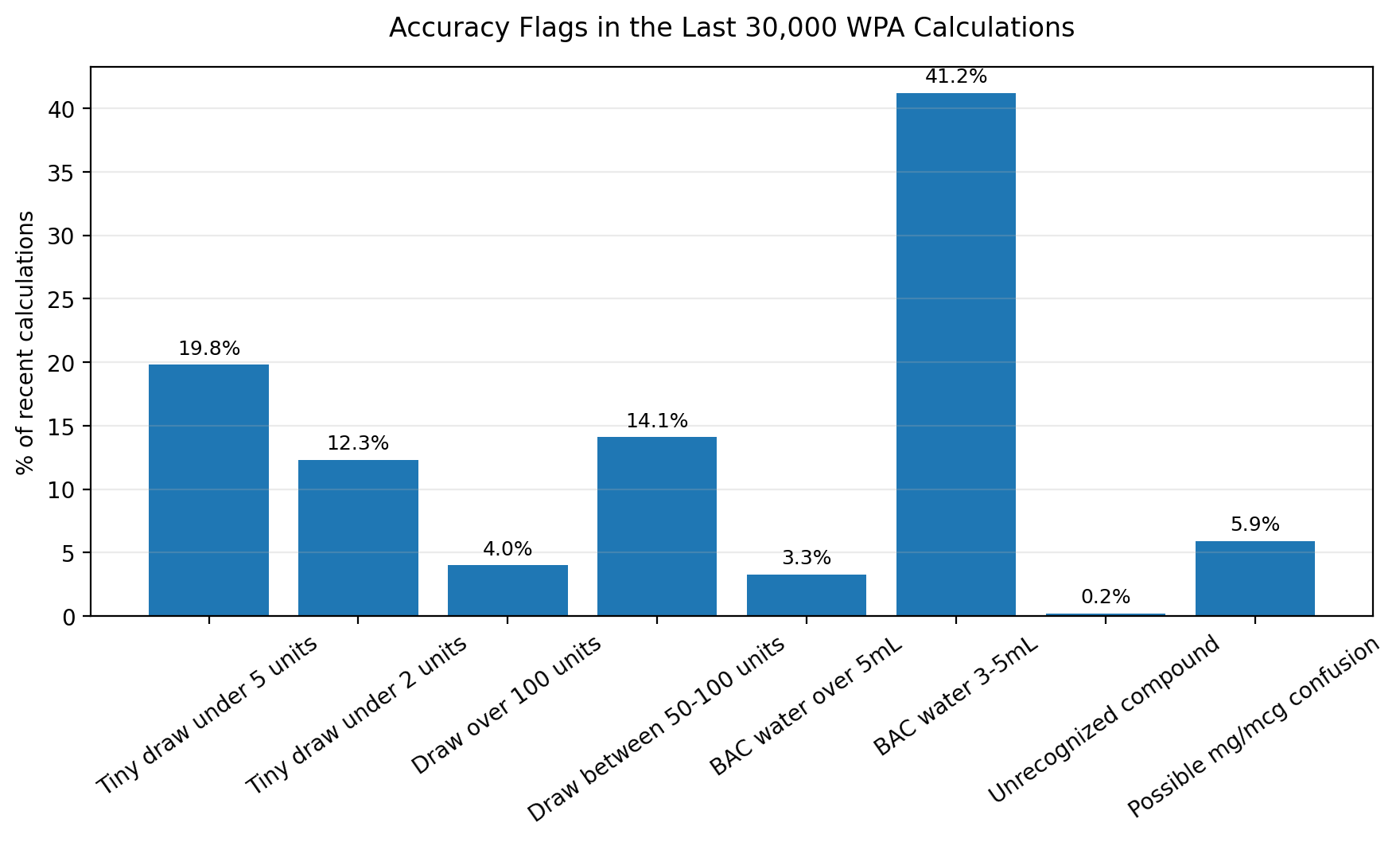
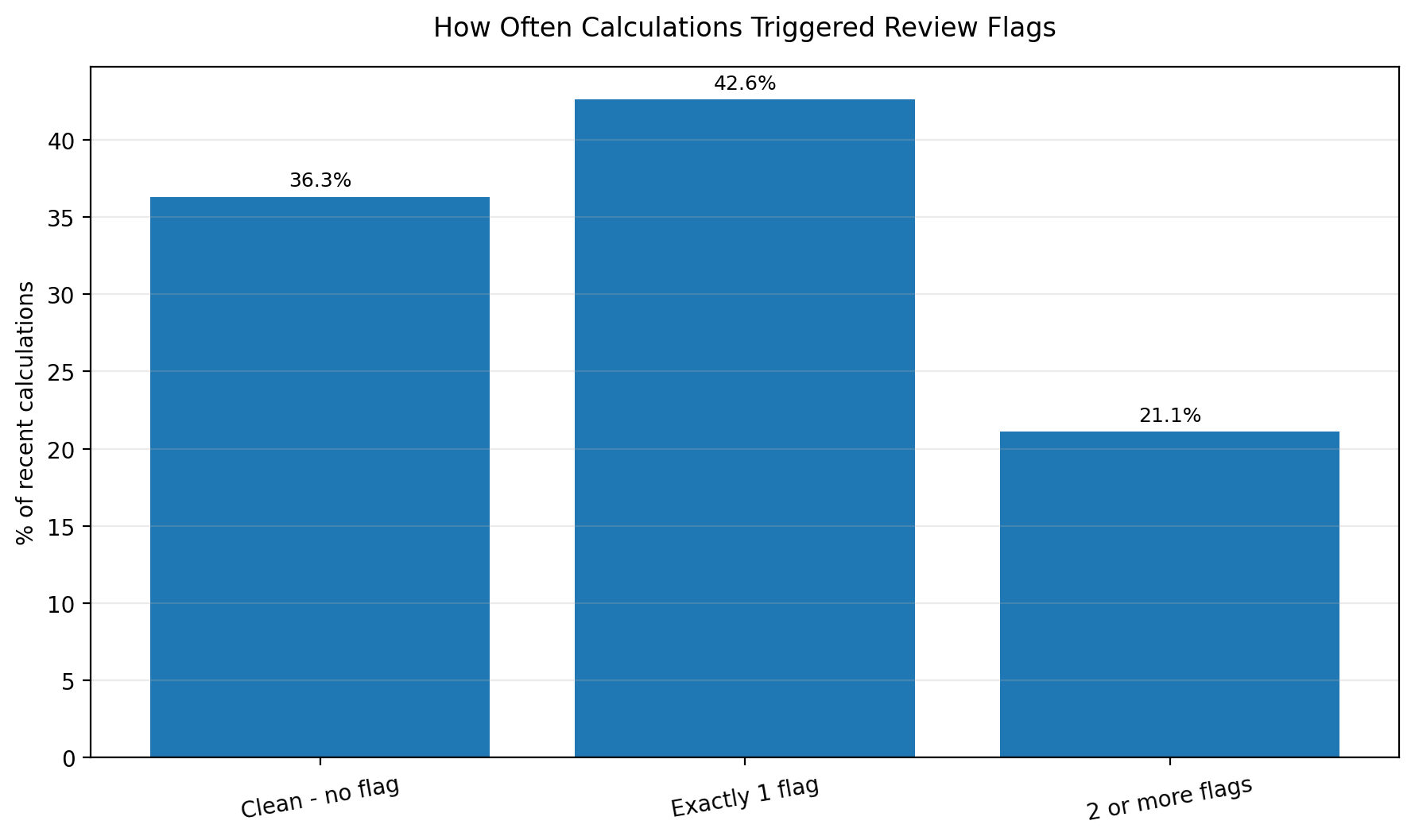
The point is simple: the formula may be easy, but the inputs still matter.
Mistake #1: Mixing up mg and mcg
This is the most important unit mistake.
1 mg = 1,000 mcg.
That means 0.5 mg is the same as 500 mcg. But 500 mg and 500 mcg are not the same thing.
This mistake can make a calculator result look impossible. For example, if a user chooses retatrutide, a 10mg vial, 2mL BAC water, and then enters 1 mcg when they meant 1 mg, the calculator returns about 0.02 units on a U-100 syringe.
That is not a normal draw. It is a red flag.
When a calculator gives a result that is a tiny fraction of one unit, the first thing to check is the unit toggle.
Check the unit first: mg and mcg are 1,000x apart.
Mistake #2: Creating a draw that is too small to read
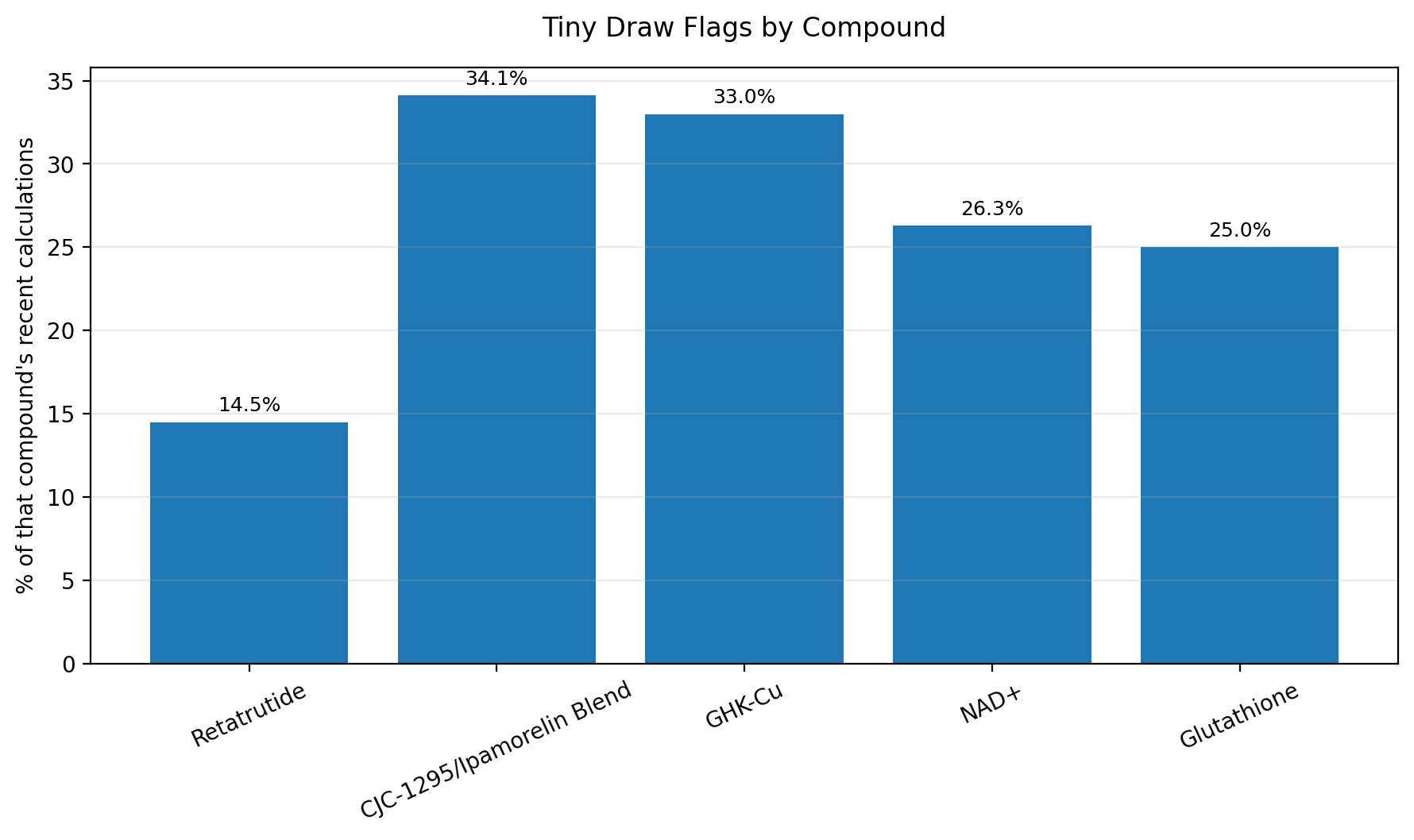
A tiny draw is the most common accuracy flag in WPA data.
In the last 30,000 calculator runs, 5,933 calculations produced a draw under 5 units on a U-100 syringe. That is 19.8% of recent calculations.
Even more important, 3,694 calculations — 12.3% of recent runs — were under 2 units.
A very small draw is easy to misread. On a U-100 syringe, each unit is a small line. When the result is only 2 or 3 units, being off by even a small amount can change the result a lot.
Here is a real common pattern from WPA data:
| Input | Value |
|---|---|
| Compound | GHK-Cu |
| Vial size | 100mg |
| BAC water | 3mL |
| Desired dose | 1mg |
| Concentration | 33.3mg/mL |
| Draw volume | 0.03mL |
| Syringe draw | 3 units |
Three units is very small. That does not mean the math is wrong. It means the input setup created a draw that may be hard to read. When a result comes back this small, the BAC water amount and the dose unit are the first two inputs to re-check.
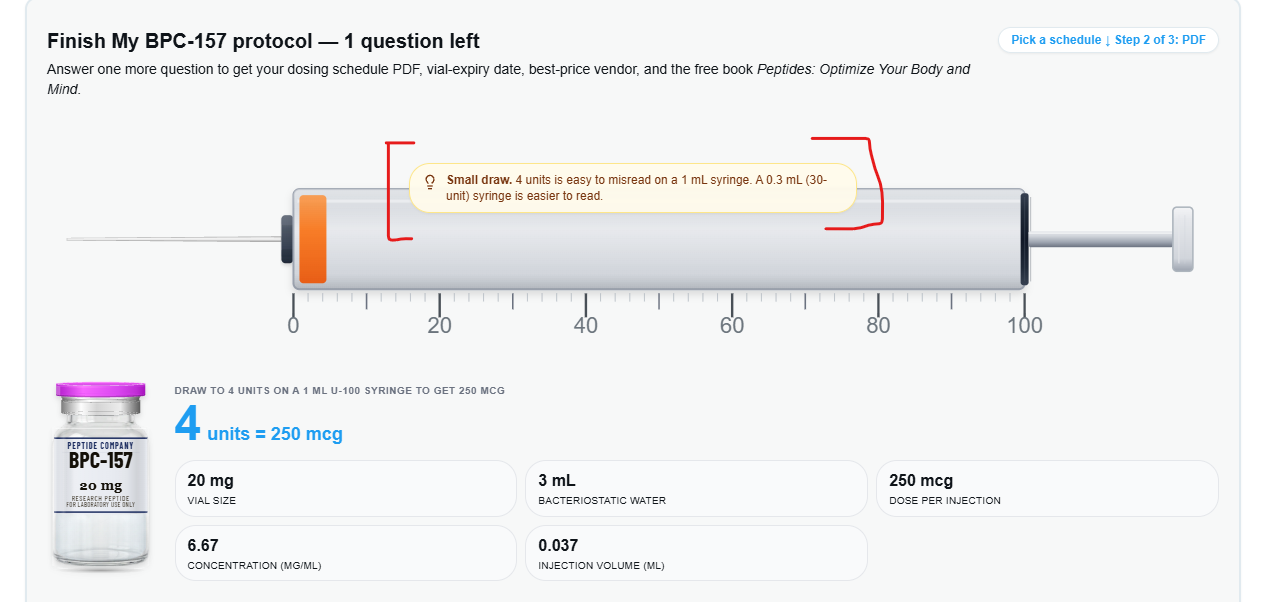
WPA does not just return a number. When a draw is small, the calculator shows a warning above the syringe output and notes that a smaller syringe may be easier to read — so the user understands the number, not just receives it. See WPA's syringe size guide for a side-by-side look at 0.3mL, 0.5mL, and 1.0mL barrels.
Mistake #3: Creating a draw that does not fit in one syringe
The opposite problem also happens.
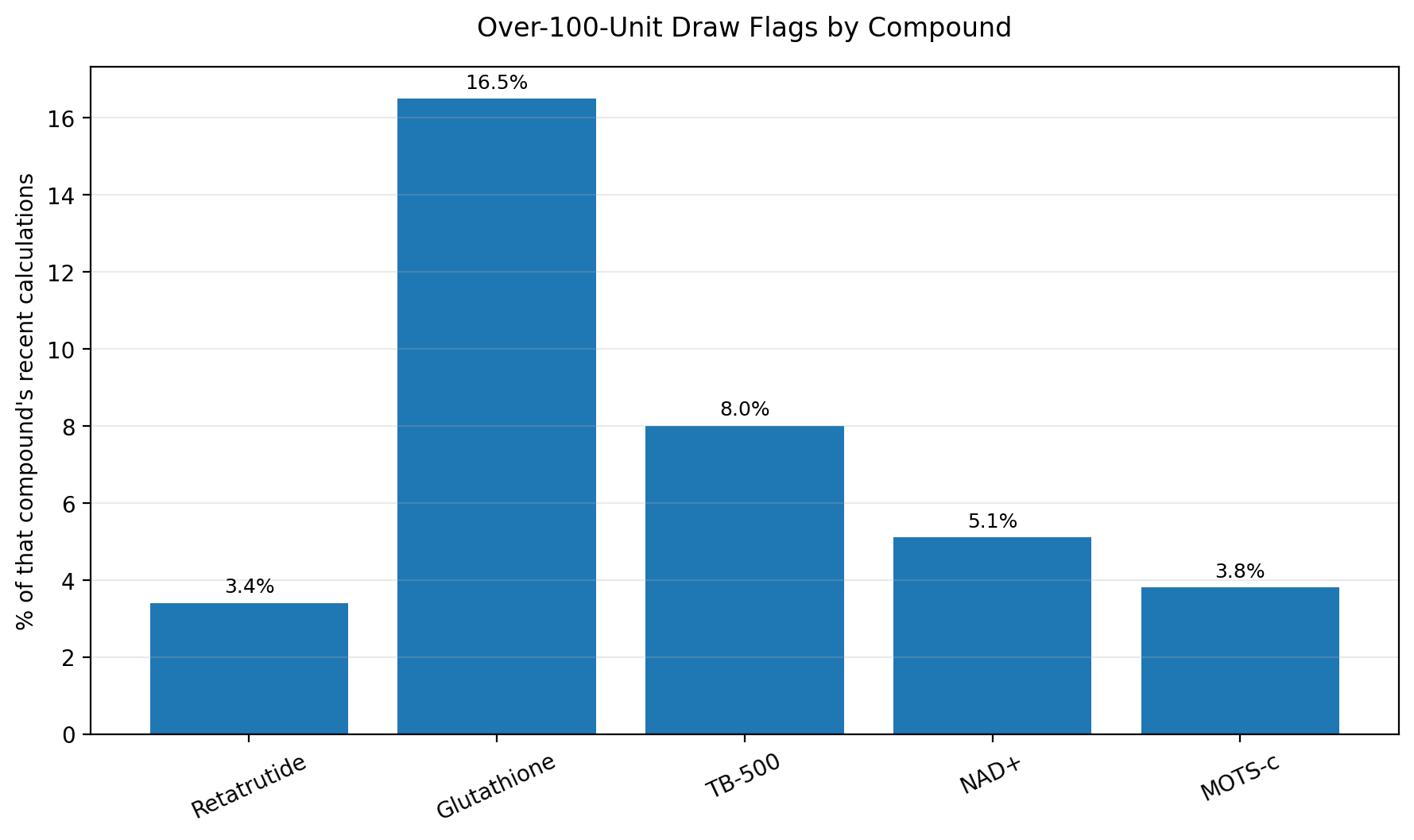
A standard 1mL U-100 syringe holds 100 units. If the calculator returns more than 100 units, the draw is larger than one full syringe.
In the last 30,000 calculator runs, 1,189 calculations returned a draw over 100 units. That is 4.0% of recent calculations.
Another 4,235 calculations returned a draw between 50 and 100 units. Those fit in a 1mL syringe, but they are still large.
Here is a common example:
| Input | Value |
|---|---|
| Compound | Retatrutide |
| Vial size | 10mg |
| BAC water | 3mL |
| Desired dose | 4mg |
| Concentration | 3.33mg/mL |
| Draw volume | 1.2mL |
| Syringe draw | 120 units |
The desired dose did not change. The issue is the liquid volume needed to carry that dose. A 120-unit result is bigger than a standard 1mL U-100 syringe. When a result is over 100 units, the BAC water input is the first thing to re-check.
Mistake #4: Thinking more BAC water always makes things easier
More BAC water lowers the concentration. That means the same dose takes up more liquid.
Sometimes that helps. Sometimes it creates a draw that is too large.
Here is the clearest example:
Same compound. Same vial. Same desired dose. Only the BAC water changes.
| Retatrutide Example | Concentration | Draw volume | Syringe units | Result |
|---|---|---|---|---|
| 10mg vial + 1mL BAC water + 4mg dose | 10mg/mL | 0.4mL | 40 units | Comfortable |
| 10mg vial + 2mL BAC water + 4mg dose | 5mg/mL | 0.8mL | 80 units | Fits, but large |
| 10mg vial + 3mL BAC water + 4mg dose | 3.33mg/mL | 1.2mL | 120 units | Does not fit one 1mL syringe |
The dose never changed. The water changed the draw. That is the thing to check: not whether more water sounds easier, but what draw each water amount actually creates.

Mistake #5: Using too little BAC water
Too little BAC water can create the other problem: the solution becomes very concentrated, and the draw becomes tiny.
Tiny draws are hard to read because small syringe-line errors matter more.
This is why a good calculator should not only say:
Draw 3 units.
It should help the user understand:
This is a small draw. Check the inputs. A different syringe size or reconstitution volume may make the result easier to read.
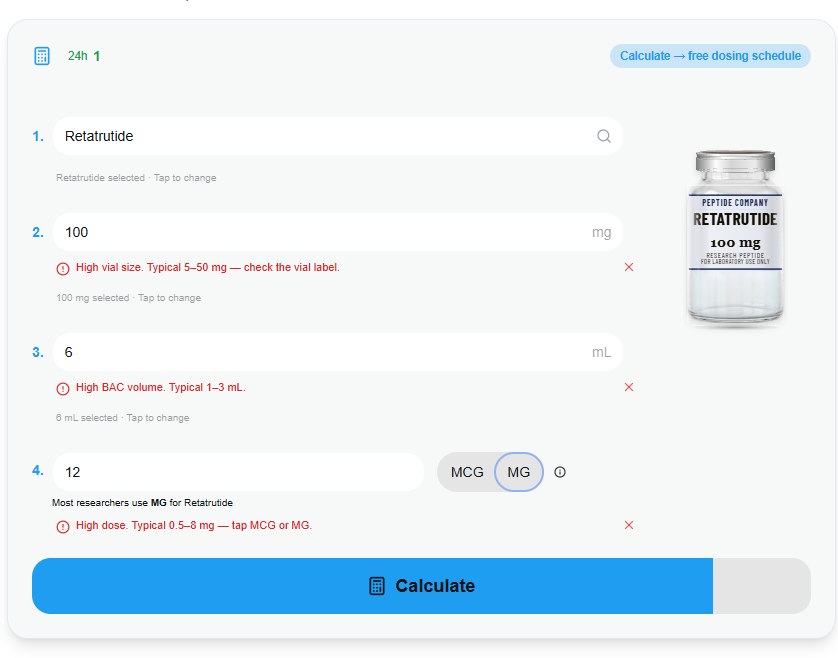
WPA compares calculator inputs against typical compound-specific ranges and shows a red warning when a value looks unusual — before the user relies on the result.
Mistake #6: Assuming 2mL is always the right BAC water amount
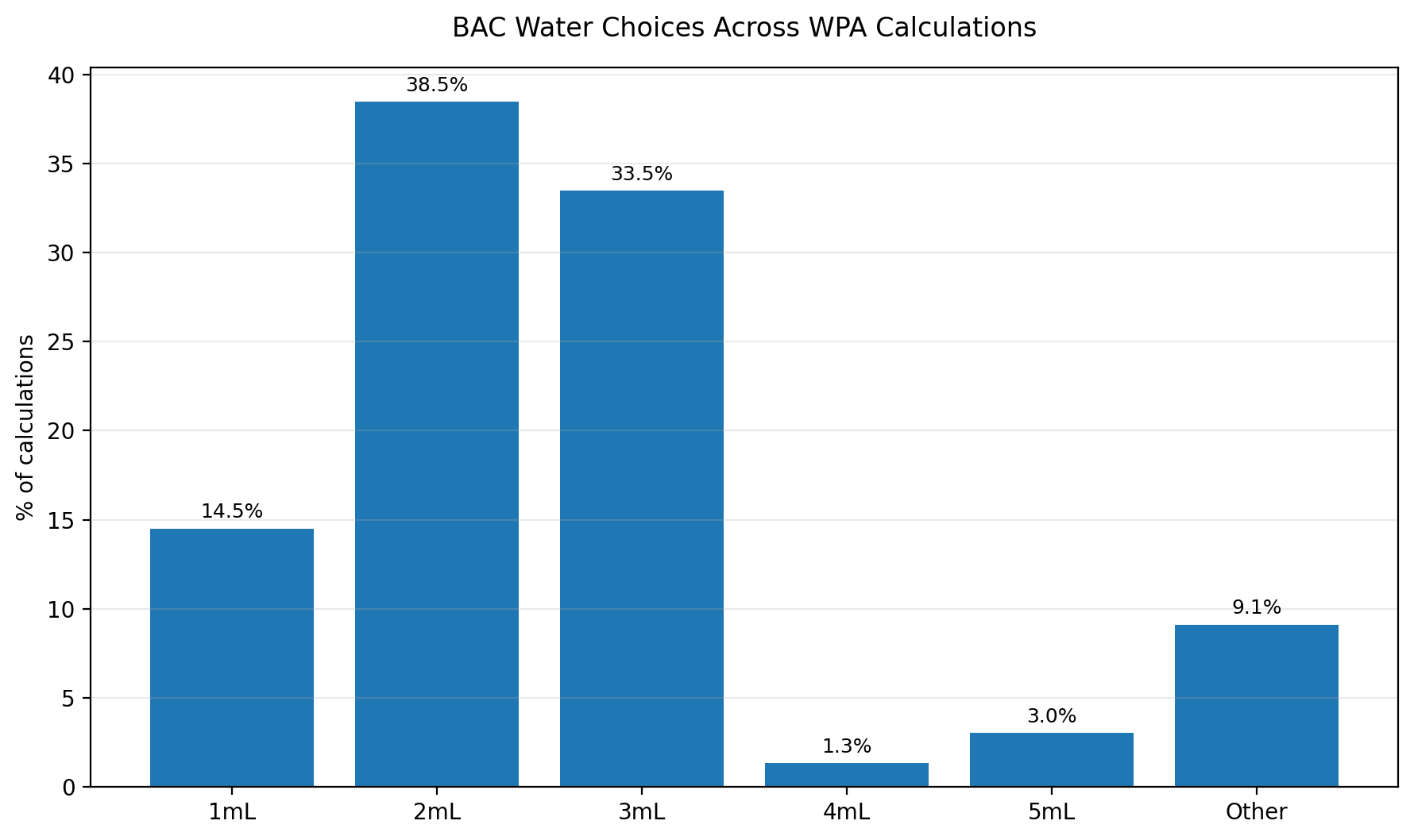
Across WPA data, 2mL is the most common BAC water amount. But that does not mean 2mL is always the right calculator input.
WPA production data shows:
| BAC water amount | Share of calculations |
|---|---|
| 2mL | 38.5% |
| 3mL | 33.5% |
| 1mL | 14.5% |
| Other | 9.1% |
| 5mL | 3.0% |
| 4mL | 1.3% |
2mL and 3mL together account for about 72% of all calculations. They are the most common choices. But the better question is not "What is most common?"
The better question is:
What vial size, dose, and syringe draw does this water amount create?
For a step-by-step walkthrough of mixing itself, see the WPA peptide reconstitution guide.
Mistake #7: Ignoring vial size
Vial size changes everything.
A 5mg vial and a 100mg vial do not behave the same way in the calculator.
WPA data shows a clear pattern: as vial size goes up, users are more likely to choose more than 2mL of BAC water.
| Vial size bucket | % using more than 2mL BAC water |
|---|---|
| 0-5mg | 26.8% |
| 6-10mg | 31.0% |
| 11-20mg | 35.5% |
| 21-30mg | 50.0% |
| 31-50mg | 60.9% |
| 51-100mg | 74.6% |
| 100mg+ | 84.8% |
The crossover happens around the 21-30mg bucket. At that point, more than 2mL becomes the majority choice.
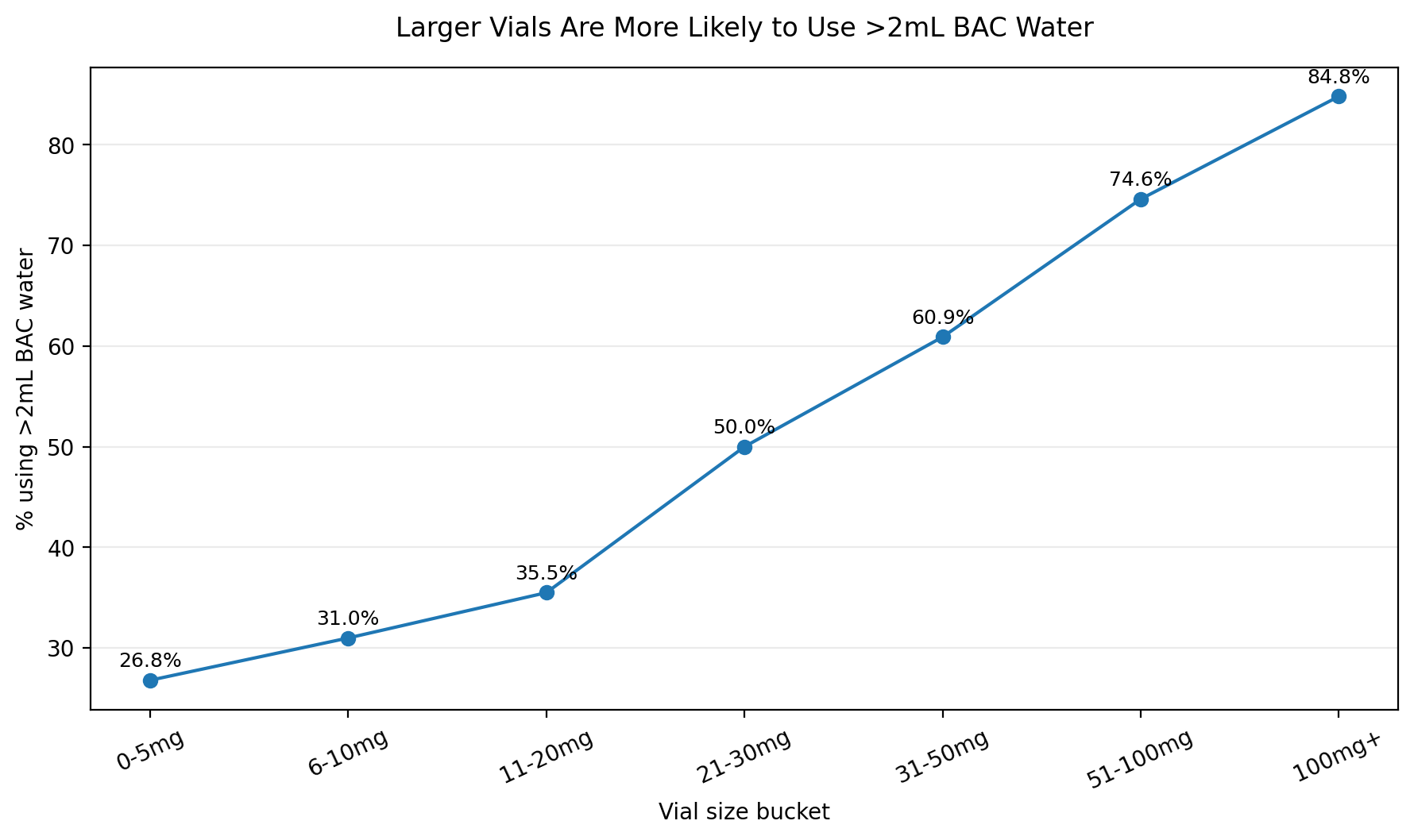
The reason is simple. Bigger vials usually need more planning. If the vial has a lot of compound and very little water, the result can become too concentrated. If the vial has too much water, the result can become too large to draw in one syringe.
A good peptide calculator should help users see that tradeoff before they rely on the result. For a deeper breakdown of how vial size and BAC water choices track together, see the reconstitution volume data on WPA's dosing data hub.
Mistake #8: Thinking syringe units are the dose
Syringe units are not the same as peptide amount.
Units show liquid volume. The actual amount depends on concentration.
That means 10 units can mean different things depending on the vial size and BAC water amount.
For example:
- 10 units from a 5mg vial mixed with 1mL BAC water is not the same as 10 units from a 20mg vial mixed with 1mL BAC water.
- The syringe line is the same.
- The concentration is different.
- The amount in the draw is different.
So a unit number on its own does not tell you how much compound is in the draw. It only makes sense next to the concentration.
This is why WPA shows the full chain:
vial size → BAC water → concentration → draw volume → syringe units
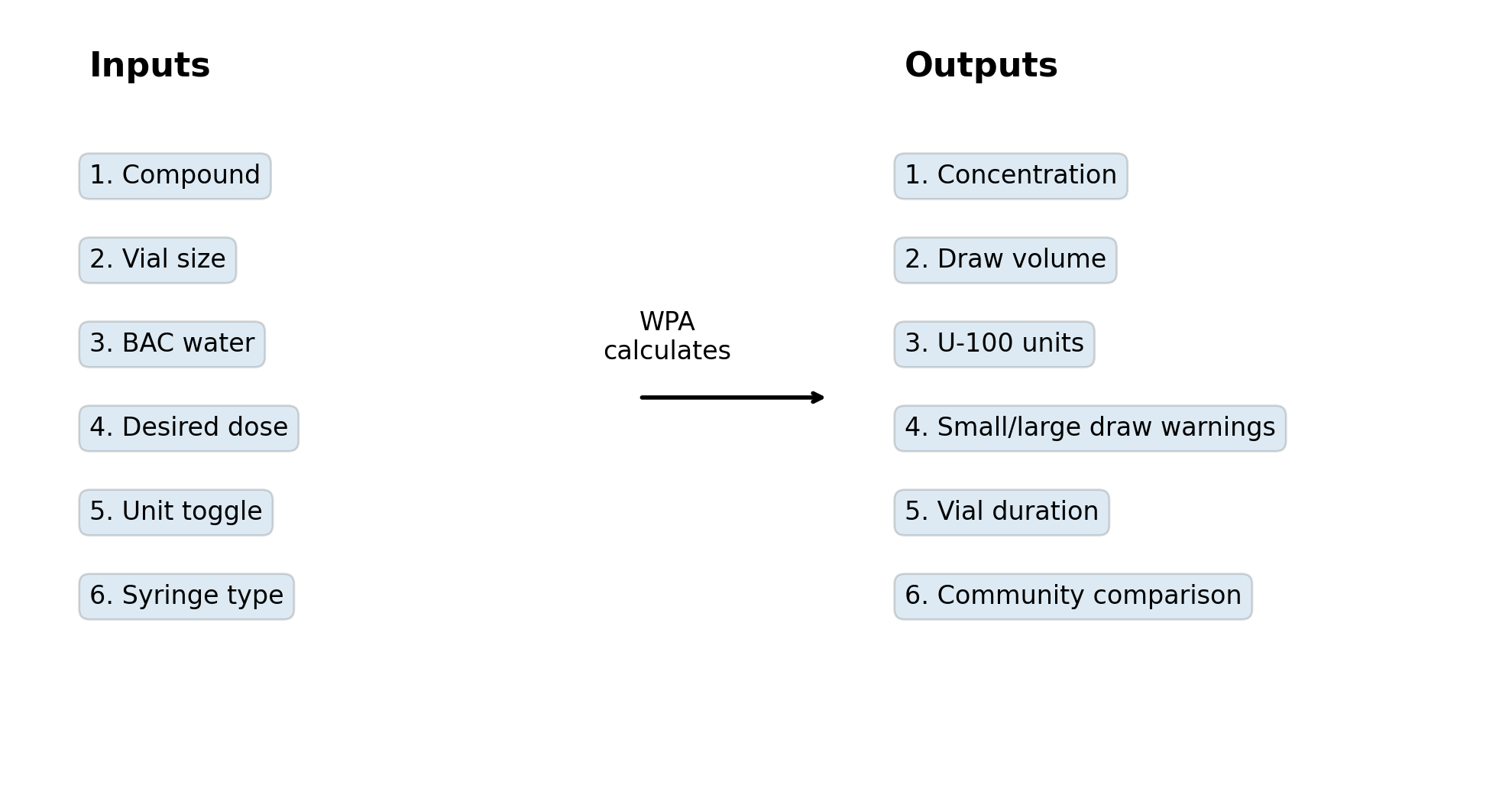
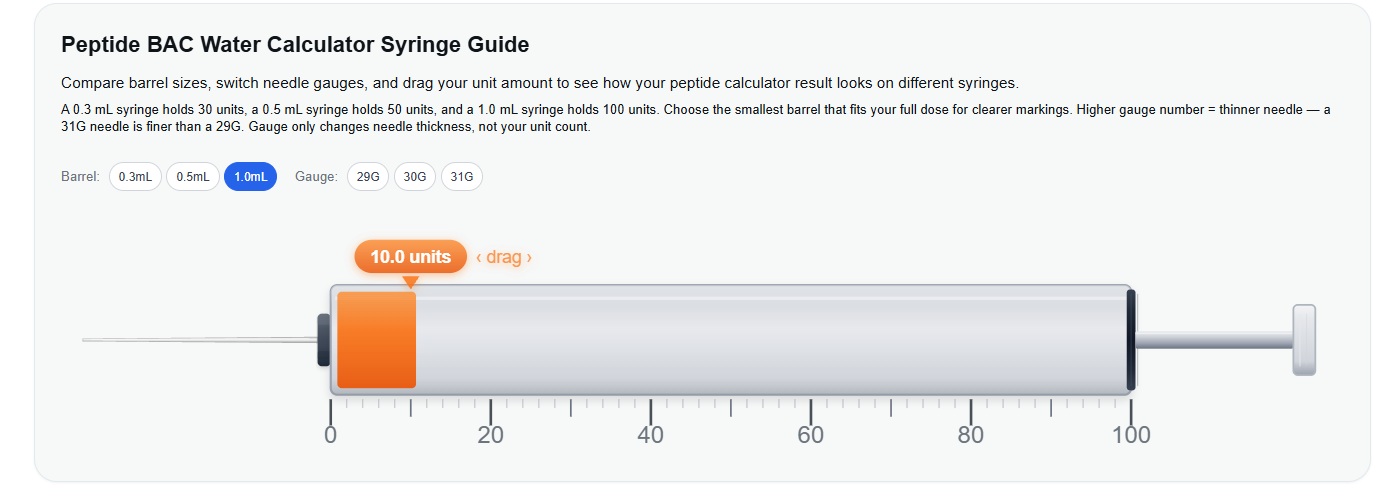
Most calculators show a result. WPA also visualizes the draw on a realistic syringe and helps users understand which barrel size — 0.3mL, 0.5mL, or 1.0mL — makes the result easiest to read.
Mistake #9: Copying someone else's setup
This may be the most common real-world problem.
A user sees a setup online and copies it:
- same compound
- same dose
- same water
- same syringe units
But one hidden input may be different.
The vial size may be different. The BAC water amount may be different. The unit may be mg instead of mcg. The syringe may be different. The research cadence may be different.
That is why copying a comment from Reddit, YouTube, or a forum can be risky. The only setup that matters is the one based on the actual vial, actual BAC water amount, actual target dose, and actual syringe type.
WPA helps solve this by turning the user's own inputs into a full research planning output. New to peptides in general? WPA's beginner guide walks through building a plan from your own inputs instead of copying someone else's.
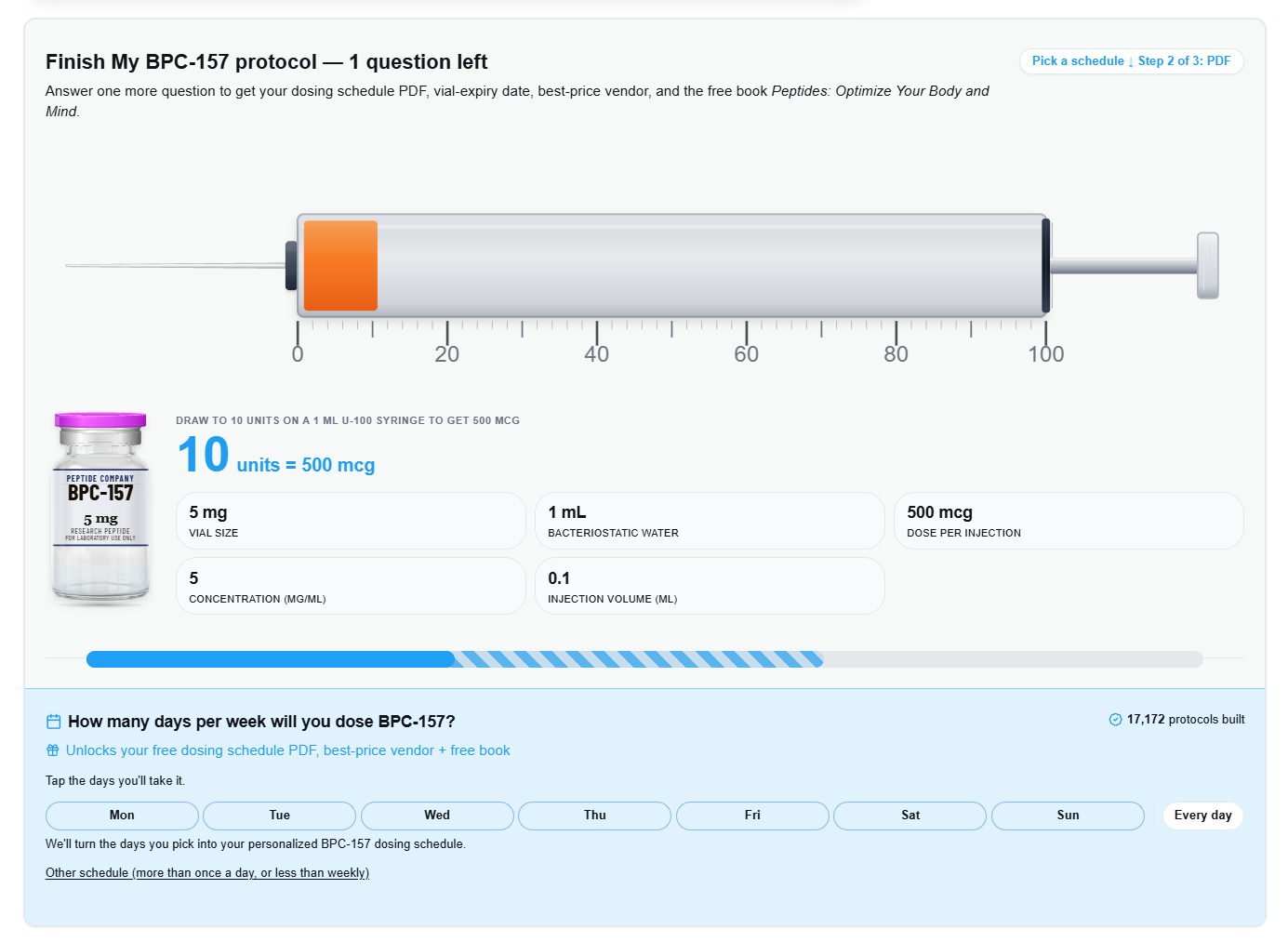
How WPA helps users check the math
Most peptide calculators stop after one number.
WPA goes further.
After a calculation, WPA can show:
- concentration
- injection volume
- U-100 syringe units
- small-draw warnings
- input range warnings
- vial duration
- expected run-out date
- research schedule
- calendar reminders
- community comparison data
- vendor options
This matters because the draw amount is only one part of the full research planning picture. Running more than one compound? WPA's stack planner extends this same math across a multi-compound schedule.
The most common vial sizes in WPA data
Vial size is one of the biggest drivers of calculator results.
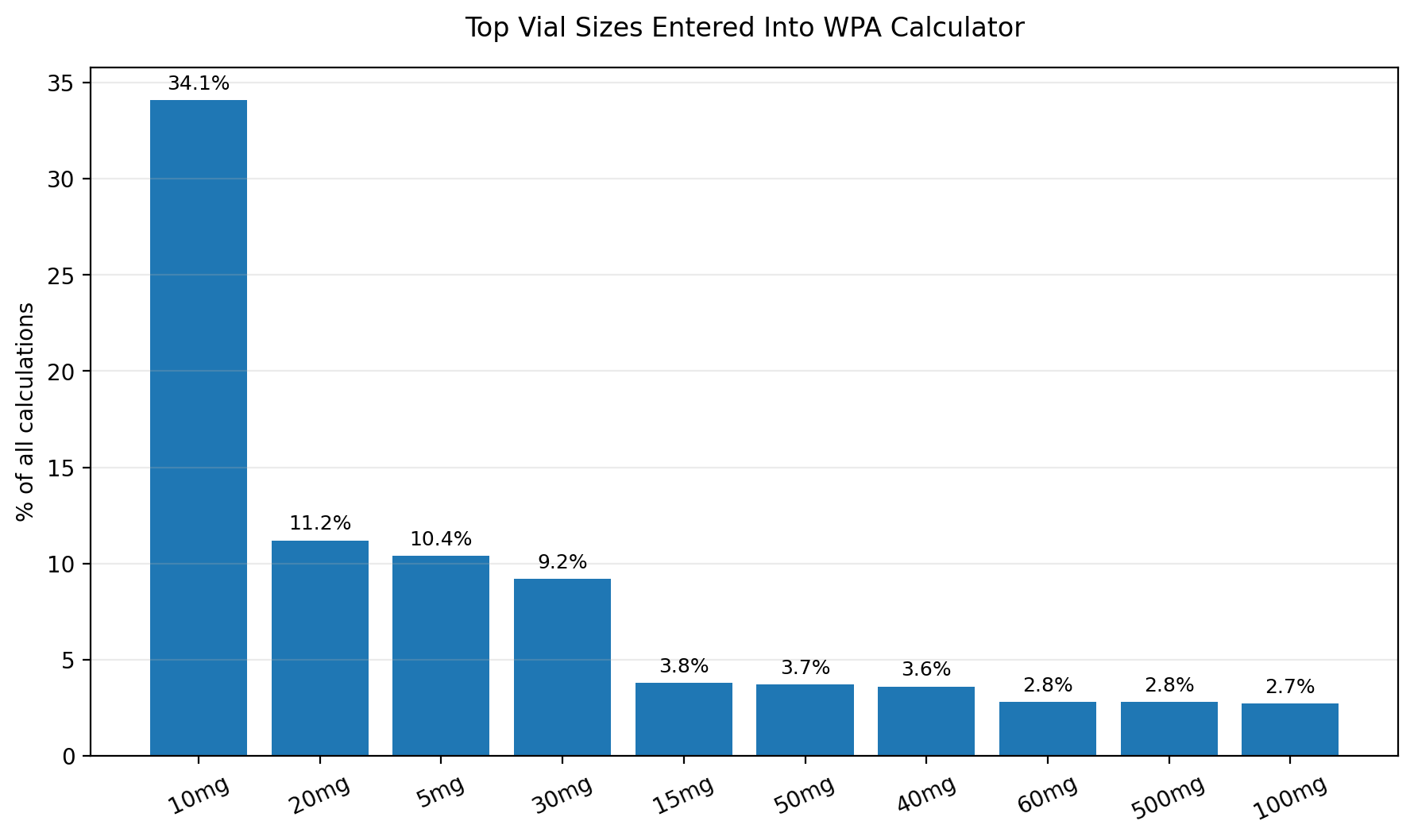
Across WPA production data, 10mg is the most common vial size by far.
| Rank | Vial size | Share of calculations |
|---|---|---|
| 1 | 10mg | 34.1% |
| 2 | 20mg | 11.2% |
| 3 | 5mg | 10.4% |
| 4 | 30mg | 9.2% |
| 5 | 15mg | 3.8% |
| 6 | 50mg | 3.7% |
| 7 | 40mg | 3.6% |
| 8 | 60mg | 2.8% |
| 9 | 500mg | 2.8% |
| 10 | 100mg | 2.7% |
The top four sizes — 10mg, 20mg, 5mg, and 30mg — account for about 65% of all calculations.
What this means for researchers
The main lesson is simple.
A calculator result is not just one number.
It is the result of a chain:
Compound → vial size → BAC water → concentration → desired dose → syringe units
When one part of the chain is off, the final draw can be too small, too large, or physically hard to measure.
That is why WPA built the calculator around both math and context. The math gives the result. The context helps users see whether the result makes sense.
Check your peptide calculation before you rely on it
Enter the compound, vial size, BAC water amount, and desired dose to see concentration, draw volume, and syringe units.
Open the WPA Peptide CalculatorPopular WPA calculators
For compound-specific questions, WPA also has dedicated calculators for the most popular research compounds:
Comparing products for a research compound?
Browse WPA's vetted vendor directoryMethodology
This article uses anonymized WPA calculator data.
The accuracy audit reviewed the most recent 30,000 calculator runs out of 91,082 lifetime calculations. A calculator run is counted when a user enters the required calculator inputs and runs the calculation.
The audit looked for review flags such as:
- syringe draw under 5 units
- syringe draw under 2 units
- syringe draw over 100 units
- syringe draw between 50 and 100 units
- BAC water over 5mL
- BAC water between 3mL and 5mL
- unrecognized custom compound names
- possible unit confusion
These are not all proven mistakes. Some flagged values are valid in certain research contexts. For example, 3-5mL BAC water can be normal for larger vials or high-mass compounds. The purpose of a review flag is to show where a result may deserve extra attention.
Frequently Asked Questions
What is the most common peptide calculator mistake?
The most common accuracy flag in WPA's recent calculator data is a tiny draw under 5 units on a U-100 syringe. This showed up in 19.8% of the most recent 30,000 calculator runs.
Why is a draw under 5 units a problem?
A draw under 5 units can be hard to read because the syringe marks are very close together. A small reading error can have a bigger effect when the total draw is tiny.
What does it mean if my calculator result is over 100 units?
A standard 1mL U-100 syringe holds 100 units. A result over 100 units means the calculated liquid volume is more than one full 1mL syringe.
Is 2mL always the right amount of BAC water?
No. 2mL is the most common BAC water amount in WPA calculator data, but the right calculator input depends on vial size, desired dose, and the resulting draw volume.
What is the difference between mg and mcg?
1mg equals 1,000mcg. Mixing up mg and mcg can change a calculator result by 1,000x.
Are syringe units the same as peptide dose?
No. Syringe units measure liquid volume. The amount of peptide in that liquid depends on concentration, which depends on vial size and BAC water volume.
Why does BAC water change the syringe draw?
BAC water changes concentration. More water lowers concentration and creates a larger draw for the same dose. Less water raises concentration and creates a smaller draw for the same dose.
Does WPA calculator data provide dosing advice?
No. WPA calculator data reflects anonymized research calculator inputs. It does not provide dosing recommendations, medical advice, or human-use guidance.
Where can I run a peptide calculation?
You can use the WPA Peptide Calculator on the homepage, or use one of WPA's compound-specific calculators for popular research compounds.
All content on this page is for educational and research-use-only purposes. Nothing here constitutes medical advice, dosing guidance, or a recommendation for human use. Calculator trends reflect anonymized user inputs and should not be interpreted as safety, efficacy, or outcome data.