NAD+ 500 mg Vial Cost: Prices, Discount Codes and Shipping
Ten WPA listings show why the vial price is only part of the comparison.
Peptira’s 500 mg NAD+ listing was 21 cents cheaper than Southern Aminos’ in our September 29 review of WPA’s comparison page: $50.15 versus $50.36. But add the shipping charge shown for each, and the order flips. The sums become $65.14 and $59.36—a $5.78 difference in Southern Aminos’ favor.
That is a useful reason to look past the first price you see. It is also a reason to keep the comparison narrow. These are research-use-only vial listings, not prices for a clinic visit, an infusion or a prescribed treatment.
We reviewed ten listings labeled 500 mg on the WPA NAD+ vendor comparison page. Here, 500 mg is the amount stated on the vial label, not a treatment dose. The listed item prices ranged from $40.49 to $80.99. Below, we show what those records say, how shipping changes the comparison, and why a lab report needs more than a quick glance at a percentage.
Compare 500 mg NAD+ prices and discount codes
The table uses WPA’s listed prices and discount codes in US dollars, checked on September 29, 2026. The page said its prices had been updated three days earlier. These are WPA’s recorded offers; seller checkout prices and code eligibility may differ.
Affiliate disclosure: The vendor names below are WPA affiliate links. WPA may earn a commission if you buy through them, at no additional cost to you.
| Vendor | Code / listed saving | Discounted vial | Shipping | Price + shipping* |
|---|---|---|---|---|
| Modified Aminos | WPA · 10% ($4.50) | $40.49 | $9.95 | $50.44 |
| Peptira | WPA · 15% ($8.85) | $50.15 | $14.99 | $65.14 |
| Southern Aminos | WPA · 15% ($8.89) | $50.36 | $9.00 | $59.36 |
| Flawless Compounds | WPA · 15% ($10.35) | $58.65 | $14.95 | $73.60 |
| Glow Aminos | WPA · 15% ($10.35) | $58.65 | $14.95 | $73.60 |
| Ameano Peptides | WPA · 10% ($6.80) | $61.20 | $10.00 | $71.20 |
| EZ Peptides | WPA10 · 10% ($6.80) | $61.20 | $10.00 | $71.20 |
| LA Peptides | WPA · 10% ($7.50) | $67.49 | $9.99 | $77.48 |
| Omega | WPA · 10% ($8.60) | $77.39 | $8.00 | $85.39 |
| Felix Chem | WPA10 · 10% ($9.00) | $80.99 | $12.50 | $93.49 |
One vial in one order, assuming the listed shipping charge applies. The last column is simple addition, not a verified checkout total. It excludes tax and any other charges or location-based changes.
Savings are the difference between WPA’s displayed regular and discounted vial prices. The discount is already included; do not subtract it again. Codes and savings are recorded offers, not a promise of checkout eligibility.
Several vendor links open an account or age-verification page. Peptira’s link also redirects to a different product path, so confirm the 500 mg option before comparing it. Omega’s site showed a temporary sale below WPA’s recorded price during our check; its row remains the WPA snapshot, not a current lowest-price claim.
The highest listed item price was $40.50 above the lowest. That is a price difference within these ten records—not evidence that one vendor’s product is better, worse or interchangeable with another’s. All ten labels say 500 mg, but that alone does not establish matching formulations or testing.
How shipping changes the comparison
The Peptira–Southern Aminos example makes the trade-off easy to see:
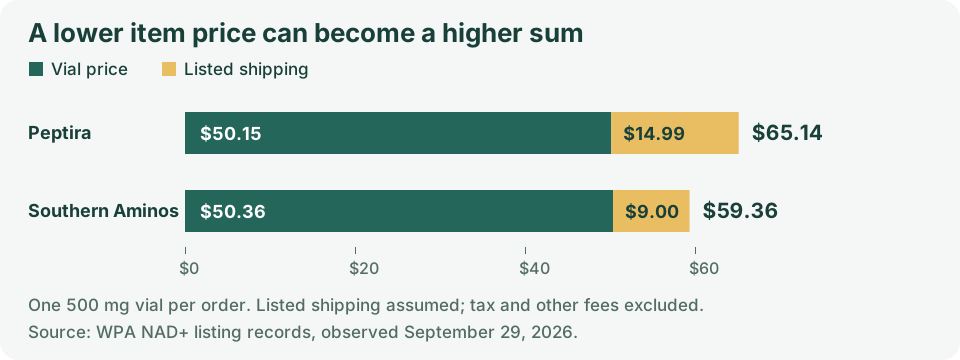
$50.15 vial + $14.99 shipping
$65.14
$50.36 vial + $9.00 shipping
$59.36
Peptira’s item price is $0.21 lower, while its listed shipping is $5.99 higher. After adding both charges, Southern Aminos has the lower illustrative sum by $5.78.
WPA listed a $250 free-shipping threshold for both. A single vial at either recorded price falls below that threshold. A larger order could change the shipping charge, so this example does not settle every basket or destination.
For a fair comparison, hold the order size steady. Start with one 500 mg vial, add the shipping charge that applies to that order, then check tax and any other fees at checkout. If you compare larger orders, run the calculation again. Do not treat a conditional free-shipping offer as the shipping price for every order.
What an NAD+ lab report tells you about the vial
Price tells you what a listing costs. A certificate of analysis, or COA, records test results for a sample. To use it well, first ask what the lab actually tested.
A purity percentage answers a different question
NAD+ is a coenzyme, not a peptide. A coenzyme helps enzymes carry out chemical reactions. The scientific database ChEBI identifies NAD+ as a coenzyme. That distinction matters when reading results on a site that also lists peptides. Janoshik’s NAD+ analysis service specifically tests identity and amount; it says peptide purity is not measured in that service because NAD is not a peptide.
So a blank peptide-purity field does not, by itself, mean no NAD+ testing was done. Equally, a displayed percentage does not tell you how many milligrams were found in the tested sample. Read the actual report and its test description.
Labeled amount and measured amount are different
Keep these three details separate:
- Labeled amount: what the product listing says the vial contains.
- Measured amount: what the lab found in the sample it tested, if an amount test was done.
- Report scope: which tests were performed and which results are absent.
A report for one sample does not establish the contents of every vial. Nor should an identity-and-amount result be read as a result for a different test, such as sterility. For the broader steps—checking the issuer, report number and batch details—see WPA’s guide to reading a COA.
WPA reports that its team reviews available vendor COAs and website information when mapping listings to compounds. That documentary work helps explain the comparison page. This article’s own check was narrower: we inspected the public listing records and calculated the price examples. We did not independently test products or authenticate the current batch reports for these ten listings.
Where to compare current NAD+ vendor listings
The most useful next step is to look at price, shipping and the report together. A low item price is easy to spot. A useful comparison also needs the same labeled amount, the relevant order charges and a clear view of what the testing covers.
Open the NAD+ vendor comparison page to review the current listings, recorded codes and COA details. Use the 500 mg rows when comparing this size, then confirm the seller’s current product and order terms. WPA reports testing code application at checkout as part of its process; this article did not repeat those checkout checks.
NAD+ vial cost FAQ
Why are clinic NAD+ prices different from research-vial prices?
A clinical service and a research-material listing are different purchases. A service price may include care and administration; the vial records here price research material. This table does not measure treatment cost or establish that a research vial is suitable for personal use. Compare what is included before treating two prices as alternatives.
Do two 250 mg NAD+ vials cost the same as one 500 mg vial?
They add up to the same labeled amount, but the order can cost more or less. Add the prices of both 250 mg vials, then apply the shipping charge for that order once. Compare that sum with the 500 mg order. If you use two different sellers, include shipping for each order. The arithmetic does not establish that the products have the same formulation or testing.
Use the NAD+ vendor comparison page to compare the current 250 mg and 500 mg listings, codes and shipping terms side by side.
Could a result above 500 mg mean a lower cost per milligram?
Yes, it could—if the greater amount is consistent across the vials being compared and the price is the same. If the material also met the same research needs, you would be getting more NAD+ for that price.
The missing piece is consistency. A single vial that tests at 589 mg, for example, does not show that the next vial contains 589 mg. That number is a hypothetical example, not a result from this comparison. For research-use-only products, a sample result should not be treated as a promise of identical fill in every vial. One test cannot tell you how much the amount varies across a batch.
Testing multiple vials can help assess that variation. Janoshik describes a separate within-batch variance test using multiple samples of the same product and batch. That evidence can help assess consistency in the batch tested; it does not guarantee every future vial.
That is why this table compares the labeled 500 mg amount and keeps measured amounts separate. Review the batch match and the testing behind any claim of consistent extra content; one high result alone is not enough.
How we made this comparison
On September 29, 2026, the WPA NAD+ page showed 14 vendors and 21 vial listings across four labeled sizes: 100, 250, 500 and 1,000 mg. That wider catalog included an out-of-stock 1,000 mg listing. For this article, we selected all ten visible single-vial listings labeled 500 mg. We excluded other vial sizes, nasal products and kits. None of these ten rows showed an out-of-stock tag at that check. We copied the listed discounted item prices and shipping charges, then added them using exact decimal arithmetic. The sums assume the listed one-order shipping charges apply; no free-shipping discount is used.
These are WPA listing observations, not a survey of every NAD+ supplier or a guarantee of current stock, code eligibility or checkout totals. The price range in this article covers only the ten 500 mg records. It is different from the page’s wider range across vial sizes. Prices and terms can change.
This analysis compares listed costs and explains report limits; it does not endorse a vendor or recommend a treatment.
Prepared with AI assistance from public source records.