What happens to MOTS-c when you exercise? In small human studies, researchers have seen levels of this body-made peptide rise during or after a workout. In a separate line of research, mice given MOTS-c performed better in running tests.
Those findings explain the interest in MOTS-c and exercise. To understand the results, follow what each study measured: changes in the body's own peptide, or performance after treatment. We will look at both, then use WPA's 10 mg listings to show how vial amounts, prices and test reports compare.
What is MOTS-c?
MOTS-c is a peptide made of 16 amino acids. A peptide is a short chain of the small units that also make proteins. Its genetic instructions sit in mitochondrial DNA. Mitochondria help cells turn fuel into usable energy.
Early cell and mouse studies linked MOTS-c to systems that sense and manage energy. That gave researchers a reason to explore its role during exercise, when the body's energy needs change. Lee et al., 2015
What do human exercise studies show?
The human studies below asked people to exercise, then measured MOTS-c already present in their bodies.
In a 2021 cycling study of 10 healthy, sedentary young men, blood MOTS-c reached 1.6 times its starting level during exercise and 1.5 times afterward, returning to the starting level after four hours. If the starting level counts as 1, a level of 1.5 adds another half: a 50% rise in blood MOTS-c. Reynolds et al., 2021
A separate study of 30 people, split among endurance exercise, resistance exercise and a control group, found a trend toward higher MOTS-c after endurance exercise. The result was statistically uncertain. The clearer increase involved humanin, a different peptide. von Walden et al., 2021
A 2026 study gave this question a different setting: 45 minutes of exercise for adults and adolescents, including adults with cerebral palsy. The adults with cerebral palsy used running frames; the other groups ran without them. Horwath et al., 2026
Frame running uses a three-wheeled frame that supports the runner and helps with balance. Picture a bike with a saddle but no pedals: the runner moves it forward with their feet on the ground. This makes running possible for people who need that support. World Abilitysport: frame running
The researchers compared MOTS-c levels before and after the workout. Of the 43 people enrolled, 35 had usable before-and-after MOTS-c measurements. Across those samples, levels were about 17% higher on average one hour after exercise. Horwath et al., 2026
Together, these studies suggest that MOTS-c is part of the body's response to exercise. The size and timing of the change varied with the people, workouts and tests used. That makes the study details useful when comparing results.
Researchers are also tracing where the MOTS-c in blood comes from. Another 2026 study looked for a net release from the working leg: more MOTS-c leaving the leg in blood than entering it. The team found no detectable net release under the tested conditions, leaving the source of the exercise-related blood changes an open question. Gudiksen et al., 2026
What did MOTS-c do in mice?
Reynolds and colleagues gave 18 old mice daily MOTS-c injections for two weeks and compared them with 19 old mice that did not receive MOTS-c. The mice then faced a treadmill test that became faster in stages. On average, the treated group ran about twice as long before exhaustion. Reynolds et al., 2021
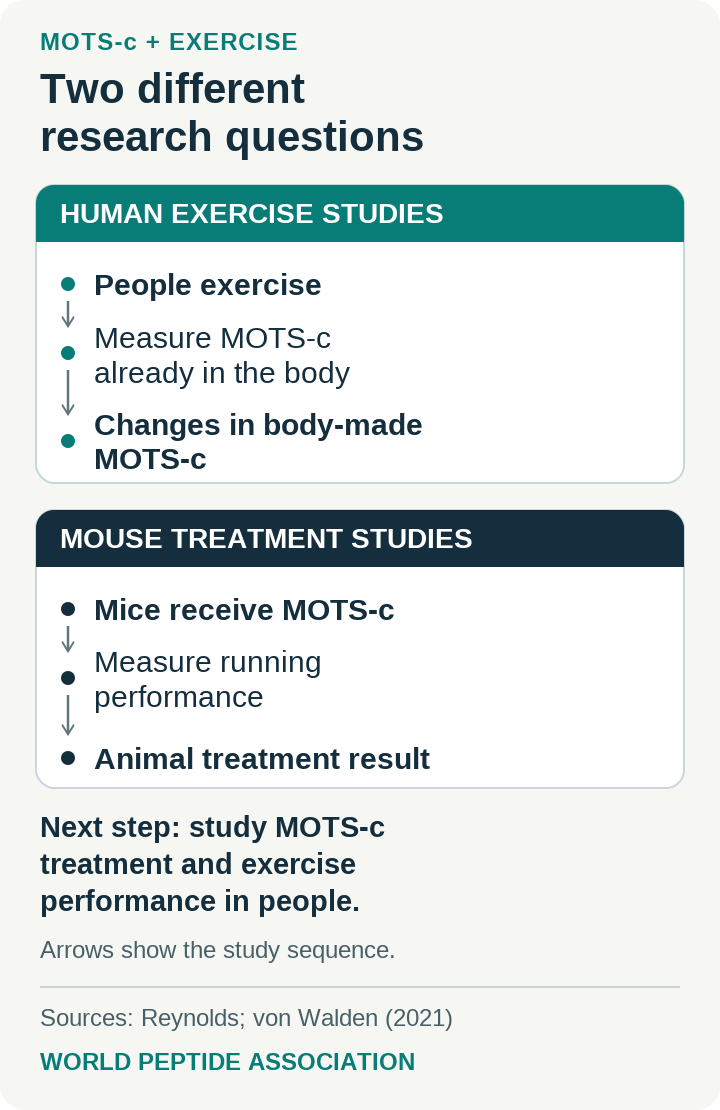
This experiment tested a performance outcome after treatment. The human exercise studies above tracked a molecule after a workout. Keeping that sequence in view makes the two lines of research easier to follow.
Can MOTS-c replace exercise?
MOTS-c has not been shown to replace exercise in people. Its effects on endurance, muscle growth and body fat remain open research questions. The next step is human treatment research that measures those outcomes directly.
Human treatment research is also exploring metabolism—how the body handles fuel. A registered trial is a public record of a study's plan. One MOTS-c trial lists insulin sensitivity among its outcomes. That means how well the body responds to insulin, a hormone that helps manage blood sugar. The trial focuses on metabolic measures and safety; exercise performance is a separate research question. ClinicalTrials.gov: NCT07505745
At our October 3, 2026 check, the record listed the trial as recruiting, meaning it was seeking participants, with no results posted. That entry came from the study team's April 1 update. Readers can use the registry to follow the study plan, reported progress and any results added later. Trial status and results
An earlier completed trial studied CB4211, a modified relative of MOTS-c, often called an analogue. Its results belong to that specific compound, so the compound name is a useful detail to check when following this research. ClinicalTrials.gov: NCT03998514, CohBar's filed compound description
What WPA's MOTS-c listings can tell you
Alongside the research, product listings raise practical questions: what amount is listed, what does it cost, and what test information is available?
WPA's September 29, 2026 snapshot found 14 displayed listings labeled 10 mg with prices from $31.00 to $80.99, after the discounts shown on WPA and before shipping. That is a $49.99 gap for the same labeled amount.
| Among 14 listings | Label amount | Displayed price | Per labeled mg |
|---|---|---|---|
| Lowest displayed price | 10 mg | $31.00 | $3.10 |
| Highest displayed price | 10 mg | $80.99 | $8.10 |
Source: WPA’s MOTS-c comparison page. Displayed discounts included; shipping, taxes and extras excluded. Snapshot prices; confirm current terms and the final checkout total.
To compare the unit price, divide the displayed price by the amount on the label. A $31 listing labeled 10 mg works out to $3.10 per labeled milligram. The $80.99 listing works out to about $8.10. Holding the amount steady makes prices across different vial sizes easier to compare.
Next, look at the product's test report. A certificate of analysis, or COA, describes a tested sample. Check its identity, purity and amount results, then see whether the report applies to the relevant batch. Our guide to reading a peptide COA explains those fields.
WPA's comparison page brings vial amounts, displayed prices per vial and per milligram, shipping information and available COA details together. Use those fields to compare like-sized listings, then check current terms and the available documentation.
Commercial disclosure: WPA’s vendor comparison page contains affiliate links.
Questions about MOTS-c and exercise
How long does MOTS-c take to work?
A timeline for an exercise benefit from taking MOTS-c in people is still unknown. The time points in the human studies above describe when researchers measured the body's response to a workout.
Should MOTS-c be taken before or after a workout?
The available exercise research offers no tested before-or-after schedule for taking MOTS-c. In those studies, the workout was the intervention, and blood samples tracked the response.
Does naturally occurring MOTS-c mean a product is safe?
Safety depends on the amount, formulation, impurities and effects of the administered product. FDA's 2026 scientific assessment found insufficient human data to assess MOTS-c safety and effectiveness. Those gaps matter even for a molecule the body makes naturally. FDA assessment
Is MOTS-c prohibited in competitive sport?
Yes. The World Anti-Doping Agency (WADA) names MOTS-c under S4.4.1 of its 2026 Prohibited List, banning it both in and out of competition for athletes governed by those rules. WADA's official 2026 list
The contrast lies in the questions each body asks. WADA's listing criteria include actual or potential performance enhancement, actual or potential health risk, and conflict with the spirit of sport; a substance can qualify by meeting two of the three. That allows sport rules to account for potential effects while clinical evidence is still developing. WADA's listing criteria
FDA's assessment examines the evidence for safety and effectiveness. For a reader, the distinction is useful: WADA tells athletes what sport rules prohibit, while treatment research investigates the effects in people.
When you read the next MOTS-c headline, look for three details: who was studied, what was done, and what was measured. Those details make the results easier to understand. For product comparisons, start with the labeled amount, unit price and batch report.
Sources and methods
This educational article was prepared with AI assistance using the linked primary research and trial records. It focuses on study design, reported findings and research-use-only product comparisons.
The WPA price comparison uses 14 exact 10 mg vial listings visible on the MOTS-c page, matched to WPA’s catalog records on September 29, 2026. Prices include the discounts displayed by WPA. Other sizes, blends and catalog offers absent from the displayed table were excluded. Dividing each displayed price by its 10 mg label gives the per-milligram figures, rounded to cents. Shipping, taxes and extras are separate.