KLOW Peptide Blend: What’s in It and How It Differs From GLOW
GLOW usually lists three peptides: GHK-Cu, BPC-157 and TB-500. KLOW usually adds a fourth, KPV. To compare two vials, check how many milligrams of each ingredient appear on each label.
What is in KLOW?
| Ingredient | What it is | GLOW | KLOW |
|---|---|---|---|
| GHK-Cu | A three-amino-acid peptide bound to copper. | ✓ | ✓ |
| BPC-157 | A synthetic peptide made of 15 amino acids. | ✓ | ✓ |
| TB-500 | Check whether the label specifies full-length thymosin beta-4 or a shorter fragment. | ✓ | ✓ |
| KPV | A three-amino-acid peptide: lysine, proline and valine. | — | ✓ |
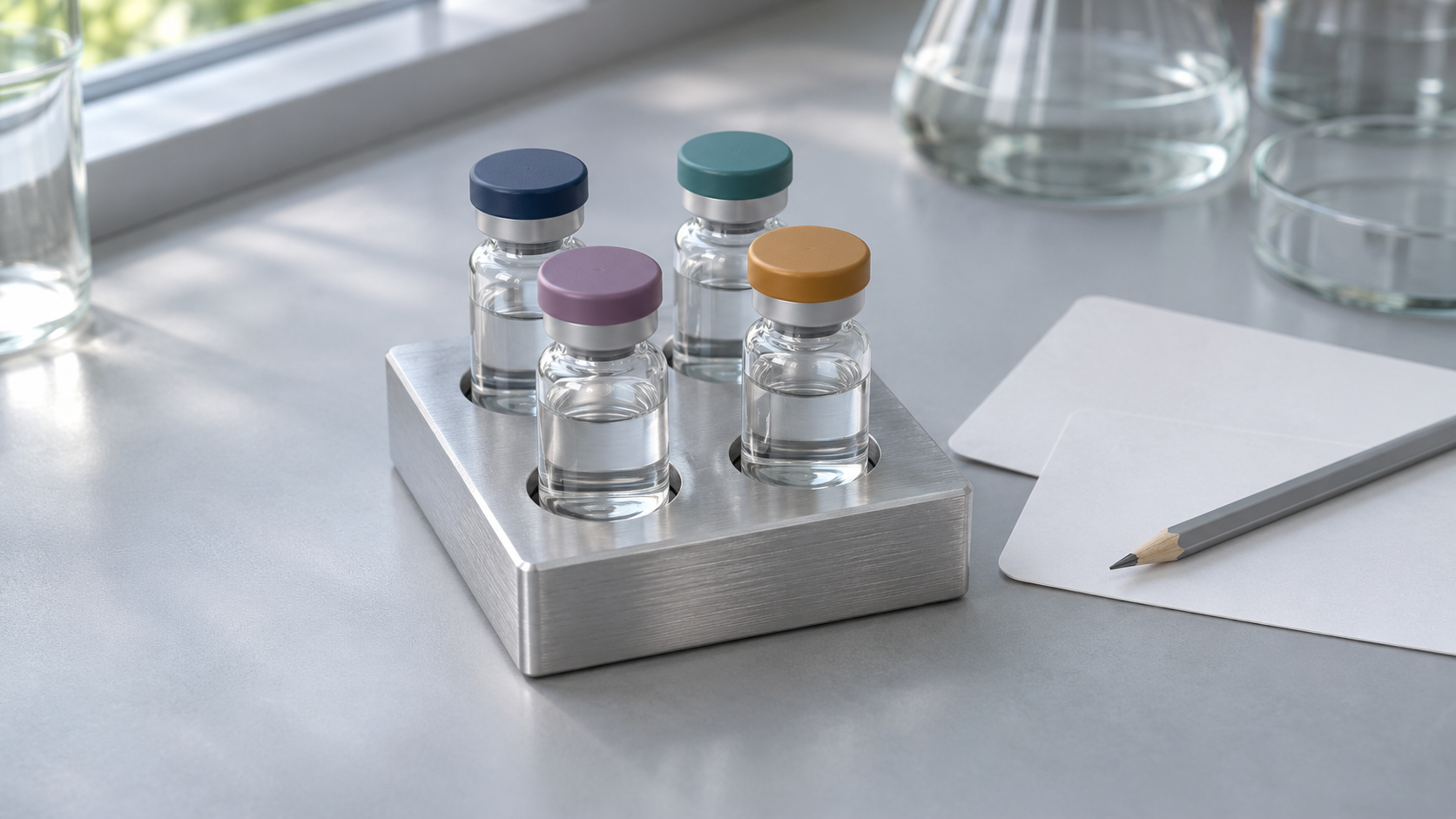
A peptide is a short chain of amino acids, the building blocks also found in proteins. A blend puts several peptides together; it does not join them into one longer peptide.
The shared ingredients have different research histories. GHK-Cu increased collagen and other supporting tissue material in rat wound chambers. BPC-157 helped rat-derived tendon cells move and survive stress in laboratory experiments, without directly increasing cell multiplication in that assay. These findings explain the interest in tissue repair; they are experiments on individual ingredients. Maquart et al., 1993; Chang et al., 2011.
What KPV adds to the research
KPV interests researchers because it can change signals that drive inflammation in experimental models.
In a 2008 study, KPV reduced inflammatory signaling and the release of inflammatory messenger proteins in intestinal and immune cells grown in the lab. Oral KPV also reduced measures of inflammation in two mouse models of colitis, an inflammatory bowel condition. The researchers linked its activity to PepT1, a transporter that helps small peptides enter cells. Dalmasso et al., 2008 — full text.
The researchers studied KPV on its own in cells and mice.
80 mg versus 70 mg: what actually changes?
Our November 2026 catalog review found KLOW product names written as a total, such as 80 mg, and as separate amounts, such as 10/10/10/50 mg. The numbers add up to 80 mg. Check the ingredient order to see which peptide accounts for the 50 mg. Then check whether the amounts are for one vial or the whole package.
The graphic uses hypothetical labels to explain the arithmetic, not measurements of a supplier’s products. Percentages refer to each ingredient’s share of the listed mass, not purity or biological strength.
Same GHK-Cu. A different total.
Hypothetical amounts per vial. Both bars use the same 0–80 mg scale.
| Ingredient | GLOW | KLOW |
|---|---|---|
| GHK-Cu | 50 mg | 50 mg |
| BPC-157 | 10 mg | 10 mg |
| TB-500* | 10 mg | 10 mg |
| KPV | 0 mg | 10 mg |
| Total | 70 mg | 80 mg |
*Check whether TB-500 refers to full-length thymosin beta-4 or a shorter fragment; see below.
Does KLOW work better than GLOW?
We found no human study comparing the complete blends head to head.
Some human research concerns individual ingredients or smaller combinations:
- Researchers reviewed 17 patient records and reached 16 people by phone. Fourteen reported less knee pain after receiving BPC-157 alone or with TB4. Without a control group, the researchers couldn’t tell how much of the improvement came from treatment. Lee and Padgett, 2021.
- In a topical GHK-Cu study with 13 people completing follow-up after laser resurfacing, objective skin outcomes did not significantly favor GHK-Cu, although participants’ own ratings favored its regimen. Miller et al., 2006.
For more on the skin findings, see our GHK-Cu skin and hair research guide.
A small 2026 rat tendon study also found no extra benefit from combining BPC-157 with material called TB-500 over the individual treatments. It tested neither GHK-Cu nor KPV and did not identify the sequence of its TB-500 material. Biçer et al., 2026.
Read the formula before comparing blends
1. Match each name to an amount
Look for every ingredient, its amount and whether that amount is per vial or per purchase. Names such as GLOW/KPV or a “Pro” suffix are reasons to check the full formula.
Also compare the product format. A topical formulation and an injectable research vial are different preparations, even when both mention an ingredient studied for skin.
2. Check what TB-500 means
Full-length thymosin beta-4 has 43 amino acids. The TB-500 fragment identified in a chemical analysis and FDA’s scientific assessment has seven, written as Ac-LKKTETQ. The letters after “Ac” name the amino acids in order; “Ac” marks an attached acetyl group. Esposito et al., 2012; FDA TB-500 assessment, May 2026.
Match that identity before borrowing a study’s findings. For example, research on full-length thymosin beta-4 in rat skin wounds concerns the longer peptide. Malinda et al., 1999.
Look for the sequence and identity test in the product specification and laboratory report. If those are missing, the TB-500 name alone cannot tell you which research applies. The 2012 analysis identified one tested product, not every product sold under that name today.
3. Ask what the report actually tested
A certificate of analysis, or COA, reports tests on a submitted sample. For a blend, check whether the sample was the finished mixture or separate ingredients tested before blending. Match the product and batch, then look for each component’s identity and measured amount.
Purity and quantity answer different questions. A chromatographic peak-area percentage measures the share of a test signal, which can differ from an ingredient’s share of the vial’s mass. Sterility needs its own testing. WPA’s guide to reading a peptide COA explains these distinctions with an example.
KLOW and GLOW FAQs
Is KLOW just GLOW with KPV added?
Usually, yes: GLOW lists GHK-Cu, BPC-157 and TB-500, while KLOW adds KPV. Check the milligrams per vial, because the maker may also change the amounts of the shared ingredients.
Does a lower GHK-Cu percentage mean less GHK-Cu?
Not necessarily. GHK-Cu can make up a smaller share of a larger blend while its amount stays the same. Compare the listed milligrams of GHK-Cu per vial before comparing percentages.
Is KLOW Pro a standard or stronger formula?
The word “Pro” alone tells you little about the formula. Check the ingredient list and milligrams per vial to see what the seller changed.
How is a fixed blend different from separate ingredients?
In a well-mixed fixed blend, changing the amount of mixture changes all its components together. Separate research materials let an experiment vary one ingredient while holding the others constant, helping researchers identify which component contributed to a result.
Can two different blend names repeat the same ingredients?
Yes. GLOW and KLOW both list GHK-Cu, BPC-157 and TB-500. Compare the ingredient lists and milligrams per vial to spot overlap and any differences in amount.
Is KLOW safe?
Human safety of the complete KLOW blend remains uncertain. FDA’s May 2026 KPV assessment found no human exposure data in its review; its TB-500 assessment describes potential immune-response concerns involving impurities and peptides clumping together. Neither gives a rate of side effects for KLOW. FDA KPV assessment; FDA TB-500 assessment.
Is there a research-established KLOW dose or cycle?
We found no validated human KLOW dose or cycle in the studies reviewed. A calculator can work out quantities, but that calculation cannot tell you whether a schedule is safe or effective. The vial amounts in this article illustrate composition, not a dosing plan.
Do the four ingredients remain stable together?
We found no original study testing the stability of the exact KLOW formula. Answering that question requires testing the mixture over time under stated storage conditions; separate-ingredient studies or a single purity result cannot supply its shelf life. A missing study is not evidence that the mixture breaks down.
Did the 2026 compounding policy approve KLOW or GLOW?
No. The October 2026 HHS policy addressed when certain single-ingredient drugs could be compounded. It did not grant FDA approval to KLOW or GLOW. HHS policy; October 30 Federal Register notice.
Compare the full label, not just the blend name
Compare the ingredient identities, milligrams, product format and tests on the batch report. Then match the research to the material being discussed.
Next: Learn how to read a peptide COA. Use the guide alongside a report to separate identity, purity and amount.
For product information, you can also compare KLOW listing details, including listed quantities and recorded COA information. That comparison page contains affiliate links; WPA may earn a commission from qualifying purchases. Listing information does not establish clinical suitability.
Sources and scope
We searched for human studies comparing the two blends on November 16, 2026. This was a focused search, not a systematic review. Direct trial-registry access was unavailable, so the search result is not a verified count of registered trials. The same search limits apply to the dose and stability answers. Some study links provide an original abstract rather than free full text.
This AI-assisted article draws on original study reports or abstracts, official scientific and policy documents, and WPA’s November 16 catalog review. The catalog observation is traceable to the saved product entries and queries reviewed that day; it describes listing text, not tested vial contents. The graphic uses hypothetical label amounts and calculated percentages. This article explains research and product information, not a human-use protocol.