CJC-1295 No DAC + Ipamorelin: Why They’re Paired and What the Research Shows
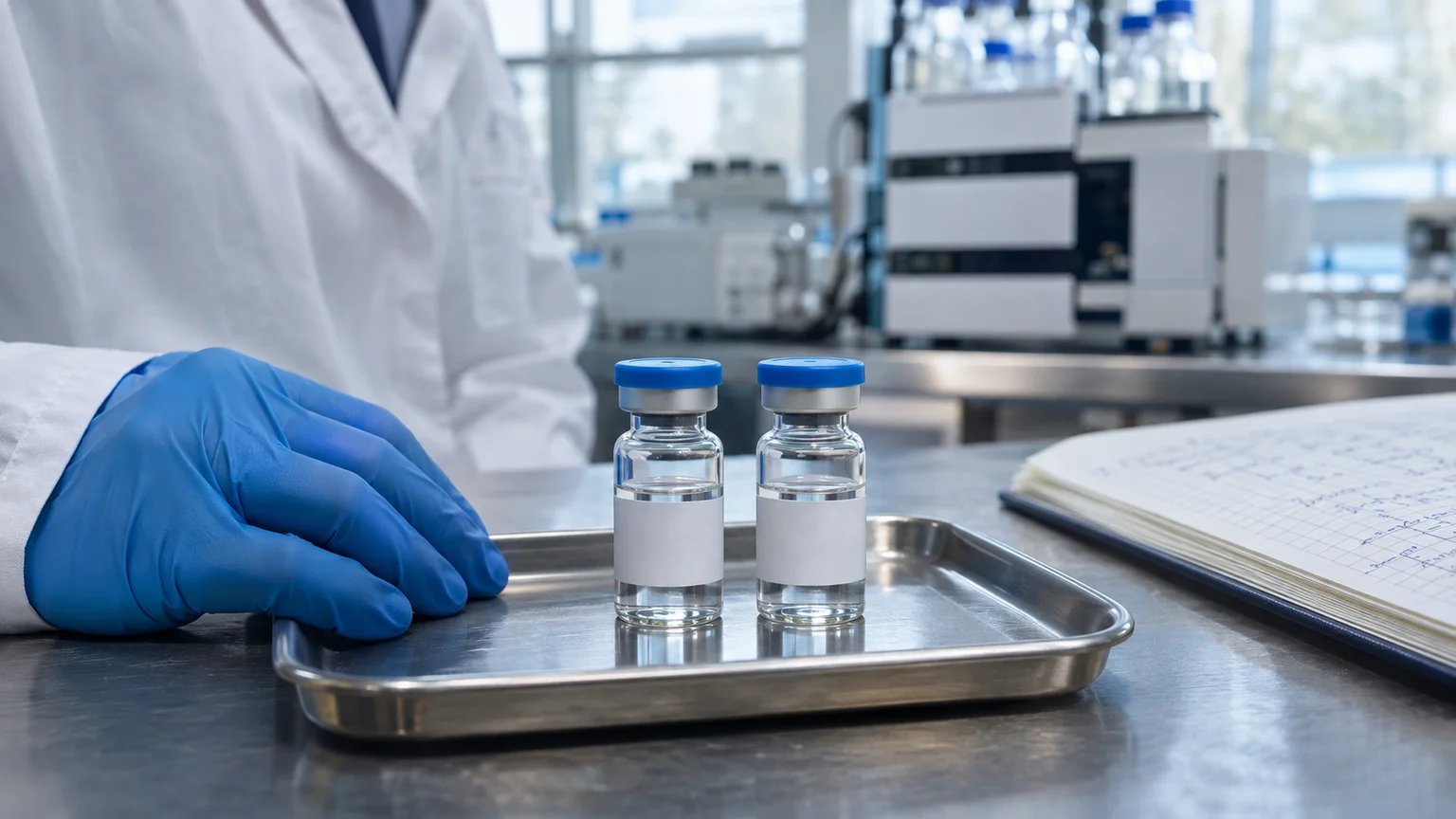
CJC-1295 no DAC and ipamorelin are paired because they send different signals that can prompt the pituitary gland to release growth hormone. Research with related peptides shows that using both signals together can produce a stronger hormone response. That is the scientific reason for interest in the pairing. [3, 4, 9, 10]
In the published sources reviewed for this article, no human trial of the exact CJC-1295 no-DAC/ipamorelin combination was identified. The available research helps explain how the pairing might work and which questions still need direct study.
Why pair two peptides that both release growth hormone?
Growth hormone (GH) is made by the pituitary, a small gland at the base of the brain. It helps stimulate production of insulin-like growth factor 1 (IGF-1), another hormone involved in growth and tissue processes. Researchers measure GH and IGF-1 in blood to track changes in this hormone system.
Each peptide uses a different receptor—a protein that receives a chemical signal:
CJC-1295 no DAC is a modified fragment of growth hormone–releasing hormone, or GHRH. It acts through the GHRH receptor.
Ipamorelin prompts GH release through the ghrelin receptor, a separate route. [3, 9, 10]
A 1990 study in healthy men helps explain why two signals may be useful. Researchers compared GHRH alone, another peptide called GHRP-6 alone, and the two together. When combined, they prompted more GH release than the separate responses added together. In other words, the signals reinforced each other. The study used different peptides from this blend, but it supports the idea behind combining these two receptor routes. [4]
WPA’s GH peptide pathway guide explains the wider family of compounds that act on these pathways.
“No DAC” changes which research applies
DAC stands for drug affinity complex. This modification lets long-acting CJC-1295 attach to albumin, a protein in blood, to prolong its presence there. Products sold as CJC-1295 no DAC, often also called modified GRF (1–29), omit that attachment feature. Naming varies, so check the molecular form when matching a product to a study. [9, 12]
The widely cited 2006 Teichman study tested CJC-1295 with DAC in healthy adults and found sustained increases in GH and IGF-1. Those findings apply to the long-acting formulation. The duration and effects of a no-DAC/ipamorelin blend require their own measurements. [1, 9]
Leaving out DAC gives researchers a reason to study a shorter period of stimulation. The research reviewed here does not establish exactly how much shorter. Early work compared the DAC molecule with natural GHRH, rather than an otherwise matching no-DAC peptide. [9, 12]
GH pulses are bursts of hormone release, with lower levels between them. They are separate from how long a peptide stays in the body. A human study found that GH pulses continued during prolonged stimulation by CJC-1295 with DAC. Both long-lasting stimulation and pulses can therefore occur together. [5]
What the studies actually tested
The compound, study population and measured result help show where each finding fits. The way a peptide is given also matters; several human ipamorelin studies used delivery into a vein.
Swipe horizontally to read the full table.
| Study | What was tested | Main finding |
|---|---|---|
| Bowers, 1990 [4] | GHRH plus GHRP-6 in healthy men | Together, the peptides produced more GH release than their separate responses added together. |
| Raun, 1998 [3] | Ipamorelin in cells, rats and swine | Stimulated GH release; swine experiments found a more selective hormone response than with two comparator peptides. |
| Gobburu, 1999 [2] | Ipamorelin delivered into a vein in healthy men | Produced a measurable episode of GH release. |
| Teichman, 2006 [1] | CJC-1295 with DAC in healthy adults | Produced sustained increases in GH and IGF-1. |
| Ionescu, 2006 [5] | Long-acting CJC-1295 in healthy men | GH pulses continued during prolonged stimulation. |
| Beck, 2014 [6] | Ipamorelin delivered into a vein after bowel surgery | The results did not clearly show that ipamorelin helped patients tolerate a solid meal sooner than placebo. |
What about muscle, recovery, sleep and fat loss?
Blood tests show whether the hormone system responds. To assess practical benefits, researchers also need to measure outcomes such as muscle strength, sleep quality and body fat. Comparison groups help separate a treatment’s effect from changes in training, food intake and other habits.
Muscle and training recovery
In female rats receiving glucocorticoids, a class of steroid drugs, ipamorelin improved a measure of calf-muscle force and counteracted reduced bone formation. This gives researchers a specific muscle-and-bone finding to investigate further; its relevance to healthy adults who train remains uncertain. [7]
The bowel-surgery trial in the table studied digestive recovery. It should be read in that setting, rather than as evidence about recovery between workouts. [6]
Sleep
GH release and sleep are related, but the useful question is whether people sleep longer, wake less often or feel more rested. The reviewed sources did not identify a human study measuring better sleep from the exact blend.
Fat loss
In one study, ipamorelin increased measures of body fat in mice with a functioning GH system. That finding shows why GH release alone is an unreliable guide to fat-loss effects. The blend’s effect on human body fat remains unresolved in the reviewed evidence. [8]
Does a selective or “natural” GH signal mean it is safe?
In early swine experiments, ipamorelin stimulated GH release without the larger rise in cortisol, a stress-response hormone, seen with two comparator peptides. Researchers describe this as a more selective hormone response. That finding concerns the hormones measured in those animals; human safety needs broader assessment. [3]
Stimulating the body’s own hormone release can still carry risks. The FDA identifies concerns about peptide impurities, immune reactions and limited safety information for these substances. Its CJC-1295 discussion includes reports of increased heart rate and reactions involving widened blood vessels. For ipamorelin, it highlights serious events in research using delivery into a vein and insufficient safety information for certain other injectable routes. [11]
Serious events in postoperative ipamorelin research included deaths, although their relationship to the treatment was unclear. These reports need careful interpretation: they neither establish that ipamorelin caused the deaths nor give a risk estimate for healthy adults using the blend. [10]
A research-use-only label describes intended use, not evidence of safety in people.
Four things to check when comparing blends.
When comparing listings or matching a product to research, check:
The CJC form. Does the description explicitly say no DAC?
Both ingredients. Are CJC-1295 no DAC and ipamorelin separately identified?
The amount of each. Does the label state each component’s mass, rather than only a combined total?
The batch report. Does the available report match the product and batch, and what did the laboratory actually test?
For example, 5 mg CJC-1295 no DAC + 5 mg ipamorelin means 10 mg combined, split equally by mass. “10 mg blend” alone leaves the split unclear. This is a label-reading example, not a recommended amount or ratio.
A certificate of analysis (COA) reports test results for a sample. Check which tests the report actually includes: identity, purity, ingredient amounts, and whether sterility testing was performed. A purity result alone does not answer the other analytical questions. WPA’s guide to reading a peptide COA explains those distinctions and how to match a report to a batch.
Frequently asked questions
Why combine CJC-1295 no DAC and ipamorelin rather than use one alone?
They stimulate GH release through different receptor routes. Human research with other GHRH/GHRP compounds shows that these routes can work together to amplify GH release. That makes the pairing scientifically plausible, but it does not establish how much extra benefit this exact blend provides over either ingredient alone. [3, 4, 10]
Why use no DAC rather than DAC in this pairing?
No DAC leaves out the albumin-binding extension designed to prolong exposure. That gives researchers a reason to investigate a shorter period of stimulation. It is a design rationale, not a measured benefit: the reviewed evidence does not show that removing DAC makes this pairing more effective or safer. Nor does it establish an exact no-DAC duration from a matched comparison. [9, 12]
Is this blend the same as taking growth hormone?
No. Taking GH supplies the hormone itself. These two peptides aim to signal the body to release GH. That difference explains the mechanism, but it does not establish that stimulating release is risk-free or that the two approaches produce the same benefits. [3, 9, 10]
How long does it take to improve sleep or build muscle?
No exact-blend human outcome trial was identified, so this review cannot establish a timeline. A study showing a prompt GH response answers when a hormone changed—not when sleep, strength or body composition will improve. A credible timeline would need measurements of the actual outcome over time. [2]
Does the blend burn belly fat?
The reviewed human evidence does not establish that the exact blend reduces abdominal fat. GH activity alone cannot answer that question, and animal ipamorelin findings are not uniformly consistent with a simple fat-loss story. Look for direct human body-composition results for the exact formulation, not a benefit inferred from its receptor action. [8]
Does flushing mean a vial is genuine or that it is working?
No. A flush is a physical reaction, not a test of a vial’s identity, ingredient amounts or benefits. The FDA notes vasodilatory reactions in its CJC-1295 safety discussion, so a sensation should not be treated as a quality badge. Batch-matched analytical evidence answers a different question from how someone feels after exposure. [11]
Does a 5 mg + 5 mg blend have the “best” ratio?
That label describes an equal-mass mixture, not a clinically validated optimum. The class-level synergy study did not test this commercial blend or establish its ideal ratio. It also does not show that a premixed vial works better than separately supplied ingredients. Check the amount of each ingredient to understand the product; do not treat the arithmetic as evidence that the ratio is effective. [4]
What does the research establish about dosing, fasting or cycle length?
The studies reviewed do not establish a validated human regimen for this exact no-DAC/ipamorelin blend. Intravenous ipamorelin research and long-acting DAC research cannot be converted directly into a no-DAC blend schedule. A fasting rule or cycle found online needs its own supporting evidence; repetition across websites is not validation. [1, 2, 9, 10]
Comparing a listing with the research
The pairing makes sense because the peptides use different routes to stimulate GH release. To judge a claim, match it to the compound and outcome actually studied.
To check a product description, compare CJC-1295 no-DAC/ipamorelin listings on WPA, then confirm the ingredient amounts and batch report.
Some vendor links on WPA’s comparison page are affiliate links. WPA may earn a commission at no extra cost to you.
Sources and research scope
This AI-assisted review covers sources examined through October 29, 2026. It drew on original abstracts, accessible study material and FDA reviews. Some full texts and database searches were inaccessible; unpublished or inaccessible studies may be missing. Community discussions informed questions, not benefit claims. No individual seller’s batch report was authenticated.
Teichman et al. (2006). Prolonged stimulation of GH and IGF-1 secretion by CJC-1295 in healthy adults. Original abstract.
Gobburu et al. (1999). Pharmacokinetic–pharmacodynamic modeling of ipamorelin in human volunteers. Original abstract.
Raun et al. (1998). Ipamorelin, the first selective growth hormone secretagogue. Original abstract.
Bowers et al. (1990). GH-releasing peptide stimulation of GH release in normal men, alone and with GHRH. Original abstract.
Ionescu and Frohman (2006). Pulsatile GH secretion during continuous stimulation by CJC-1295. Original abstract.
Beck et al. (2014). Randomized trial of ipamorelin for postoperative ileus. Original abstract.
Andersen et al. (2001). Ipamorelin, bone formation and muscle strength in glucocorticoid-treated rats. Original abstract.
Lall et al. (2001). GH-independent adipogenic effects of ipamorelin. Original abstract.
FDA (2024). CJC-1295 scientific review for the Pharmacy Compounding Advisory Committee. Official briefing.
FDA (2024). Ipamorelin acetate scientific review. Official briefing.
FDA, checked October 29, 2026. Certain bulk drug substances for use in compounding that may present significant safety risks. Current safety discussion.
Jetté et al. (2005). Human GHRH analog conjugated to serum albumin. Original abstract.